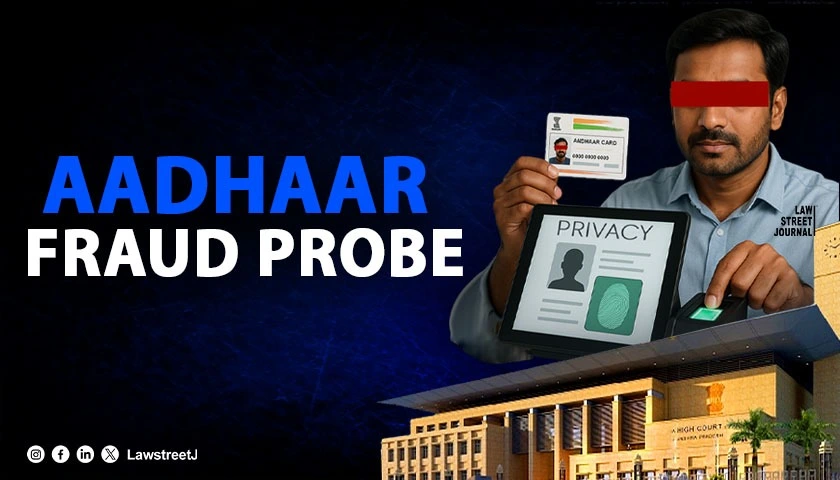
Andhra Pradesh: The Andhra Pradesh High Court has held that Aadhaar-linked biometric information may be disclosed to investigating authorities in cases involving serious allegations of forgery, and that a person accused of committing such an offence cannot be permitted to evade investigation by claiming the protection of the right to privacy.
A Division Bench comprising Chief Justice Lisa Gill and Justice R. Raghunandan Rao delivered the judgment on 7 May 2026 in Writ Appeal No. 252 of 2026, while setting aside a contrary order passed by a learned Single Judge of the same Court.
The appellant, Shri Sitaramanjaneyulu Elaprolu, alleged that an unknown person impersonated him using a forged Aadhaar card and executed two sale deeds in favour of a third party, fraudulently transferring agricultural land situated in Saripalli Village, Visakhapatnam District.
Upon discovering the alleged fraud, the appellant lodged an FIR at Pendurthi Police Station and also instituted a civil suit seeking a declaration that the sale deeds were null and void, in which an interim injunction was granted in his favour. Separately, the District Registrar cancelled the disputed sale deeds on 2 November 2021, though that order was subsequently challenged before the High Court by the purchaser.
To identify the impersonator, the appellant sought Aadhaar and biometric details linked to the fraudulent Aadhaar card under the Right to Information Act, 2005. The request was rejected under Section 8(1)(j) of the RTI Act on the ground that the information constituted personal information exempt from disclosure. Alleging inaction on the part of the investigating authorities in obtaining the information through official channels, the appellant approached the High Court seeking a direction for disclosure.
The learned Single Judge dismissed the writ petition on 22 December 2025, holding that disclosure of Aadhaar information is governed by Section 33(1) of the Aadhaar Act, 2016, which permits disclosure only pursuant to an order of a court not inferior to a High Court. Since no such request had been made by the Commissioner of Police, the Court declined to direct disclosure in the petition as framed.
The Division Bench, however, reversed the Single Judge’s decision and allowed the writ appeal. It held that Section 33(1) of the Aadhaar Act does not impose an absolute prohibition on disclosure of Aadhaar-linked information but merely prescribes safeguards by requiring an order of a High Court or a higher court, or in certain cases an order on grounds of national security. According to the Court, these conditions regulate the process of disclosure and are not intended to completely bar access in cases involving serious allegations of criminal fraud.
On the central question of whether the right to privacy could operate as a bar, the Court was unequivocal:
“A person who is alleged to have committed an offence of forgery for personal gain, cannot be permitted to get away with such an offence, if he has committed such an offence, on the ground of protection of his privacy.”
The Court further noted that the fraudulent Aadhaar card had been issued in the appellant’s own name, even though it was allegedly created by an impersonator. In such circumstances, the Court observed that any claim to privacy by the impersonator in relation to that document stood considerably weakened.
Accordingly, the Division Bench set aside the order of the Single Judge and directed the concerned UIDAI authorities to furnish the Aadhaar-linked information to the Station House Officer of Pendurthi Police Station within three weeks. The Court clarified that only such information as is permissible under the Aadhaar Act, 2016, could be disclosed, thereby preserving the statutory safeguards while enabling the criminal investigation to proceed. The SHO was also authorised to share the information with the Investigating Officer in Crime No. 430 of 2021.
Case Title: Shri Sitaramanjaneyulu Elaprolu v. The Union of India and Others, Writ Appeal No. 252 of 2026