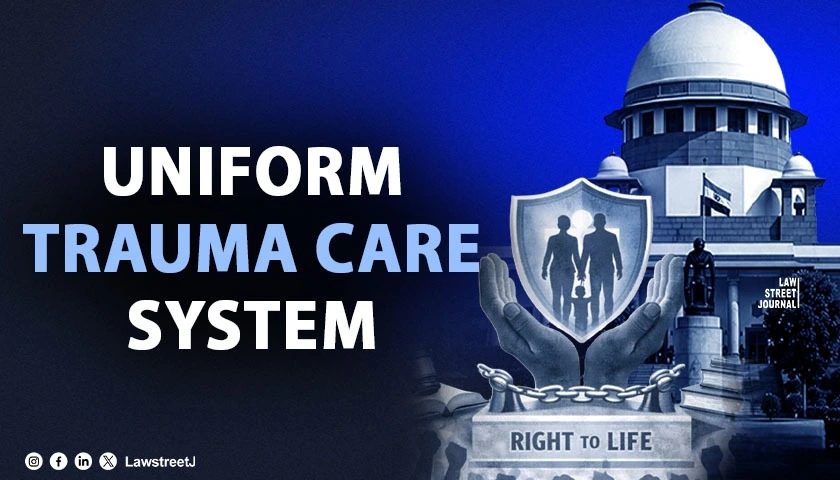
New Delhi: The Supreme Court has held that the right to trauma care is an integral part of the right to life guaranteed under Article 21 of the Constitution of India.
A Bench of Justice J.K. Maheshwari and Justice Atul S. Chandurkar issued wide-ranging interim directions to all States and Union Territories to establish a robust and uniform trauma care system across the country while hearing a writ petition filed under Article 32 by SaveLife Foundation and its Founder and Managing Trustee.
The petition sought directions to integrate all emergency helpline numbers into the universal access number 112, establish Good Samaritan grievance redressal systems, frame a comprehensive medical rescue protocol for road crash victims, ensure ambulance compliance with the National Ambulance Code, standardise paramedic training, mandate GPS fitment in ambulances, establish Trauma Registries, grade medical facilities for trauma care, frame cashless treatment schemes for road crash victims, and undertake mass-media campaigns on all of the above.
The Court observed that in cases of road accidents or similar traumatic incidents, the absence of swift emergency and medical intervention is a major cause of preventable deaths. The Bench underscored that every minute without medical care significantly narrows the scope for survival and that “swiftness is, quite literally, like medicine.” The Court further noted that a robust mechanism for trauma care must take a bottom-up approach, accounting for multiple stakeholders, from the bystander who provides initial first aid to the paramedic and the hospital.
The Court acknowledged that bystanders often hesitate to assist accident victims due to fear of legal proceedings or the psychological weight of the situation and that systemic intervention and Good Samaritan protections are necessary to overcome such reactive paralysis. It referred to its earlier judgment in SaveLife Foundation v. Union of India, (2016) 7 SCC 194, wherein it had recognised the need for Good Samaritan laws in India, which eventually led to the incorporation of Section 134A in the Motor Vehicles Act, 1988, through its 2019 amendment.
The learned Attorney General, Mr. R. Venkataramani, submitted before the Court that the Union’s role is to act as an enabler and lay down a national framework, which it has done through various schemes and policies, including the PM RAHAT cashless treatment scheme, the Rah-Veer Scheme, the Good Samaritan Rules, the National Ambulance Code, the NELS Curriculum, the ERSS-112 system, and the Ministry of Health and Family Welfare trauma guidelines. He, however, conceded that implementation of these policies across States and Union Territories remains scanty and fragmented and urged the Court to issue time-bound compliance directions to them.
The Court considered the Compliance Affidavit dated 12.05.2026 filed by the Union of India, which compiled the responses of 34 State Governments and Union Territories. The Bench noted that while there appeared to be willingness among States and Union Territories to progressively implement the Union’s schemes, implementation remained fragmented and differed from one jurisdiction to another. The Court observed that a uniform and robust trauma care system, along with sustained public awareness efforts, may prove absolutely critical in reducing preventable deaths.
In these circumstances, the Court issued the following interim directions:
(a) All States and Union Territories shall complete full technical and operational integration of all emergency and ambulance helplines (100, 101, 102, 108, 1033, 1091, etc.) into helpline 112 within three months, undertake concurrent mass-media publicity of 112, and report compliance.
(b) All States and Union Territories shall establish functional Good Samaritan Grievance Redressal Systems, both physical and digital, with designated nodal authorities at the State and District levels within three months, and furnish periodic compliance reports through monthly meetings, with minutes uploaded on the concerned portals.
(c) The Union of India (Ministry of Health and Family Welfare and Ministry of Road Transport and Highways) shall issue a medical rescue protocol for trauma cases within three months, and all States and Union Territories are directed to operationalise the same within three months of its issuance.
(d) All States and Union Territories shall ensure full AIS-125 compliance across all registered ambulances (public and private), mandate GPS and Vehicle Location Tracking Device fitment with real-time integration into helpline 112, and conduct periodic structured audits covering response times, quality of care, equipment, and outcomes, with compliance reporting to a designated Union-level authority, within three months.
(e) All States and Union Territories shall adopt and implement the NCAHP-notified EMT curriculum and align their training institutions and certified personnel within three months.
(f) The Union of India (Ministry of Health and Family Welfare) shall issue guidelines prescribing the data format for a Trauma Registry within eight weeks, and all States and Union Territories shall establish State Trauma Registries covering all medical facilities and linking them to a Coordinated Trauma Registry within four months.
(g) All States and Union Territories shall undertake grading and designation of all medical facilities (public and private) in accordance with the Ministry of Health and Family Welfare guidelines, extending geographic scope beyond National Highways to State Highways, major district roads, and urban and peri-urban areas, within three months.
(h) All States and Union Territories shall take steps to fully operationalise the PM RAHAT cashless treatment scheme within eight weeks, including designation of hospitals, onboarding of State Health Agencies on the Transaction Management System, deployment of district police on the electronic Detailed Accident Report system, and opening of DC sub-agency accounts within three months. Non-implementation of the PM RAHAT scheme was clarified to amount to a violation of the Motor Vehicles Act.
(i) The Union and all States and Union Territories shall undertake sustained, structured, multilingual mass-media campaigns covering helpline 112, the Good Samaritan protections under Section 134A of the Motor Vehicles Act, the grievance redressal system, and the PM RAHAT scheme, with defined obligations and compliance reporting within one month.
The Court directed that a copy of the order be sent to the Chief Secretaries of all States and Union Territories, who are to issue general directions in their respective jurisdictions. Action-taken reports, along with details of ground realities indicating either inaction or good practices, are to be submitted to the Registry within the stipulated timelines. The matter has been listed for hearing after four months for issuance of further directions based on such reports.
Appearances: The Petitioners were represented by Mr. Sidharth Luthra, Senior Advocate, and Ms. Malvika Kapila, Advocate, appearing pro bono. The Union of India was represented by Mr. R. Venkataramani, learned Attorney General.
Case Title: SaveLife Foundation & Anr. v. Union of India & Ors., Writ Petition (Civil) No. 726 of 2024