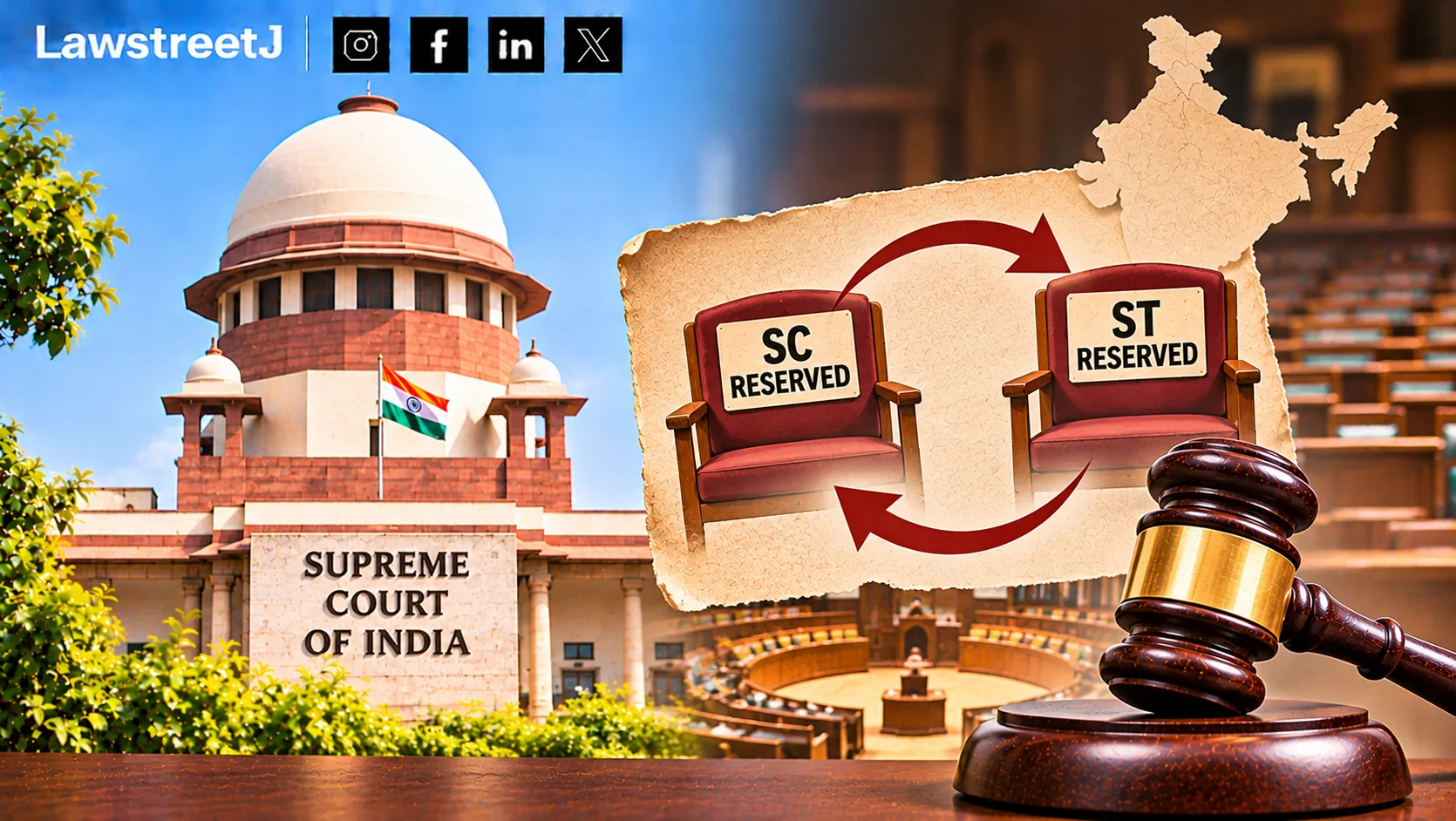
New Delhi: The Supreme Court has refused to interfere with the Allahabad High Court’s rejection of a challenge to Section 9(1)(c) of the Delimitation Act, 2002, which the petitioner sought to have read to require rotation of reserved Assembly seats for Scheduled Castes and Scheduled Tribes, holding that reservation of seats in the State Legislative Assemblies and Parliament is “essentially a matter falling within the domain of the Legislature”.
A Bench of the Chief Justice of India, Justice Joymalya Bagchi and Justice V. Mohana passed the order on 4 November 2026, disposing of the Special Leave Petition with liberty to the petitioner to approach the elected representatives.
The petition, Special Leave Petition (C) No. 37437 of 2026 filed by Jagdish Singh against the Union of India and others, challenged the judgment dated 22.06.2026 of a Division Bench of the Allahabad High Court, Lucknow Bench, in WC No. 6153/2011, which had turned down his challenge to the vires of Section 9(1)(c) of the Delimitation Act, 2002.
According to the Court’s recital of the petitioner’s case, the reservation of State Legislative Assembly seats for Scheduled Castes and Scheduled Tribes should be governed by the principle of rotation. He contended that the 191-Kadipur Assembly Constituency, which has remained reserved for Scheduled Caste candidates since its creation and was continued after the delimitation exercise of 2006, could then be de-reserved, and another constituency with the highest Scheduled Caste population reserved in its place.
The High Court had rejected the contention, observing, among other things, that although rotation may ideally be followed, the decision to undertake such an exercise falls within the domain of the Legislature.
After hearing the petitioner’s Senior Counsel, the Supreme Court said it found no ground to take a view different from that of the High Court. It held that reservation of seats in the State Legislative Assemblies and in Parliament is a matter within the domain of the Legislature.
The Court added that the petitioner, if so advised, may approach the elected representatives with a view to persuading them to consider adopting the principle of rotation, on which he relied on the basis of the observations made by the Delimitation Commission in 2006. With this liberty, it disposed of the Special Leave Petition along with pending applications.
The order does not examine the merits of the rotation argument or decide whether Section 9(1)(c) is constitutional, and records only that the High Court’s view was not interfered with.
Appearances: For the Petitioner: Mr. Gagan Gupta, Senior Advocate, with Ms. Indira Bakhar, Mr. Mukesh Kumar Singh, Mr. Vineet Singh, Mr. Chirayu Sharma, Mr. Narendra Kumar Goyal, Mr. Rahul Saini, Mr. Divyanshu Saraswat, Mr. Sabyasachi Dubey, Mr. Saroj Kumar Sinha, Mr. Sreejith P.R., Mr. Saurabh Kumar Singh and Mr. A.A. Kalebudde, Advocates, and M/s Mukesh Kumar Singh and Co., AOR.
Case Title: Jagdish Singh v. Union of India and Others, Special Leave Petition (C) No. 37437 of 2026