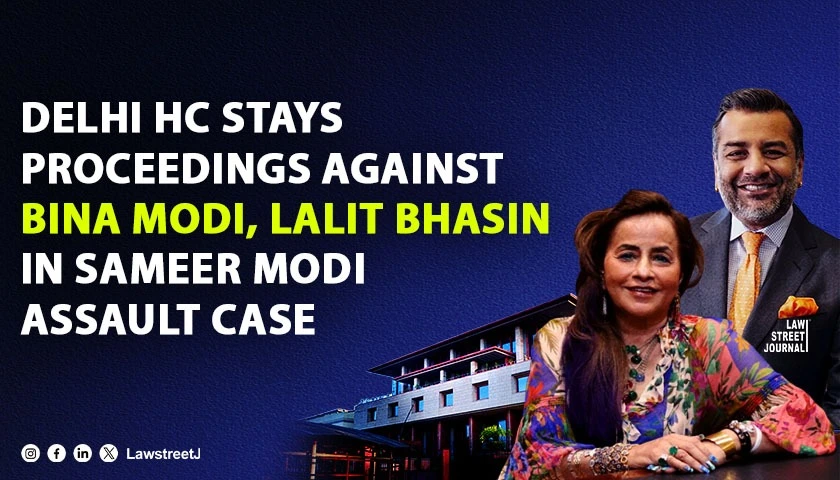
New Delhi: The Delhi High Court on Wednesday granted significant interim relief to industrialist Bina Modi and Senior Advocate Lalit Bhasin by staying the trial court proceedings initiated against them in an alleged assault case. The case involves allegations of physical assault levelled by Samir Modi, Executive Director of Godfrey Phillips India (GPI) and son of Bina Modi, following a contentious board meeting in 2024.
Justice Saurabh Banerjee, presiding over the matter, issued notices to the Delhi Police and the complainant, Samir Modi, while directing the authorities to submit a detailed status report within four weeks.
The legal dispute originates from an incident that took place on May 30, 2024, at the Jasola office of Godfrey Phillips India. Samir Modi alleged that when he attempted to attend a scheduled board meeting in his capacity as Executive Director, he was physically blocked by Surendra Prasad, his mother’s personal security officer (PSO). According to the complaint, Prasad was acting on the explicit instructions of Bina Modi to prevent Samir from entering the boardroom. Samir Modi claimed that during the ensuing confrontation, the PSO assaulted him and twisted his hand with such force that his right index finger was fractured.
The medical consequences of the alleged assault were described as grievous in the medico-legal report. Samir Modi underwent surgical intervention requiring the insertion of a screw and wire to stabilise the fracture. In his complaint, he further alleged that even after informing his mother about the injury and the assault, she showed no sympathy and instead instructed him to sit down and proceed with the meeting. He also claimed that Lalit Bhasin supported the continuation of the board meeting despite the evident injury.
Following an investigation, the Delhi Police filed a chargesheet on March 1, 2025. While the police named the PSO, Surendra Prasad, as an accused based on sufficient prima facie material, the investigation found insufficient evidence to prosecute Bina Modi and Lalit Bhasin. The police placed the duo in Column 12 of the chargesheet, reserved for individuals against whom the investigating agency does not seek trial due to lack of evidence.
This conclusion was challenged by Samir Modi through a protest petition filed in April 2025. On February 10, 2026, Judicial Magistrate First Class Aneeza Bishnoi of the Saket Court took cognisance of the matter. The Magistrate disagreed with the police’s assessment, observing that at the stage of cognisance, the court is not strictly bound by the opinion of the investigating officer. The trial court held that the material on record, though circumstantial, suggested a “meeting of minds” and a prima facie chain of events indicating the involvement of Bina Modi and Bhasin in the alleged offence. Consequently, summons were issued to all three individuals, directing them to appear on May 7, 2026.
Bina Modi and Lalit Bhasin subsequently approached the Delhi High Court to challenge the summoning order and seek quashing of the proceedings. During the hearing, Senior Advocate Mukul Rohatgi, appearing for Bina Modi, characterised the trial court’s decision as “complete perversity.” He argued that the summoning order was based on an incorrect assumption that the police could not exonerate individuals during investigation. Rohatgi emphasised that the Investigating Officer had examined CCTV footage and interviewed attendees, concluding that neither Bina Modi nor Bhasin were involved in the scuffle.
A central point of the defence’s argument relied on the conduct of Samir Modi following the alleged incident. Rohatgi pointed out that the complainant remained in the board meeting for nearly two hours after the scuffle. It was further argued that Samir Modi signed approximately 20 pages of documents during the meeting—a feat the defence suggested would be highly improbable for someone who had just suffered a fractured index finger on his dominant hand. Rohatgi contended that the CCTV footage showed Bina Modi attempting to defuse the situation by directing that Samir be allowed into the room.
Justice Banerjee, while staying the trial court proceedings, raised questions regarding the timeline of the injury reporting. The High Court noted that if the complainant remained present in the meeting for two hours, it was pertinent to examine whether he had informed anyone of the injury at that time.
The legal battle is set against the backdrop of a larger family inheritance dispute estimated at approximately ₹11,000 crore. This broader conflict involves the distribution of assets following the death of industrialist K.K. Modi in 2019, including significant shareholdings in Godfrey Phillips India and other Modi Group companies. Samir Modi has previously accused his mother of mismanaging the family trust—allegations she has consistently refuted. He has further alleged that the assault was an attempt to deprive him of his rights and force a settlement on unfavourable terms.
The High Court has directed all parties to file a written synopsis of their arguments, not exceeding five pages, at least one week before the next hearing.
The matter is now listed for further hearing on July 29, 2026.
Case Title: Bina Modi v. State & Anr.


![Delhi High Court Sets Aside Arbitral Tribunal's Award Against NHAI in Highway Project Delay Case [Read Judgment]](/secure/uploads/2023/07/lj_9605_23374c2e-392c-4491-a2fe-f2f12fc5272f.jpg)
![Delhi Court Rejects Stay Request in Defamation Case Against Rajasthan CM Ashok Gehlot [Read Order]](/secure/uploads/2023/08/lj_5208_80de1ddc-d76a-4f7f-b180-408e3ae14fb4.jpg)