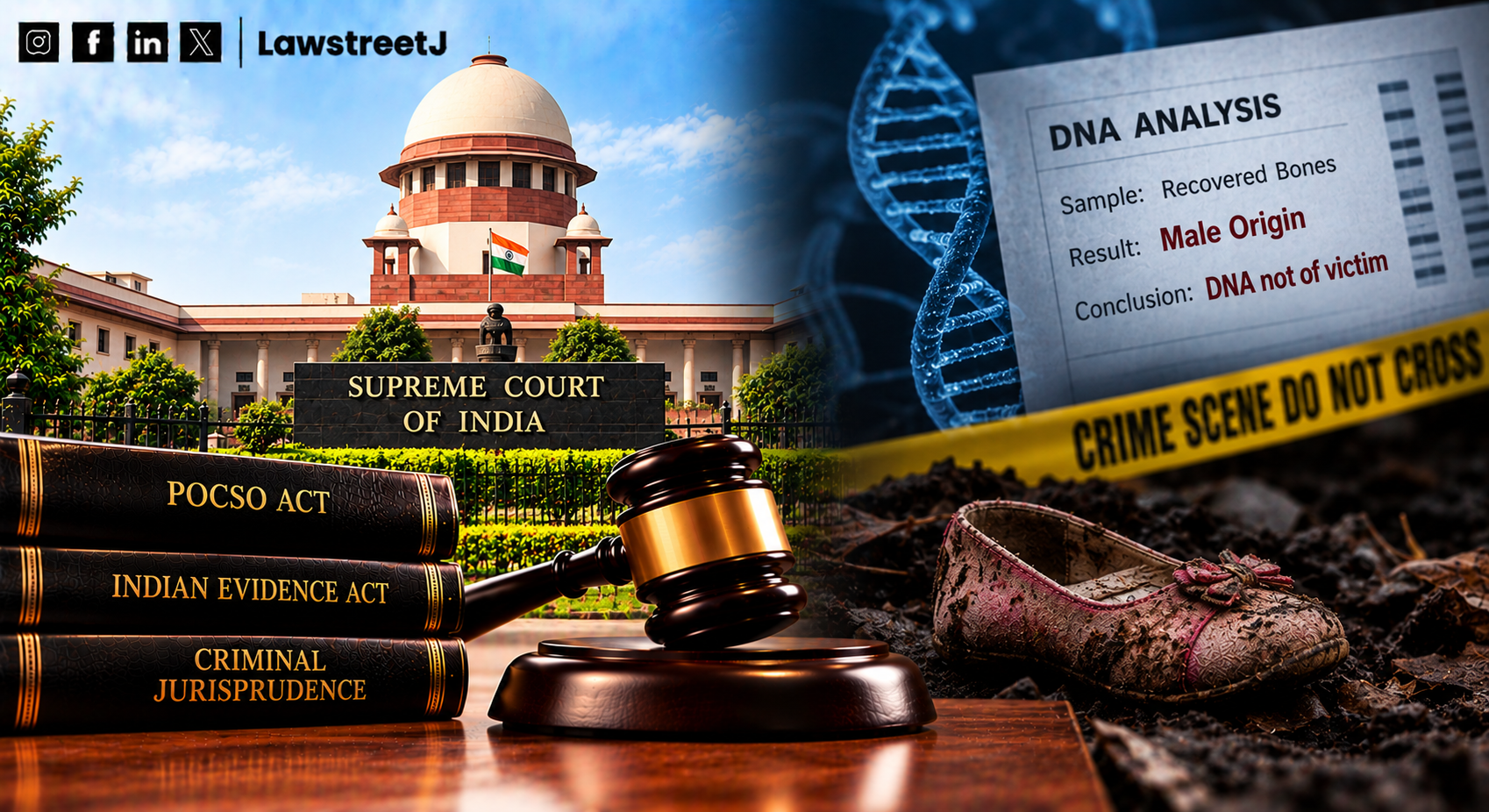
New Delhi: The Supreme Court has acquitted a man convicted of raping and murdering his minor niece, holding that the prosecution's chain of circumstantial evidence was fatally broken, including by a DNA report which showed that bones recovered at his instance were of male origin even though the victim was female.
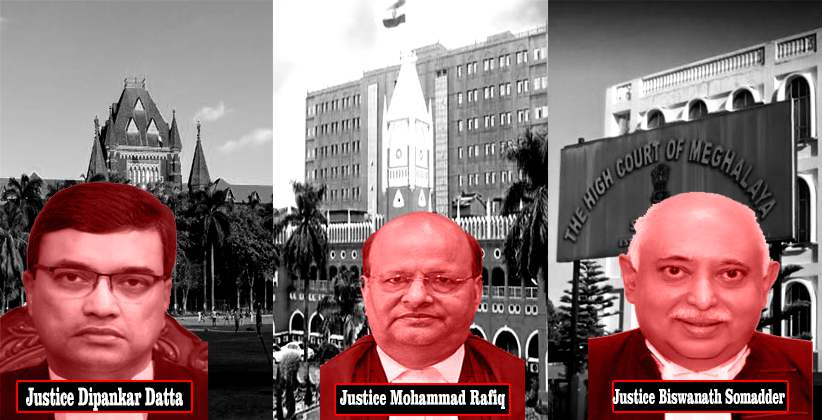
A Bench of Justice Ujjal Bhuyan and Justice Atul S. Chandurkar, was examining a challenge to concurrent findings of the Sessions Court and the High Court of Sikkim convicting him under Sections 376(2)(i), 302 and 201 of the Indian Penal Code and Sections 4 and 6 of the POCSO Act, and sentencing him to life imprisonment, over the alleged rape and killing of the victim on 06.11.2013.
The prosecution's case rested on six circumstances: that the appellant was last seen with the victim; recovery of articles under Section 27 of the Evidence Act; a DNA report on recovered bones and teeth; an FSL report; recovery of a brown shawl allegedly used after the killing; and the appellant's silence in his statement under Section 313 of the CrPC.
Examining the “last seen” circumstance, the Court found no direct evidence that the appellant had taken the victim from the house, and noted that nearly six months separated the date he was allegedly last seen with her and the discovery of bones on 15.05.2014, holding that under its earlier ruling in State of U.P. v. Satish, such a gap makes it “hazardous to come to a conclusion of guilt.”
Most significantly, the Court held that the DNA report “in clear terms refers to the bone extracts being of male origin while the victim was a female,” so that the recovered remains “naturally did not match with the blood samples of the victim's mother and sister,” undermining the very premise that these were the victim's remains.
The Court also noted that the appellant's own mother had denied that the brown shawl recovered belonged to her, creating further doubt, and held that the appellant's statement under Section 313 “cannot be taken as an additional link in the chain of circumstances” once the underlying evidence itself was undermined.
Holding that “the chain of circumstances has not been formed on the basis of the prosecution evidence,” and that both the Sessions Court and the High Court had “failed to notice all these infirmities,” the Court held that the appellant's guilt had “not been established beyond reasonable doubt” and that he was entitled to “the benefit of doubt.”
The Court accordingly quashed and set aside the judgments of the Sessions Court and the High Court, acquitted the appellant, and directed that he be set free forthwith unless required in any other case.
Appearances: Ms. Sangeeta Kumar, Advocate, appeared for the appellant. Mr. Sameer Abhyankar, Advocate, appeared for the respondent, State of Sikkim.
Case Title: Santosh Gurung vs. State of Sikkim