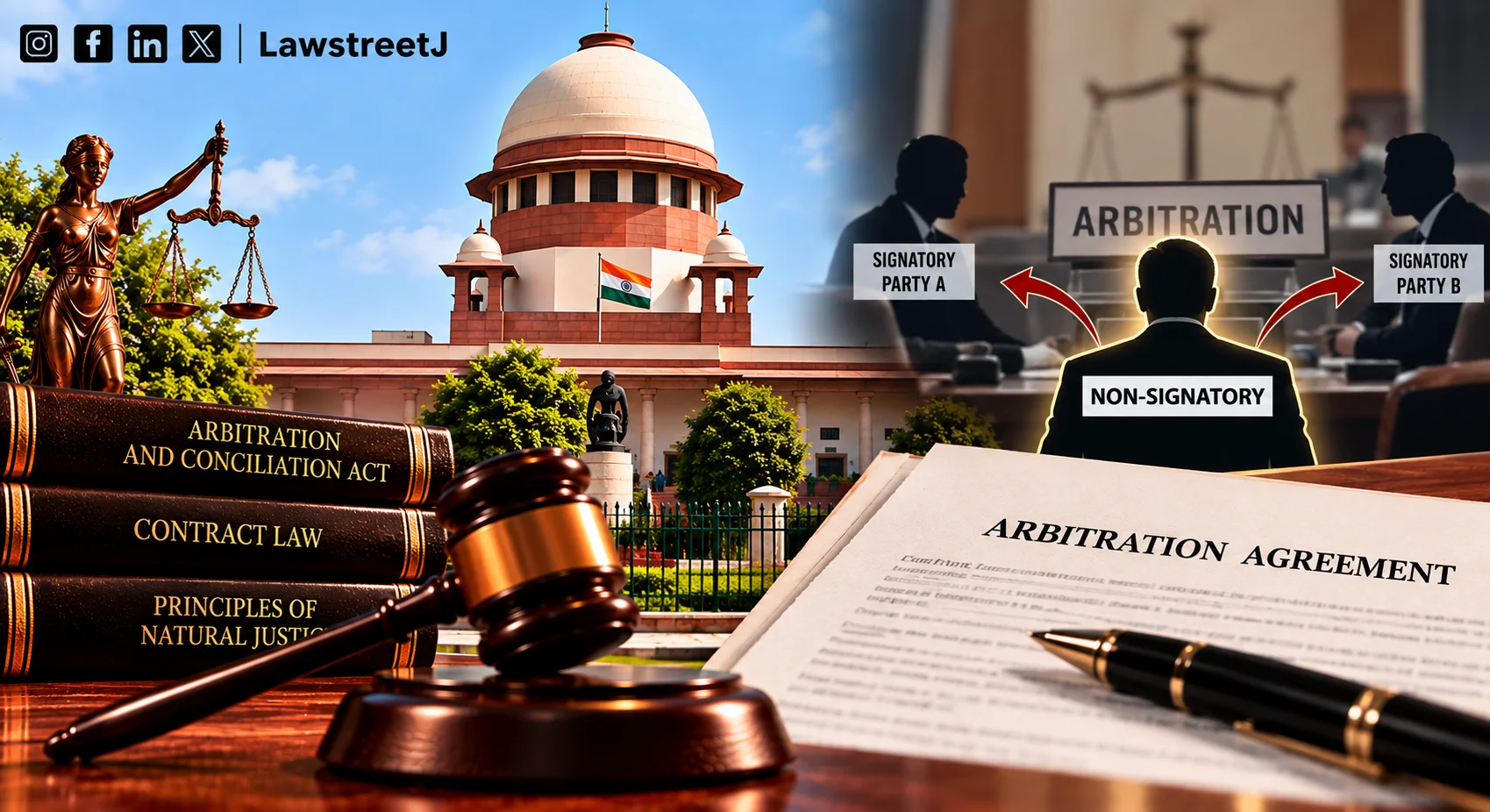
New Delhi: The Supreme Court has held, on a prima facie view, that two respondents who were not signatories to a 1985 partnership deed containing an arbitration clause are veritable parties to the arbitration over a property acquired by the partnership firm, modifying a High Court order that had declined to join them, while leaving the issues of limitation and estoppel raised by them open for decision by the Arbitral Tribunal.
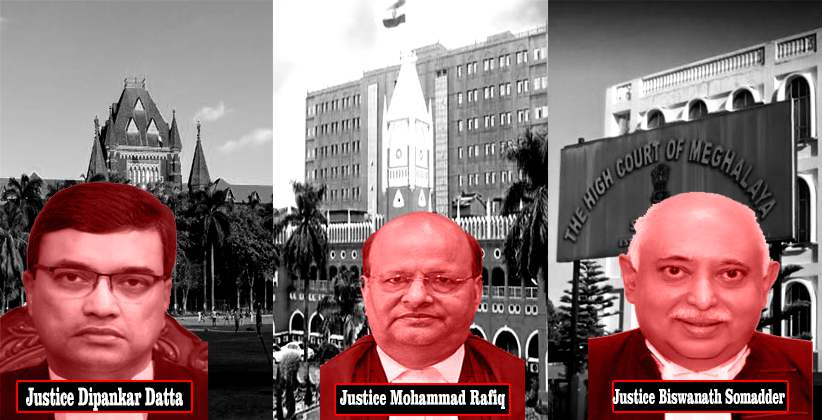
A Bench of Justice J.B. Pardiwala and Justice K. Vinod Chandran delivered the judgment on October 12, 2026, reported as 2026 INSC 1111 (non-reportable), in a civil appeal arising out of SLP (C) No. 26474 of 2026, filed by Hemant D. Shah HUF and another against Chittaranjan D. Shah HUF and others. The judgment was authored by Justice K. Vinod Chandran. The Bench noted at the outset that the question of who is a "veritable party" in an arbitration cannot be put down in a strait jacket formula and has to be determined more on the facts.
The High Court, in an application under Section 11 of the Arbitration and Conciliation Act, 1996, had held the question of limitation in favour of the appellants, who had earlier obtained an arbitral award that was set aside under Section 34, but that finding was held to be an answer only as against the 1st and 2nd respondents. It declined the appellants' prayer to join the 3rd and 4th respondents, finding that they were not signatories to the arbitration agreement and did not fall within the recognised exceptions of persons claiming through or under a signatory or the Group of Companies doctrine.
The dispute concerns Unit No. 2, admeasuring 3,500 sq. ft. on the ground floor of Manish Commercial Centre, Worli, Mumbai, originally acquired in 1977 by the partnership firm M/s Prospective Traders. The firm was reconstituted by a partnership deed dated 09.12.1985, which contains the arbitration clause and in which the appellants and the 1st and 2nd respondents were inducted. The appellants say they never retired and that the partnership and its assets continue, but the respondents rely on a deed of retirement dated 03.07.1995, which the appellants allege to be forged, followed by the 2nd respondent's retirement, the continuation of the firm as a proprietorship with the 1st respondent, and the induction of the 3rd and 4th respondents as partners under 2009 deeds, who distanced themselves from the 1985 agreement.
The court reviewed Cox & Kings Limited v. SAP India Private Limited, noting that the requirement of a written arbitration agreement does not exclude binding non-signatories, that a rigid approach to excluding persons who by conduct and relationship intended to be bound is not warranted, and that the referral court should leave it to the Arbitral Tribunal to decide whether a non-signatory is bound. It also noted that Hindustan Petroleum Corporation Limited v. BCL Secure Premises Private Limited allows the referral court to be prima facie satisfied that a non-signatory is a veritable party, while preserving the tribunal's jurisdiction to decide on evidence. It observed that the Group of Companies doctrine did not apply here, but that the principle in Cox & Kings would assist.
The court noted that the dispute revolves around the ownership of an immovable property acquired by the partnership, and that, if the retirement deed of 03.07.1995 is found invalid, the parties revert to the 1985 partnership, which would affect the rights of the 3rd and 4th respondents, who obtained rights over the property through a partnership deed under which neither the appellants nor the 1st and 2nd respondents are partners. It therefore held that the 3rd and 4th respondents are veritable parties to the dispute, since their rights would be substantially affected.
Emphasising that the finding is only prima facie, the court said it would not govern adjudication of the issue, and that the questions of limitation raised by the 3rd and 4th respondents and whether the appellants are estopped from including them, as they were not included in the earlier arbitration despite knowledge of the retirement deed, are left to be considered by the Arbitral Tribunal. The impugned order was modified only to the extent of finding the 3rd and 4th respondents to be veritable parties despite not being signatories to the 1985 deed, and the appeal was disposed of with pending applications rejected.
Appearances:
For the Appellants: Sri Ashim Sood, Advocate.
For Respondent Nos. 1 and 2: Sri Sanjay Sarin, Advocate.
For Respondent Nos. 3 and 4: Sri Ritin Rai, Senior Advocate.
Case Title: Hemant D. Shah HUF & Anr. vs. Chittaranjan D. Shah HUF & Ors., Civil Appeal arising out of SLP (C) No. 26474 of 2026 (2026 INSC 1111)