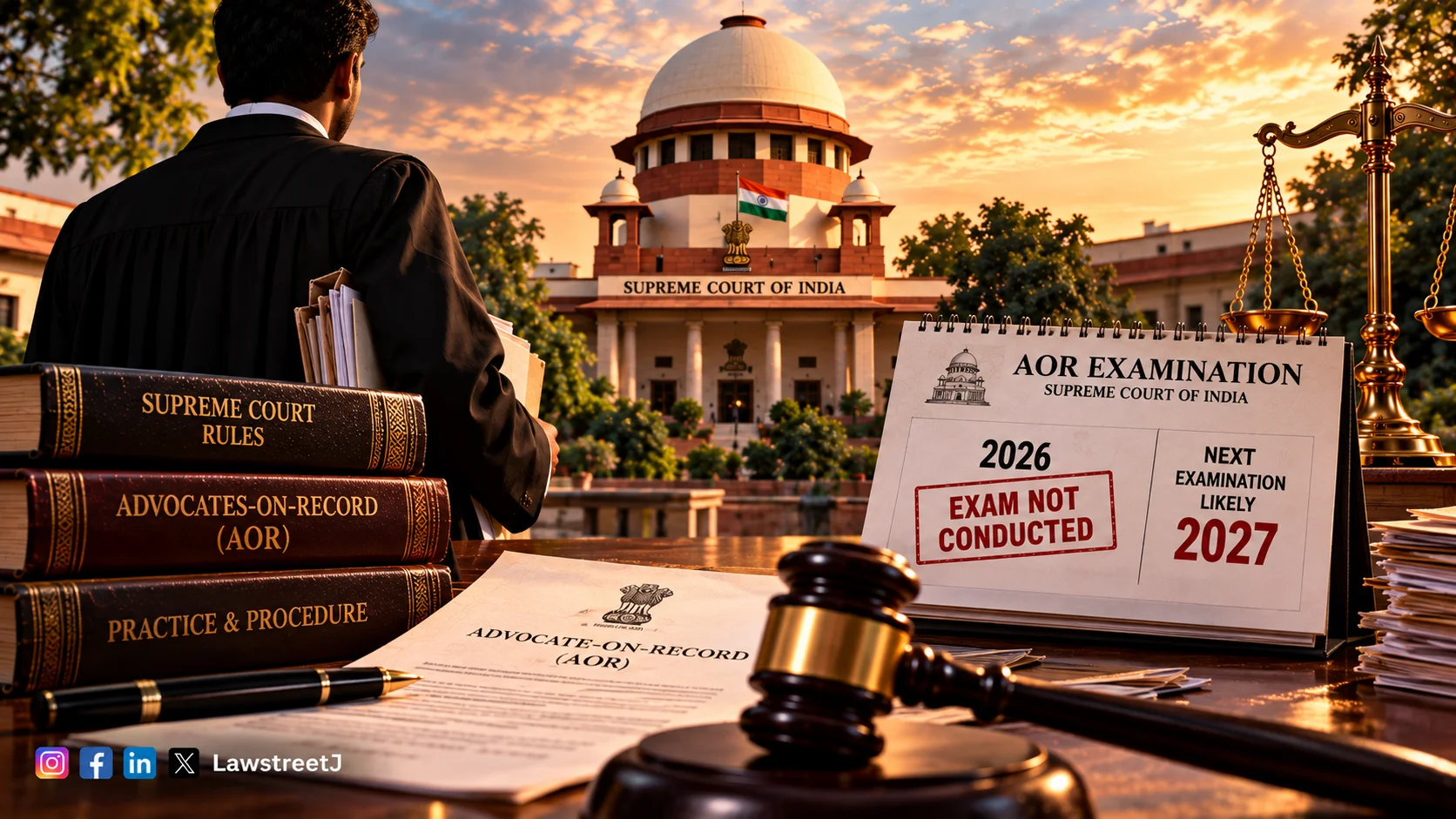
New Delhi: The Supreme Court of India has notified that the Advocates-on-Record (AOR) Examination December 2026 will be held at New Delhi on 19th, 20th, 22nd and 23rd December, 2026, exclusively for candidates who are eligible to re-appear under Regulation 11(i) or Regulation 11(ii) of the Regulations Regarding Advocates-on-Record Examination, arising out of the result of the AOR Examination held in June 2025, as well as earlier examinations. The Notification was issued by the Registrar (J) and Secretary of the Board of Examiners on 25th September, 2026.
Candidates eligible to re-appear under Regulation 11(i) or 11(ii) have been informed that although they are permitted to appear in the subsequent examination in one paper only, this remains at their option, and such candidates may, if they choose, opt to appear in the entire examination afresh. The Notification clarifies that this option must be exercised finally by candidates at the time of submitting the proforma application, and the choice made shall be final and binding on them.
Duly filled applications are to be submitted at the AOR Examination Cell, Room No. 308, 3rd Floor, B-Block, Administrative Buildings Complex, Supreme Court of India, New Delhi, during office hours between 1st October and 15th October, 2026. The Notification states that no application will be accepted after 5:00 p.m. on 15th October, 2026, the last date fixed for receipt of applications, and that the Registry will not be responsible for any delay.
Under Regulation 4(a), the examination comprises four subjects, namely Practice and Procedure of the Supreme Court, Drafting, Advocacy and Professional Ethics, and Leading Cases. On Drafting, the Notification clarifies that the syllabus, apart from petitions for special leave and statements of case, also covers petitions of appeal, plaints and written statements in suits under Article 131 of the Constitution, review petitions under Article 137, transfer petitions under Section 25 of the Civil Procedure Code, 1908, proceedings under Article 139 and Section 446 of the Bharatiya Nagarik Suraksha Sanhita, 2023, contempt petitions under Article 129, and interlocutory applications including those for bail, condonation of delay, exemption from surrendering and revocation of special leave.
For Advocacy and Professional Ethics, the suggested topics include the concept and history of the legal profession, the provisions of the Advocates Act, 1961 governing professional and other misconduct, the Bar Council of India Rules on standards of professional conduct, lawyer-client confidentiality under Section 132 of the Bharatiya Sakshya Adhiniyam, 2023, and the special obligations of an Advocate-on-Record towards the Supreme Court, including adjournments and contempt of court. For Leading Cases, the Notification lists 86 landmark judgments, ranging from Kesavananda Bharati v. State of Kerala to Tej Prakash Pathak v. High Court of Rajasthan, the head notes of which will be supplied to candidates in the examination hall and must be returned at the end of the examination.
The Notification further states that under Regulation 12, no application for re-evaluation of answer sheets will be entertained, and that representations seeking any other relief must be filed within 30 days from declaration of the result. Candidates who are issued roll numbers but remain absent will be treated as not sufficiently prepared under Regulation 5(b) and barred from any subsequent examination without the express permission of the Board of Examiners. Under Regulation 11(iii), a candidate who fails in all papers shall not be permitted to appear in the next examination, and candidates who do not appear in all papers and fail in those attempted shall be treated as having failed in all papers, including those not attempted.
On the number of permissible attempts, the Notification reiterates that under Regulation 11(iv), a candidate is not allowed more than five chances to appear in the examination, with appearance in even one paper counting as a chance. However, by virtue of a Circular dated 17th May, 2024, the AOR Examination held in December 2021 will not be reckoned while counting the five permissible chances, and as a one-time relaxation, eligible candidates who have exhausted their chances stand entitled to one additional chance based on the result of the last examination they appeared in.
The examination fee has been fixed at ₹750, payable through the Integrated Online Payment System on the Supreme Court's website, following which applicants must submit the physical application form, self-attested enrolment certificate and payment receipt at the AOR Examination Cell. The Notification also sets out the procedure for availing the facility of a scribe for persons with benchmark disabilities, who will additionally be entitled to compensatory time of 20 minutes for every hour of the examination.
The Advocates-on-Record Examination – December 2026 will be conducted through Pen and Paper mode only.