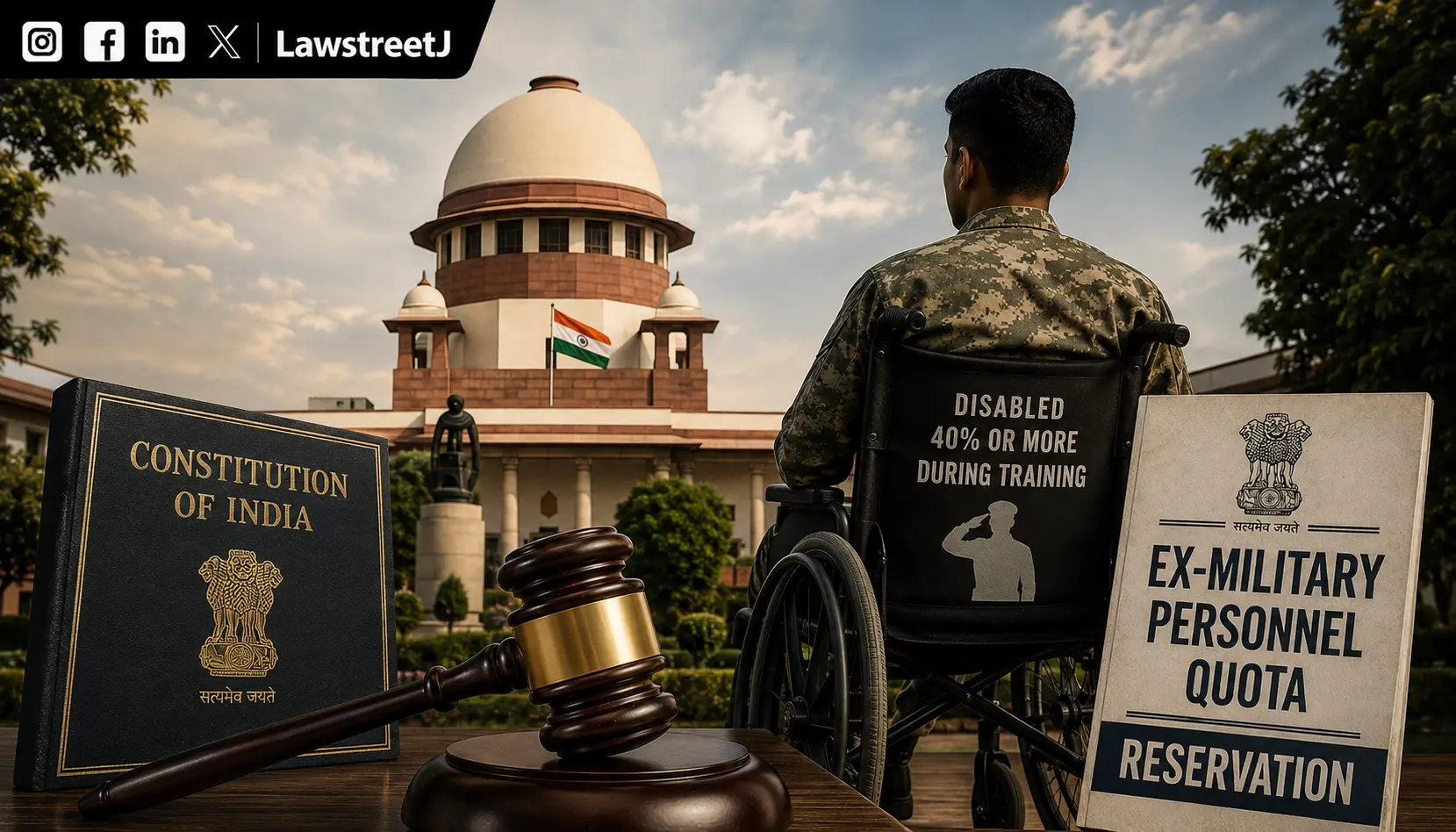
New Delhi: The Supreme Court has directed States and Union Territories to consider extending reservation to cadets discharged from military training on account of disability referred to as “out-boarded” cadets under the Ex-Military Personnel (Ex-MP) quota, while affirming their entitlement to horizontal reservation under Section 34 of the Rights of Persons with Disabilities Act, 2016.
A Bench of Justice B.V. Nagarathna and Justice Manmohan was hearing a suo motu writ petition concerning the welfare and rehabilitation of cadets who suffer disabilities during military training. Smt. Rekha Palli, senior advocate, appeared as Amicus Curiae, and Sri N. Venkataraman, learned Additional Solicitor General, appeared for the respondents.
The Court noted, on the basis of affidavits filed by the Ministry of Finance and the Ministry of Defence, and as acknowledged by the Amicus, that pursuant to its earlier directions the Ministry of Defence had extended Ex-Servicemen Contributory Health Scheme benefits to invalidated cadets, taking care of their medical expenses for life. The Court described this as a “laudable measure.”
The Amicus, however, drew attention to a continuing disparity in monetary benefits: the monthly disability benefit paid to an officer trainee, that is, an Army Cadet, together with dearness allowance, is Rs.12,240, whereas a Jawan trainee or recruit before attestation in the Army receives Rs.18,000 per month. It was submitted that a similar disparity exists in the ex gratia amount paid to out-boarded cadets. In response, the learned ASG informed the Court that the Eighth Pay Commission has been constituted and would consider enhancement of the ex gratia rates payable to out-boarded cadets. The Court accordingly reserved liberty to the concerned persons to make representations before the Eighth Pay Commission, observing that the Commission would be well placed to examine the matter from all aspects and suitably enhance the monthly payment.
The Court also considered the applicability of the Rights of Persons with Disabilities Act, 2016 to out-boarded cadets, noting that its provisions may not apply to cadets whose benchmark disability is less than 40 per cent. For such cadets, who are nevertheless out-boarded and fall outside the Act's coverage, the Court directed that a suitable scheme be prepared and extended to them, and the learned ASG stated that instructions would be sought on this aspect.
On the question of reservation, the Court noted that Section 34 of the Act requires every appropriate government to reserve not less than 4 per cent of vacancies in each group of posts for persons with benchmark disabilities of 40 per cent and above, by way of horizontal reservation. The Court held that out-boarded cadets ought to be entitled to the benefit of this provision and may apply for employment in the reserved category accordingly. The Court further placed on record its appreciation of States that have already treated out-boarded cadets as “ex-servicemen” for the purpose of reserved-category employment, and directed as follows:
“The States are directed to consider granting reservation to out boarded cadets in the quota of ‘Ex-Military Personnel (Ex-MP)’ so that the prospects of employment of these persons in the reserved category would be enhanced in the States and Union Territories within the respective cadres of posts in the services under the States,”
clarifying that this consideration is to be de hors the definition of “Ex-Servicemen” prescribed by the Department of Personnel and Training. The Registry was directed to dispatch a copy of the order to the Chief Secretaries of the States for their consideration and implementation under Section 34 of the Act.
The Court additionally directed the respondent-Departments to reconsider the recommendations of the Sabharwal Committee in light of the matter now being before the Court, expressing the expectation that favourable recommendations would emanate towards ameliorating the conditions of out-boarded cadets.
It was further clarified that the pendency of the suo motu petition would not prevent individual writ petitions filed before High Courts from being considered on their own merits, and that liberty stood reserved to petitioners whose such petitions may have been disposed of on account of the pendency of this proceeding, to apply for revival of those petitions.
The matter has been listed for further hearing on September 8, 2026.
Appearances:
Amicus Curiae: Smt. Rekha Palli, Senior Advocate.
For the Respondents: Sri N. Venkataraman, Additional Solicitor General.
Case Title: In Re: Cadets Disabled In Military Training, Suo Motu Writ Petition (Civil) No.6/2025