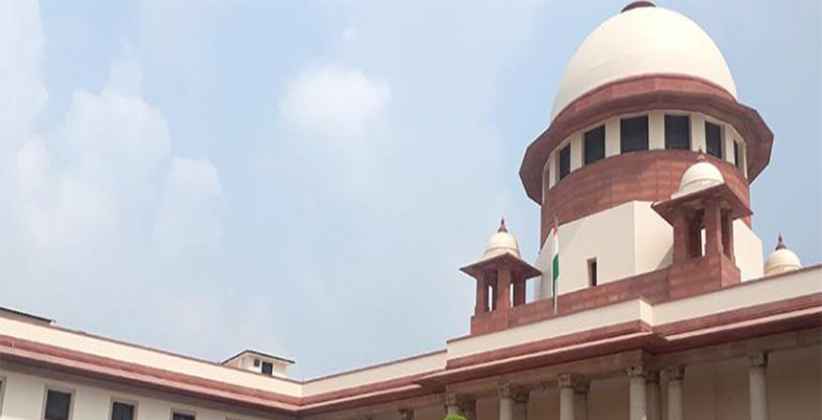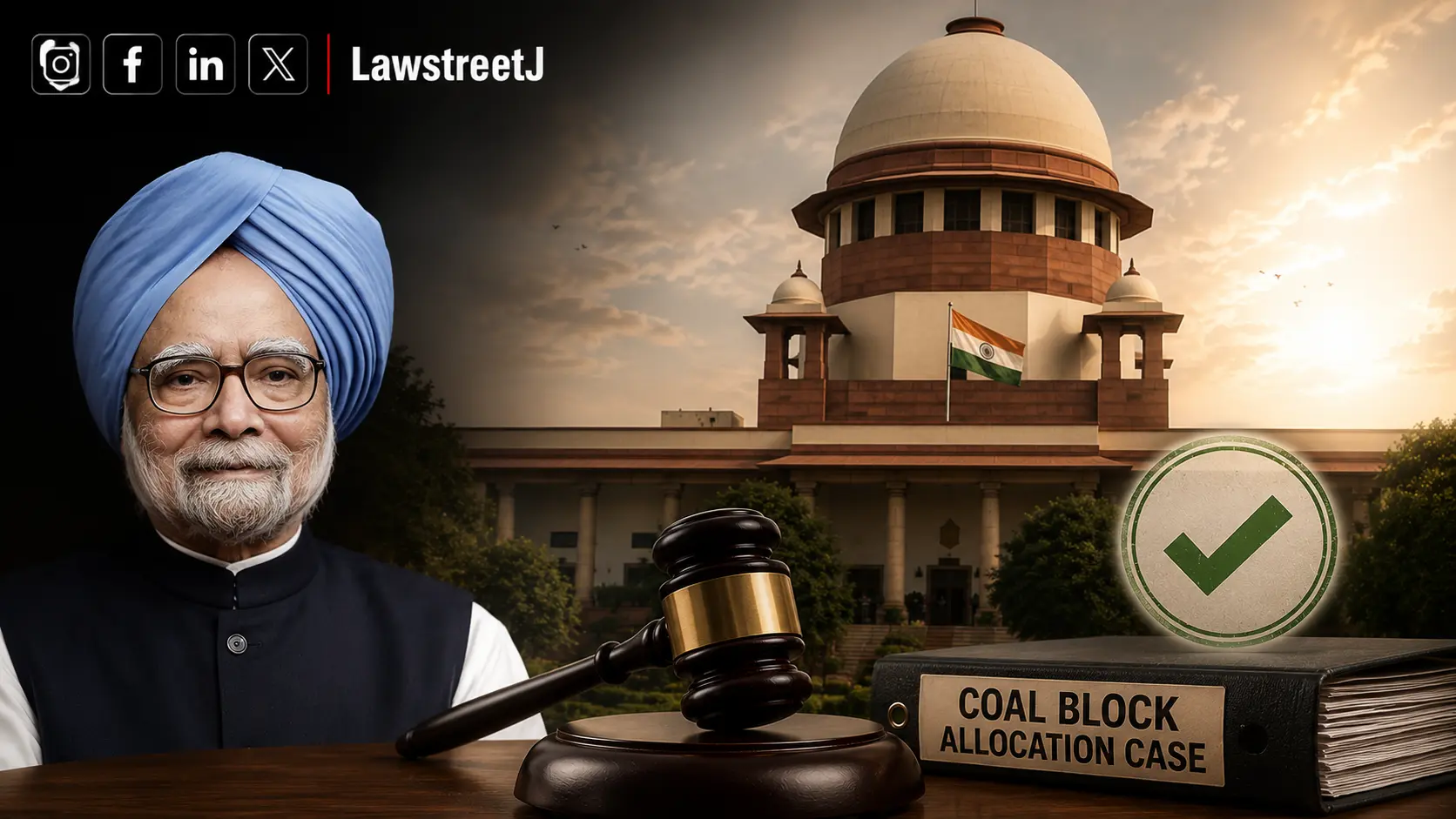
New Delhi: The Supreme Court of India on Wednesday, July 29, 2026, formally brought an end to over a decade of legal proceedings against the late former Prime Minister Dr Manmohan Singh in the Talabira-II coal block allocation case.
A three-judge bench, comprising Chief Justice of India Surya Kant and Justices Joymalya Bagchi and V Mohana, set aside a 2015 order of the Special CBI Court that had rejected the investigating agency's closure reports and summoned Dr Singh as an accused. Dr Singh, who served as Prime Minister from 2004 to 2014, passed away in December 2024 at the age of 92 while his appeal against the summons was still pending.
The bench held that there was "no cogent reason" or "compelling basis" for the trial court to reject the findings of the Central Bureau of Investigation (CBI) and proceed with criminal prosecution. While the Court observed that the appeal could technically have become infructuous due to Dr Singh's death, it nevertheless decided to examine the merits because the trial court's order contained adverse observations that had remained against the former Prime Minister for more than eleven years.
The legal proceedings originated from the 2005 allocation of the Talabira-II coal block in Odisha to Hindalco Industries, a flagship company of the Aditya Birla Group. At the time, Dr Singh held the Union Coal portfolio in addition to serving as Prime Minister. The CBI investigation examined whether the change in allocation, allegedly made contrary to the initial recommendations of the Screening Committee in favour of a private entity alongside public sector undertakings, involved criminal conspiracy, criminal breach of trust, or the abuse of official position.
Following a comprehensive investigation, the CBI filed two separate closure reports in August and October 2014, concluding that there was insufficient evidence to prosecute Dr Singh. However, in March 2015, Special CBI Judge Bharat Parashar rejected these reports, holding that a prima facie case existed. The trial court took cognizance of alleged offences under Sections 120-B (criminal conspiracy) and 409 (criminal breach of trust) of the Indian Penal Code, along with provisions of the Prevention of Corruption Act.
Dr Singh immediately challenged the summoning order before the Supreme Court, contending that the allocation of the coal block was a bona fide administrative decision taken within the prevailing policy framework and involved no criminality. On April 1, 2015, the apex court stayed the summons and all consequential proceedings, granting him interim protection that remained in force for the rest of his life.
During the final hearing, Senior Advocate Kapil Sibal, appearing for Dr Singh's legal heirs, requested the Court to expunge the adverse observations recorded by the trial court. Sibal argued that the Special Judge had effectively imposed vicarious criminal liability on the former Prime Minister despite the CBI having twice concluded that there was no evidence of wrongdoing. Senior Advocate Abhishek Manu Singhvi also urged the Court to remove the findings against Dr Singh in light of his passing.
The Supreme Court expressed concern that the trial court had rejected the investigating agency's conclusions without adequate legal justification. The bench emphasised that settled legal principles governing the acceptance or rejection of investigation reports must be followed and held that, in this case, the Special Judge had exceeded those limits. Senior Advocate R.S. Cheema, appearing for the CBI, informed the Court that the agency did not support the trial court's decision to disregard its recommendation for closure.
With this ruling, the Supreme Court has formally accepted the CBI's closure reports and posthumously exonerated Dr Manmohan Singh. The bench clarified that while the criminal proceedings against the former Prime Minister have now conclusively ended, the judgment does not automatically bring an end to proceedings against other co-accused, whose cases will require independent consideration. For Dr Singh, however, the verdict brings judicial finality to a case that had long overshadowed his political legacy.
Appearance:
For the petitioners: Senior Advocate Kapil Sibal and Senior Advocate Abhishek Manu Singhvi.
For the respondents: Senior Advocate R.S. Cheema (for the CBI).
Case Title: Dr. Manmohan Singh v. Central Bureau of Investigation & Others (Criminal Appeal Nos. 562–563 of 2015).