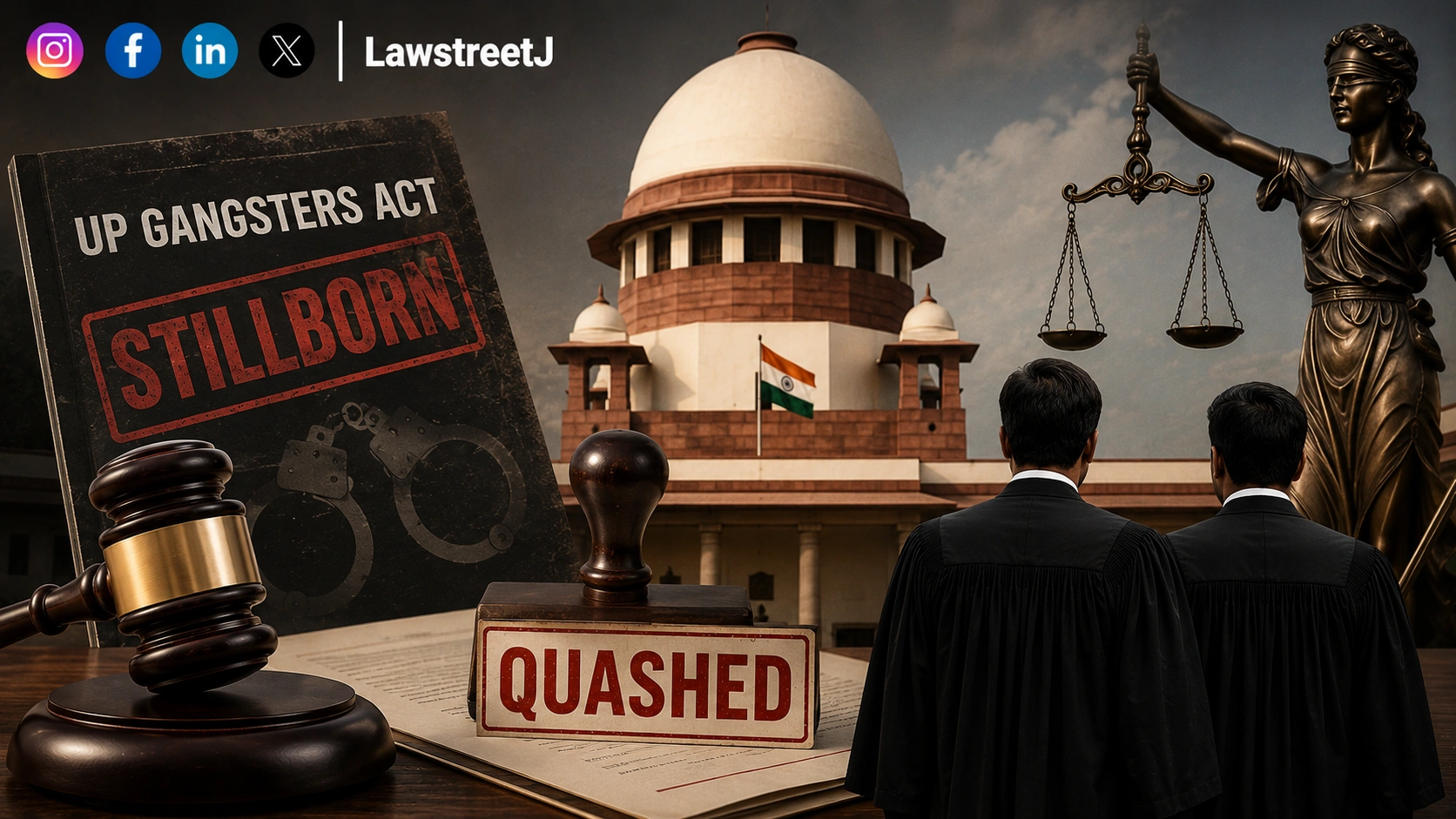
New Delhi: The Supreme Court has held that the Uttar Pradesh Gangsters and Anti-Social Activities (Prevention) Act, 1986, is “stillborn”, ruling that the statute does not create any independent criminal offence and can therefore not sustain a prosecution or punishment.
A Bench of Justices J.B. Pardiwala and K. Vinod Chandran quashed proceedings launched under the Act against two practicing advocates, allowing their appeals against orders of the Allahabad High Court declining to quash the respective charge sheets.
The Court was hearing two connected appeals arising out of separate gang-chart proceedings. In the first, an advocate from Fatehgarh, Farrukhabad, who had been embroiled in a dispute over Bar Association elections and later debarred by the Bar Council of Uttar Pradesh, was named an accused in an FIR registered under the U.P. Act on the strength of a Gang Chart prepared under the Uttar Pradesh Gangsters and Anti-Social Activities (Prevention) Rules, 2021. The Bench noted that the Bar Council of Uttar Pradesh's debarment order had itself been stayed by the High Court and later declared a nullity by the Bar Council of India.
The second appeal concerned another advocate proceeded against, along with his father and brother, under Sections 2/3 of the U.P. Act in connection with a case crime registered at Police Station Loni Border, Ghaziabad. The appellant's plea to quash the charge sheet had been rejected by the High Court.
Examining the scheme of the U.P. Act, the Court noted that Section 2(b) merely defines a ‘gang’ by reference to activities already punishable under other penal enactments such as the Indian Penal Code, the Narcotic Drugs and Psychotropic Substances Act and the Arms Act, while Section 2(c) defines a ‘gangster’ as a member, leader or organiser of such a gang. Section 3 prescribes punishment for a ‘gangster’, but the Bench found that the Act nowhere creates a distinct offence of its own, contrary to the requirement flowing from the definition of ‘offence’ under the General Clauses Act as “an act or omission made punishable by any law for the time being in force.”
Relying on the Constitution Bench decision in S.A. Venkataraman v. Union of India, the Court reiterated that a penal statute must itself create the offence and prescribe punishment in accordance with that offence. It held that the Gang Chart mechanism under the Rules prepared by police officers and approved administratively determines the status of a person as a ‘gangster’ without any guidelines traceable to the parent statute, amounting to punishment of status rather than of a defined criminal act.
The Bench also examined this Court's earlier brushes with the Act, including Dharmendra Kirthal v. State of Uttar Pradesh and Shraddha Gupta v. State of Uttar Pradesh, observing that the specific question of an offence being absent under the Act had never been decided by the Supreme Court, though it had been rejected by a Full Bench of the Allahabad High Court in Ashok Kumar Dixit v. State of U.P. The Court respectfully disagreed with that view, contrasting the U.P. Act with the Maharashtra Control of Organised Crime Act and the Gujarat Control of Terrorism and Organised Crime Act, both of which expressly create and punish an offence of organised crime, unlike the U.P. enactment.
Describing the effect of the Act as akin to preventive detention but without any of its statutory safeguards, the Court observed:
“the U.P. Act is stillborn and the proceedings initiated under it cannot survive.”
The judgment opens with a quote from George Orwell “Those who abjure violence can do so only because others are committing violence on their behalf” and closes by turning that observation on the statute itself, finding that an enactment framed as a measure against violence was, in the Bench's words, “perpetuating it on un-suspecting citizens.” The Court also invoked the English proverb ‘give a dog a bad name and hang him’ to describe how a person's inclusion in a Gang Chart, prepared by police and administrative officers under Chapter III of the 2021 Rules, could result in a foregone conviction irrespective of the outcome of the underlying criminal case.
The Bench clarified that it had not examined the constitutional validity of the Act, an issue it left open, and that its ruling would not affect prosecutions under other penal statutes arising from the same facts, which must proceed independently in accordance with the Code of Criminal Procedure and the relevant substantive law. It also clarified that it had not expressed any opinion on the correctness of the Full Bench of the Allahabad High Court on the other constitutional grounds it had rejected, nor endorsed the Gujarat or Maharashtra enactments, which were referred to only to illustrate that those statutes, unlike the U.P. Act, expressly create an offence of organised crime.
Accordingly, the Court quashed the charge sheet arising from FIR No. 41 of 2024 registered at Fatehgarh Kotwali and the proceedings in Sessions Case No. 73 of 2024 arising from FIR No. 740 of 2022 registered at Police Station Loni Border, Ghaziabad Rural, both framed under Sections 2/3 of the U.P. Act. The appellants, if in custody, were directed to be released forthwith unless required in any other case, and bail bonds executed by them were ordered cancelled.
Case Title: Shiv Pratap Singh Alias Chinu vs. State of U.P. & Ors., with Himanshu Srivastava vs. State of U.P. & Ors., Criminal Appeal No. 3979 of 2026 (arising out of SLP (Crl) No. 16398 of 2025) with Criminal Appeal No. 3980 of 2026 (arising out of SLP (Crl) No. 1997 of 2026)



.jpeg)