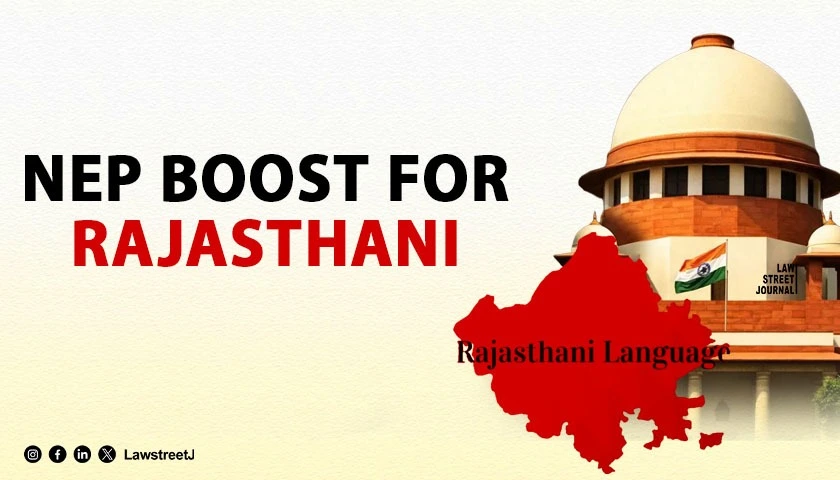
New Delhi: The Supreme Court has set aside the Rajasthan High Court’s order dismissing a public interest litigation seeking inclusion of the Rajasthani language in teacher recruitment examinations and school curricula, and has directed the State of Rajasthan to take affirmative and time-bound steps to introduce Rajasthani as a subject in all government and private schools across the State in a phased and progressive manner.
The Court further directed the State to formulate a comprehensive policy for the effective implementation of mother tongue-based education in consonance with the National Education Policy, 2020. A compliance affidavit has been sought by 25th September, 2026.
The Civil Appeal was filed by Padam Mehta and another, assailing the order dated 27th November, 2024, of the High Court of Judicature for Rajasthan at Jodhpur in D.B. Civil Writ Petition No. 5294 of 2021.
The appellants had approached the High Court seeking directions to include the Rajasthani language in the examination syllabus for recruitment to the post of Teacher, Grade-III, Level-I and Level-II under the Rajasthan Eligibility Examination for Teachers, 2021, and to impart education to children in Rajasthani or the relevant local language. The High Court dismissed the petition on the ground that a writ of mandamus is issuable only upon the petitioners establishing an enforceable legal right and a corresponding statutory duty on the State.
A Bench of Justice Vikram Nath and Justice Sandeep Mehta allowed the appeal, authoring the judgment through Justice Sandeep Mehta. The Court opened with the observation that the ability to understand and be understood in one’s own language is not a matter of convenience but a matter of existential rights, for comprehension must necessarily precede meaningful participation in society and daily life. The accessibility of language, the Court held, assumes constitutional significance in a society governed by law.
On the constitutional and legislative framework, the Court surveyed the full arc of India’s commitment to mother tongue-based education. It noted that the Constituent Assembly had devoted an entire Part, i.e., Part XVII, to the subject of language, and that the Seventh Amendment incorporated Article 350A with the avowed object of ensuring that States provide adequate facilities for instruction in the mother tongue at the primary stage of education for children belonging to linguistic minority groups.
It additionally held that the Kothari Commission (1964–66) had recommended the three-language formula, with the mother tongue or regional language as the first language of instruction, and that this recommendation was adopted in the National Policy on Education, 1968, and reiterated in its 1986 and 1992 iterations.
The Court placed particular emphasis on Section 29(2)(f) of the Right of Children to Free and Compulsory Education Act, 2009, which mandates that the academic authority, while formulating the curriculum and evaluation procedures, shall ensure that the medium of instruction shall, as far as practicable, be in the child’s mother tongue. This provision was characterised as a key statutory measure aimed at securing quality education in a real and substantive sense: instruction imparted in a language unfamiliar to the learner not only impedes effective understanding but also risks impairing foundational development and engendering a sense of alienation in the child, thereby defeating the very purpose of elementary education.
Additionally, the National Education Policy, 2020, was noted to reinforce this position further by recommending the mother tongue or regional language as the medium of instruction at least up to Grade V and preferably up to Grade VIII and beyond, uniformly in both public and private institutions.
On the constitutional right to receive education in one’s mother tongue, the Court held that this right finds its normative basis in Article 19(1)(a), since the freedom of speech and expression necessarily encompasses the right to receive information in a form that is both meaningful and comprehensible. Instruction in the mother tongue fortifies the learner’s conceptual clarity, ensures deeper cognitive engagement, and secures the constitutional promise of meaningful access to knowledge. This position was affirmed by reliance on State of Karnataka v. Associated Management of English Medium Primary and Secondary Schools, (2014) 9 SCC 485, which had held that Article 19(1)(a) encompasses the freedom of a child to receive primary education in a language of choice.
The appellants’ submission that Rajasthani speakers constitute a “linguistic minority” for the purpose of Article 350A, since Hindi is the principal official language of Rajasthan, was addressed in the course of the Court’s broader analysis. The respondent State resisted the appeal on the grounds that education is imparted only in languages recognised in the Eighth Schedule to the Constitution; that Rajasthani has not been included therein; that Article 350A is merely directory and does not give rise to enforceable rights; and that the National Education Policy, 2020, being an executive policy statement, has no statutory force and does not circumscribe the State’s discretion in formulating curricula.
The Court rejected these contentions categorically. The State’s position that the absence of a policy decision and administrative framework consequent upon non-inclusion of Rajasthani in the Eighth Schedule is a sufficient answer was characterised by the Court as a myopic and lackadaisical stance that proceeded on a technical premise to effectively sidestep the constitutional imperative.
The absence of a policy, the Court held, is a shortcoming warranting prompt rectification and cannot be projected as a ground to defend existing inertia. The Court noted pointedly that Rajasthani is presently taught as a subject at the university level in institutions including Jai Narain Vyas University, Jodhpur; Maharaja Ganga Singh University, Bikaner; and the University of Rajasthan, Jaipur, a fact that itself belied any suggestion that the language lacks institutional or pedagogical acceptance. The Court observed that the State’s persistence in treating non-inclusion in the Eighth Schedule as a bar to school-level recognition disclosed an approach that was pedantic in the extreme.
The Court was emphatic that constitutional rights, once recognised, cannot be permitted to languish as mere abstractions. A right that exists only on paper, without corresponding administrative will or implementation, is in effect no right at all.
The Court held that once the Union has itself recognised, through legislative enactments and policy frameworks, the necessity of imparting education in a language intelligible to the child, a corresponding obligation necessarily arises upon the States to adopt timely, effective, and purposive measures for the meaningful realisation of that right. The Court further observed that it cannot remain a silent spectator to the evident dilution of rights expressly recognised under the constitutional framework, statutory law, and binding judicial precedents.
The primary relief pertaining to the REET-2021 was held to have become infructuous, as the recruitment process had since been concluded and had attained finality.
However, the Court held that the issues raised transcended the confines of the particular examination and touched upon broader questions of constitutional significance, and accordingly proceeded to issue directions on the larger constitutional canvas.
Case Title: Padam Mehta and Another v. State of Rajasthan and Others [Civil Appeal arising out of SLP (C) No. 1425 of 2025; 2026 INSC 476]