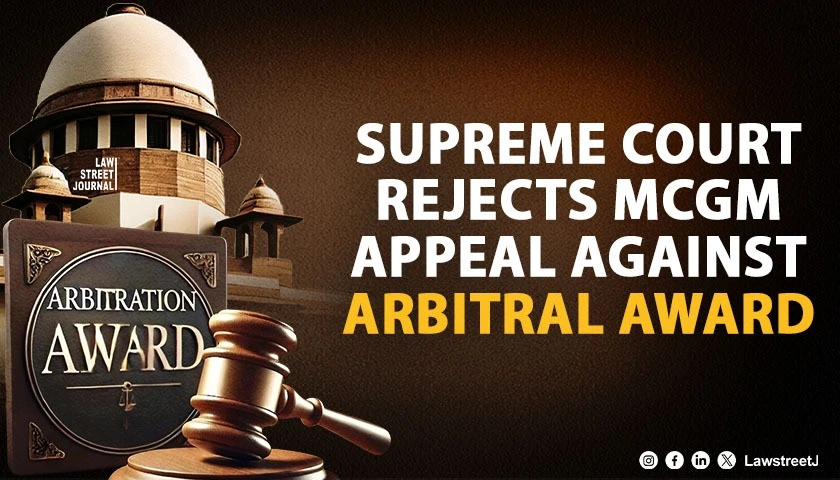
New Delhi: The Supreme Court of India has dismissed the appeals filed by the Municipal Corporation of Greater Mumbai (MCGM), upholding an arbitral award passed in favour of M/s R.V. Anderson Associates Limited.
The Court held that Clause 8.3(b) of the Agreement was enabling in nature and did not strip the Co-Arbitrators of their power to appoint the Presiding Arbitrator after thirty days. It further held that the conduct of a party in actively participating in arbitral proceedings without raising any objection is a relevant consideration while deciding a jurisdictional challenge under Section 16 of the Arbitration and Conciliation Act, 1996.
A Bench of Justices J.K. Maheshwari and Atul S. Chandurkar observed that the arbitration clause in question provided a fail-safe mechanism for the parties to approach the Secretary General of the International Centre for Settlement of Investment Disputes (ICSID) in Washington, D.C., but this was conditioned upon a request being made by either party. Since neither party had made such a request, the enabling provision could not be read to completely extinguish the Co-Arbitrators’ power to appoint the third arbitrator.
The dispute arose from an agreement dated 18.09.1995 between MCGM and R.V. Anderson Associates Limited, a Canadian engineering firm, for consultancy services relating to the upgrade of sewerage operations and maintenance. The project was funded by the World Bank. After the work was completed and a dispute arose over payment of outstanding dues, arbitration was invoked in 2005. The two Co-Arbitrators made three successive appointments of the Presiding Arbitrator before Mr. Anwarul Haque of Singapore was finally appointed in October 2008. Only after the preliminary meeting of the Tribunal in January 2009 did MCGM raise an objection, claiming that the Co-Arbitrators had forfeited their right to appoint the third arbitrator after the expiry of thirty days from the date of appointment of the second arbitrator.
The Arbitral Tribunal, by its order dated 17.07.2009, rejected MCGM’s challenge under Section 16. The Tribunal then passed a final award on 05.06.2010, directing MCGM to pay substantial amounts in both USD and INR along with interest. MCGM filed an application under Section 34 of the 1996 Act to set aside the award, which was dismissed by a learned Single Judge of the Bombay High Court. An appeal under Section 37 was also dismissed. MCGM then approached the Supreme Court by way of Special Leave Petition.
On the interpretation of Clause 8.3(b), the Supreme Court noted that the clause did not prescribe any consequence for non-appointment of the Presiding Arbitrator within thirty days. The Court said that the clause had two distinct parts. The first part vested the power of appointment of the third arbitrator with the Co-Arbitrators. The second part only triggered upon the condition precedent of a request being made by either party before the ICSID. The word ‘shall’ in the second part cast a mandatory obligation on the ICSID to appoint, but only upon such a request being made. Since no party made any such request, the enabling clause did not come into operation at all.
The Court rejected the argument that the Co-Arbitrators were left in a state of limbo indefinitely. It said such an interpretation would lead to commercial irrationality and could not have been the intent of the parties. It also declined to read something into the agreement which it did not explicitly provide.
On the question of conduct and acquiescence, the Court noted that MCGM remained silent while three different persons were appointed as Presiding Arbitrator by the Co-Arbitrators. It did not object when Justice D.R. Dhanuka (Retd.) was first appointed in April 2007. It did not object to the appointment of Mr. John Savage in April 2008 either. It did not respond to communications from the Co-Arbitrators and the Respondent discussing the appointment of the third arbitrator. It attended the preliminary meeting of the Tribunal without raising any objection. The Court observed that a party cannot keep a jurisdictional objection up its sleeve and then claim that filing an application under Section 16 would wipe out its past conduct.
The Court clarified that while statutory waiver under Section 4 did not attract in this case since MCGM filed its Section 16 application before submission of the statement of defence, the prior conduct of the party remained a relevant consideration while adjudicating the merits of the jurisdictional challenge. The Court held that subsequent conduct of parties serves as a practical tool to understand their contractual intent and prevents adoption of a legalistic position that contradicts how they actually operated.
The appeals were dismissed with no order as to costs.
Case Title: Municipal Corporation of Greater Mumbai v. M/s R.V. Anderson Associates Limited (SLP (C) Nos. 23846–47 of 2025)