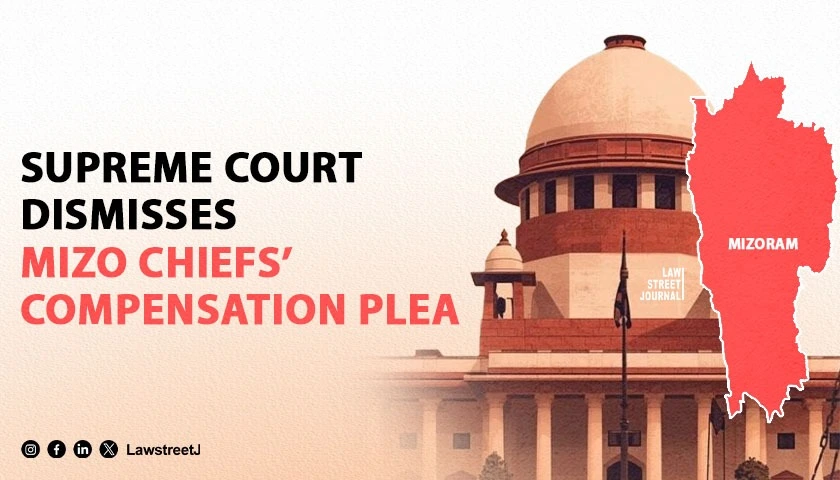
New Delhi: The Supreme Court of India has dismissed a writ petition filed by the Mizo Chief Council, Mizoram, seeking compensation for the alleged unlawful acquisition of lands belonging to tribal chieftains of the erstwhile Lushai Hills district, now the present-day State of Mizoram.
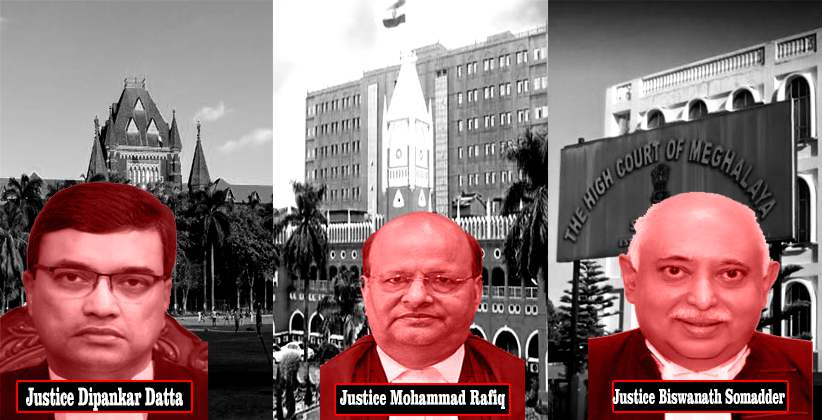
A bench of Justices J.B. Pardiwala and R. Mahadevan delivered the judgment on March 13, 2026.
The petition was filed in 2014 under Article 32 of the Constitution through the Council’s President, Shri L. Chinzah, on behalf of the Mizo Chiefs and their legal heirs. The petitioner contended that the Union of India and the State of Mizoram had seized and acquired the chiefs’ lands without paying adequate compensation, thereby violating their fundamental right to property as it existed under Part III of the Constitution at the relevant time.
Historically, Mizo society was structured around the institution of chieftainship. The chiefs claimed to be the absolute owners of vast tracts of land called “Ram,” over which they exercised executive and judicial authority. Villagers were allotted farmland from the Ram and, in return, paid a customary tribute known as “Fathang,” comprising a portion of the annual agricultural produce. Following the British annexation of the Lushai Hills district in the 1890s, the colonial administration retained the chieftainship system for administrative convenience, though the chiefs’ authority was significantly curtailed through documents called “Ramrilekha,” or boundary papers, which demarcated the territorial extent of each chief’s authority and required a pledge of loyalty to the Crown.
After independence, the area was administered as part of Assam. In 1954, the Assam Lushai Hills District (Acquisition of Chiefs’ Rights) Act, 1954 was enacted to dismantle the chieftainship system. The legislation empowered the State to vest the rights and interests of the chiefs in their Rams in the State. Pursuant to this, a notification was issued on March 23, 1955. A total sum of Rs. 14,78,980 was paid to the chiefs as compensation.
The petitioner argued that this compensation covered only the Fathang rights and did not account for the value of the land itself, contending that the deprivation of property without lawful authority or adequate compensation violated their fundamental rights under Articles 19(1)(f), 31, 14, and 21 of the Constitution.
Before addressing the merits, the Court examined whether the petition was barred by delay and laches, given that the impugned notification was issued in 1955 and the petition was filed nearly six decades later. After an extensive review of the jurisprudence on the doctrine—from the Constitution Bench decision in Tilokchand and Motichand v. H.B. Munshi (1969) to In Re: Section 6-A of the Citizenship Act, 1955 (2024)—the Court reaffirmed that the doctrine operates as a flexible rule of practice rather than a rigid rule of law, and that the operative test is not one of “unreasonable delay” but of “unexplained delay.”
The Court declined to dismiss the petition at the threshold, noting the region’s turbulent post-independence history marked by insurgency and multiple rounds of administrative reorganisation before Mizoram achieved full statehood in 1987. It also noted that the State of Mizoram had, on multiple occasions, expressed a sympathetic stance and held out hope for an amicable resolution before the Gauhati High Court, which had disposed of earlier proceedings without adjudicating the matter on merits. This conduct, the Court held, could have reasonably dissuaded the chiefs from initiating litigation sooner.
Despite allowing the petition to cross the threshold, the Court ultimately found against the petitioner on merits. To succeed on the claim of violation of the fundamental right to property, the petitioner was first required to establish clear title over the subject lands. The petitioner relied primarily on accounts and writings of British scholars and officials. The Court found this evidence highly ambiguous and legally insufficient to establish ownership over what was effectively the entire present-day State of Mizoram. An examination of the boundary papers available on record did not support the claim of absolute ownership, and the material adduced by the respondents suggested that title over the land never vested in the chiefs during British administration.
On the question of illusory compensation, the Court noted that the petitioner had failed to engage with the extensive judicial precedent on the legal parameters for determining when compensation becomes constitutionally inadequate. The petitioner’s contention that the Mizo Chiefs stood on par with rulers of erstwhile princely states and were entitled to similar privy purses was also rejected, as such entitlements arose from specific pre-constitutional political and contractual arrangements and could not be claimed as a universally applicable fundamental right.
The Court also declined to examine the constitutional validity of the Act of 1954 or the impugned notification, as the foundational burden of establishing a fundamental rights violation had not been discharged.
The writ petition was accordingly dismissed along with all pending applications.
Case Title: Mizo Chief Council Mizoram Through President Shri L. Chinzah v. Union of India & Ors., Writ Petition (Civil) No. 22 of 2014.