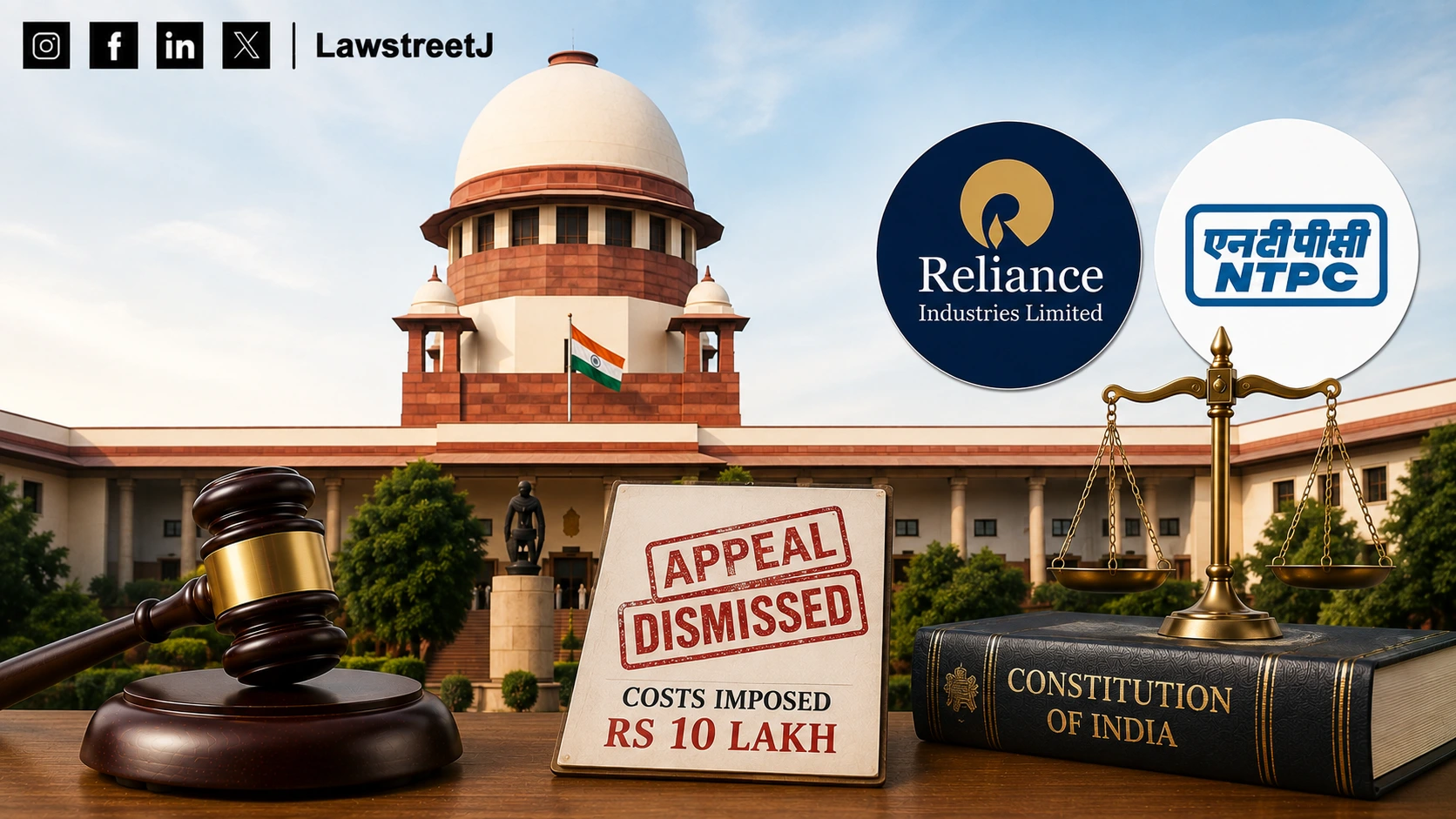
New Delhi: The Supreme Court has dismissed an appeal filed by Reliance Industries Limited (RIL) against an order of the Bombay High Court redacting portions of two examination-in-chief affidavits filed by its witness, Mr. B.K. Ganguly, in a long-pending commercial suit filed by NTPC Limited for specific performance of a gas supply contract.
The Bench of Justices Pamidighantam Sri Narasimha and Alok Aradhe imposed costs of Rs. 10 lakh on RIL, payable to the Supreme Court Advocates-on-Record Association within five weeks.
The dispute traces back to a Request for Qualification issued by NTPC inviting proposals for supply of natural gas to its power plants. RIL's financial proposal was followed by a Letter of Intent dated 16th June, 2004, accepted by RIL subject to a Gas Sale and Purchase Agreement to be negotiated and finalised. When the terms of the Letter of Intent were allegedly not honoured, NTPC filed a suit in 2006 seeking a declaration that a binding contract existed and specific performance of supply of 132 trillion BTU of natural gas over 17 years.
The Court noted that the suit has been marked by repeated litigation at every stage, observing that RIL's capacity to litigate and obstruct progress "seems unlimited" given the absence of any financial constraint or obligation to assist the court in clearing its backlog.
In the first round of litigation, RIL sought discovery and inspection of NTPC's internal documents and correspondence relating to the finalisation of the agreement. The Bombay High Court dismissed the application in 2014, finding the discovery sought to be vague and in the nature of a fishing enquiry, and holding that the question of a concluded contract had to be decided on documents already exchanged between the parties, not internal notings. The Division Bench affirmed this view on appeal, additionally noting gross delay in filing the application.
In the second round, shortly after RIL filed Mr. Ganguly's first evidence affidavit in February 2015, it sought leave to bring additional internal documents on record. The High Court allowed this only in part in January 2016, holding that RIL's own unilaterally prepared internal documents could throw no light on what the parties mutually intended, and were therefore irrelevant to proving a concluded contract. RIL's special leave petition against this order was later withdrawn.
The third round began when NTPC sought redaction of portions of both evidence affidavits that referred to such internal communications. The High Court's order redacting certain portions while permitting oral evidence on the excluded documents was carried in appeal to the Supreme Court, which by judgment dated 28th February, 2019 held that once internal communications had been excluded from the documentary record, parties could not be permitted to introduce their contents indirectly through oral testimony. The Court had observed:
"We have no hesitation to set aside the order so far it permits oral evidence to be adduced with respect to the contents of the documents, email etc. and what transpired in the meeting of officer/employer of defendants or the correspondence which has already been held to be irrelevant."
Applying this mandate, the Bombay High Court undertook a paragraph-by-paragraph scrutiny of the two evidence affidavits in its order dated 22nd August, 2024, redacting portions that referred to internal e-mails or meetings among RIL's own officers, while retaining portions reflecting the witness's contemporaneous perception of correspondence actually exchanged between the parties. For instance, while the reference to an internal e-mail in paragraph 23 of the first affidavit was redacted, the High Court retained the succeeding sentence recording the witness's state of mind, reasoning that it did not fall within the mischief identified by the Supreme Court.
Before the Supreme Court, RIL sought to reopen the issue by invoking Section 60 of the Indian Evidence Act, 1872, on leading oral testimony, and argued that the High Court had exceeded its jurisdiction in ordering redaction. Rejecting this, the Bench held that the same argument had already been considered and answered by the 2019 judgment, and declined to revisit it:
"We are neither in a position to revisit the judgment and order passed by this Court on 28th February, 2019, nor inclined to do so. Suffice it to say that the High Court was fully justified in arriving at its conclusions. We have no hesitation in upholding the judgment and order of the High Court."
The Court expressed concern over the pace at which the suit, filed in 2006, has progressed, noting that discovery proceedings alone took four years, the dispute over production of internal documents took over a year, and the redaction issue took a further three years to be resolved, only for the present appeal to follow the High Court's implementation order. It recalled that in 2019 itself, the Supreme Court had directed the trial to conclude within nine months, a timeline that has since lapsed by seven years. Reiterating the direction, the Bench observed:
"High Court will take note that permitting a party to a suit to prolong the litigation is also a sad reflection of the way courts conduct their proceedings."
Holding that the Bombay High Court had correctly understood and applied the mandate of the 2019 judgment, the Supreme Court dismissed the appeal and directed the Registry to request the High Court to dispose of the suit expeditiously.
Case Title : Reliance Industries Limited v. NTPC Limited, 2026 INSC 862