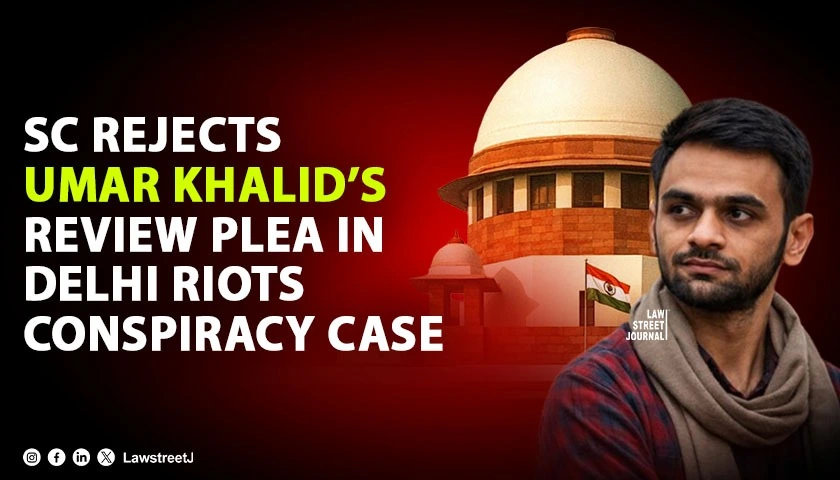
New Delhi: The Supreme Court of India has dismissed a review petition filed by Umar Khalid challenging the judgment dated 05.01.2026, by which the Court had denied him bail in the “larger conspiracy” case arising out of the 2020 Northeast Delhi communal riots.
The review petition was disposed of by a Bench comprising Justice Aravind Kumar and Justice N. V. Anjaria, which found no sufficient ground or reason to review the earlier judgment. The prayer for an oral hearing in the review petition was also rejected.
The order, passed on 16.04.2026, dismissed the petition on merits, stating that, upon perusing the petition and the documents enclosed, the Court found no basis for interference with its earlier decision. All pending applications were also disposed of.
The judgment sought to be reviewed was pronounced on 05.01.2026 in Criminal Appeal No. 17 of 2026, in which the same Bench had conducted an individualised assessment of the roles attributed to each of the seven accused persons who had challenged the Delhi High Court’s order denying bail. While five co-accused—Gulfisha Fatima, Meeran Haider, Shifa-ur-Rehman, Mohd. Saleem Khan, and Shadab Ahmed—were granted bail under that judgment, Umar Khalid and Sharjeel Imam were denied relief.
In the judgment, the Court held that Umar Khalid and Sharjeel Imam stood on a “qualitatively different footing” compared to the other accused, with the prosecution material attributing to them central roles in the planning, mobilisation, and strategic direction of the alleged conspiracy. The Court found that the material disclosed a prima facie case against them and that the statutory threshold under Section 43D(5) of the Unlawful Activities (Prevention) Act, 1967 stood attracted, rendering their enlargement on bail unjustified at that stage.
In the earlier judgment, the Court also carved out a pathway for future recourse, observing that Khalid and Imam may move fresh bail applications after the examination of protected witnesses or after one year from that date. Such applications would be considered on their own merits and uninfluenced by the earlier order. The trial court was also directed to expedite proceedings, particularly the examination of protected witnesses, and to ensure that the trial is not unnecessarily prolonged.
The batch of petitions arose from the Delhi High Court’s September 2025 order, which had denied bail to all appellants on the ground that violence in the name of protest is not protected as free speech. The prosecution consistently maintained that the riots were a pre-planned, choreographed, and orchestrated conspiracy aimed at destabilising the government.
The case arises from the communal violence that erupted in Northeast Delhi in February 2020 during nationwide protests against the Citizenship Amendment Act, 2019 (CAA). The clashes resulted in the deaths of 53 persons and left more than 700 injured. The Delhi Police registered a “larger conspiracy” case alleging that the violence was a deliberate attempt to threaten India’s sovereignty. Several individuals were arrested under the UAPA. Umar Khalid has been in custody since September 2020, and Sharjeel Imam since January 2020.
Case Title: Umar Khalid v. State of NCT of Delhi, Review Petition (Criminal) Diary No. 14473 of 2026 in Criminal Appeal No. 17 of 2026