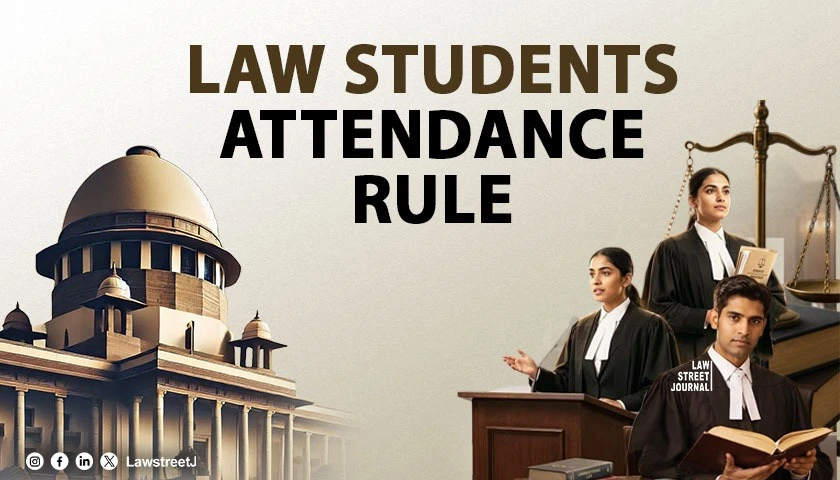
New Delhi: The Supreme Court on May 14, 2026 expressed reservations over a 2025 Delhi High Court judgment which held that law students cannot be barred from appearing in examinations solely on account of shortage of attendance, observing that such a position could reduce law colleges to mere boarding and lodging institutions. A Bench of Justices Vikram Nath, Sandeep Mehta and Vijay Bishnoi issued notice on a petition filed by Narsee Monjee Institute of Management Studies (NMIMS) challenging the High Court ruling.
Justice Mehta remarked from the Bench: “The impact of that order would be that National Law University hostels would become mere boarding and lodging facilities, nothing else… The High Court was swayed by the suicide of the student, that seems to be the issue.”
Senior Advocate Mukul Rohatgi, appearing for NMIMS, sought a stay of the concerned observation of the High Court, arguing that it had effectively rendered attendance requirements meaningless and had led to multiple legal proceedings against the petitioner. “People don’t want to go to colleges. I wonder why we went to college then,” Rohatgi submitted.
The Court, however, declined to stay the High Court judgment for the time being. Justice Nath stated: “We are not suspending that order. We will hear the matter and decide and lay down the correct position.” The matter was kept for further hearing on May 26, 2026.
The Court tagged the petition with pending proceedings challenging circulars issued by the Bar Council of India regarding criminal background disclosures, declarations relating to simultaneous academic pursuits, and compliance with attendance norms for law students. The NMIMS petition was filed through Advocate Kanu Agrawal.
The controversy arises from a November 2025 judgment of the Delhi High Court delivered in proceedings stemming from the 2016 suicide of a law student who had allegedly faced harassment over attendance shortages. The High Court held that no student enrolled in a recognised law college or university could be detained from taking examinations or prevented from continuing academic progression solely on the ground of inadequate attendance. It further observed that attendance regulations should not be enforced with such rigidity as to cause mental distress or contribute to extreme consequences for students.
The High Court had additionally directed the Bar Council of India to reconsider mandatory attendance norms for three-year and five-year LLB programmes in light of the National Education Policy, 2020 and evolving educational frameworks. Relying on the division bench ruling, a single judge of the Delhi High Court subsequently granted relief to several University of Delhi law students who had either been denied permission to sit for examinations or had their results withheld on account of attendance shortages.
The present hearing follows observations made by the Supreme Court the previous week while hearing petitions filed by two final-year NALSAR University students challenging Bar Council of India circulars issued in September 2024. At that hearing, Justice Nath had remarked that the Delhi High Court decision had created “chaos” and had become a matter of concern for National Law Universities. The Court had observed: “Students are not going to the classes… NLUs are known for their good faculty… if the students do not attend, what’s the point?”
Case Details: SVKMS Narsee Monjee Institute of Management Studies v. Bar Council of India, Supreme Court of India (Diary No. 28872/2026). Before Justices Vikram Nath, Sandeep Mehta and Vijay Bishnoi. Hearing dated May 14, 2026. Senior Advocate Mukul Rohatgi appeared for the petitioner.