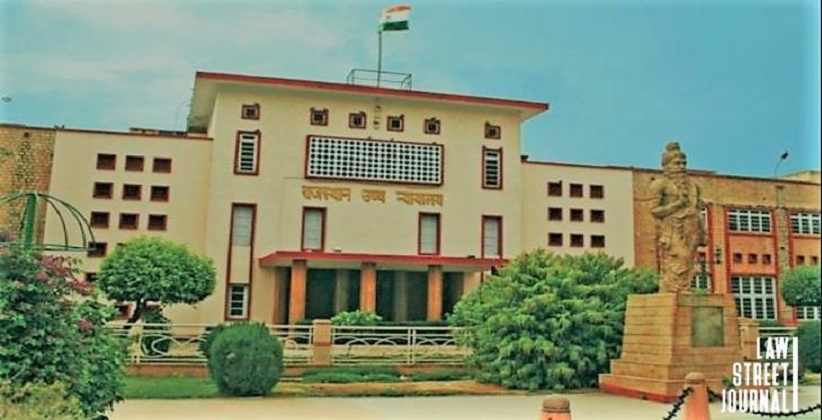
New Delhi: The Supreme Court has expunged adverse remarks and strictures made by the Rajasthan High Court against a District Judge for allegedly using “cut, copy and paste” in a judgment, holding that they were “uncalled for and avoidable” and were recorded on the judicial side without giving the judicial officer an opportunity to explain.
A Bench of Justice Sandeep Mehta and Justice Devendra Kumar Upadhyaya passed the judgment on 2 November 2026 (2026 INSC 1188) and also set aside the High Court’s directions for training and for placing the remarks in her Annual Confidential Report (ACR).
The appellant is a judicial officer in the District Judge cadre of the Rajasthan Judicial Services, and her name was masked in the title of the judgment. The case arose from an FIR registered in 2019 at Police Station Malsisar, District Jhunjhunu, under Section 376-D IPC and the POCSO Act, against an adult accused and a child in conflict with law. After a Juvenile Justice Board assessment under Section 15(1) of the JJ Act, 2015, the child’s case was sent for trial as an adult to the Special Judge, POCSO Act Cases, Jhunjhunu.
Because Section 23 of the JJ Act bars joint proceedings, the two accused were tried separately in different sessions cases. On 20 January 2024, the appellant pronounced separate judgments in both cases, convicting both accused and sentencing each to 20 years’ rigorous imprisonment. The Supreme Court noted that, while rendering these judgments, some overlapping extracts of evidence and numerical details from one trial were inadvertently incorporated into the other.
While rejecting the child’s application for suspension of sentence on 1 May 2025, the High Court’s Single Judge held that the appellant had “shirked her responsibility” by using the methodology of cut, copy and paste, and that the judgment was in all probability written by the stenographer or clerk and signed without being read. The High Court also remarked that a judicial officer who does not dictate a judgment fully is not entitled to remain in service, directed that a copy of the order be sent to the Rajasthan Judicial Academy for training on judgment writing, and directed that it form part of her ACR for 2024 after obtaining her comments.
The appellant explained before the Supreme Court that the facts and witnesses in the two cases were intricately intermingled, that the Special POCSO Court has limited resources and must dispose of cases expeditiously, and that the sole stenographer was on leave, so she dictated part of the judgment directly to a Lower Division Clerk on the computer and the rest to the stenographer on his return. She said that the errors, including the incorrect serial numbers of prosecution witnesses, were bona fide typographical errors which did not alter the outcome or substance of the judgment.
The Supreme Court observed that, under Article 227 of the Constitution, the High Courts’ supervisory power should be exercised in a manner that guides, strengthens and nurtures the district judiciary. It held that the remarks were recorded on the judicial side without a show-cause or opportunity to explain, and so suffered from non-adherence to the principles of natural justice, and the course chosen was contrary to the principle of audi alteram partem.
The Court held that it was a fit case in which the High Court should have acted with greater magnanimity as the guardian of the district judiciary, and that castigating a judicial officer for inadvertent typographical errors that did not affect the outcome was avoidable. It said that such remarks could have a deleterious effect on the officer’s career and a chilling effect on the entire district judiciary, and it was unable to subscribe to the High Court’s view that she acted in dereliction of duty.
Relying on Kaushal Singh v. State of Rajasthan, In Re: ‘K’, A Judicial Officer and Sonu Agnihotri v. Chandra Shekhar, the Court reiterated that High Courts should ordinarily refrain from strictures against judicial officers on the judicial side, and that criticism of an erroneous order is different from adverse comments on a judicial officer’s personal conduct or calibre. Concerns about conduct, it said, may be brought to the Chief Justice on the administrative side, and, following Shuvendu Saha v. State of West Bengal, observations on the quality of a judgment may be recorded in a remark slip placed before the administrative Judge or the Chief Justice.
Allowing the appeal, the Court expunged and set aside the strictures and adverse remarks in paragraphs 9, 10 and 11 of the 1 May 2025 order, as well as the directions in paragraphs 17 and 18 on training and the ACR. It directed the Registry to transmit a copy of the judgment to the Registrar General of the Rajasthan High Court, for placing before the Chief Justice.
Case Title: In Re: XXX, A Judicial Officer in the District Judge Cadre of Rajasthan Judicial Services, Criminal Appeal arising out of SLP (Crl.) No. 13501 of 2025