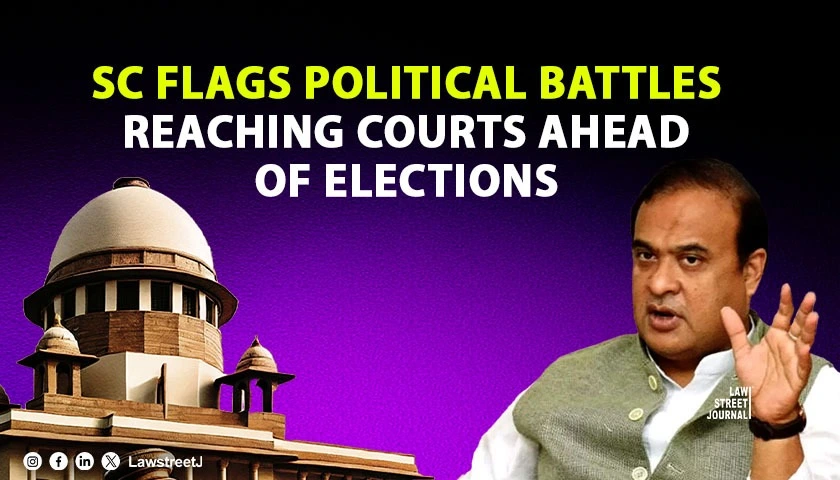
New Delhi: The Supreme Court of India recently observed that political disputes are increasingly being fought within its corridors, particularly as elections draw closer. The remark was made while the Court considered requests for urgent listing of petitions filed against Assam Chief Minister Himanta Biswa Sarma over alleged hate speech.
A Bench led by Chief Justice of India Surya Kant, along with Justices Joymalya Bagchi and N.V. Anjaria, noted that the Court often becomes a forum for such political confrontations during election periods. The Chief Justice stated that the Bench would examine the request for listing the matter.
The legal challenge has been initiated by Communist Party of India leader Annie Raja and the Communist Party of India (Marxist). The petitions focus on a public speech delivered by the Chief Minister and a video shared on the state unit’s social media account. According to the petitioners, the Chief Minister claimed that a large number of “Miyan” voters would be removed from electoral rolls and asserted that he and his party are directly opposed to “Miyas,” a term described in the plea as a derogatory reference to Muslims.
The petitions also point to a video depicting the Chief Minister firing a weapon at animated images of two Muslim men, arguing that the imagery contributes to an atmosphere of hostility and intimidation against a minority community.
Read More: “Why Not Assam ?”: Mamata Banerjee Challenges WB SIR, Supreme Court Issues Notice to ECI
Apart from the proceedings before the Supreme Court, multiple legal actions have been initiated elsewhere. A police complaint has been filed by peace activist Harsh Mander at a police station in New Delhi, seeking registration of an FIR under the Bharatiya Nyaya Sanhita. The complaint alleges that the Chief Minister’s remarks promote hatred and discrimination against Bengali-speaking Muslims.
In addition, a group of prominent citizens, including retired bureaucrats and academicians, has written to the Chief Justice of the Gauhati High Court urging the Court to take suo motu cognisance of the issue. The signatories contend that the Chief Minister’s statements amount to executive intimidation and public vilification, which they argue is incompatible with the constitutional oath of office.
The petitions further assert that the Chief Minister’s conduct attracts criminal liability under various provisions of the Bharatiya Nyaya Sanhita relating to communal hostility and social exclusion. Earlier, the submissions by Jamiat Ulama-i-Hind before the apex court highlighted a broader concern regarding the use of derogatory labels in public discourse, arguing that such language undermines public order and corrodes constitutional values.
However, responding to the allegations, Chief Minister Sarma has maintained that his use of the term “Miya” is not unconstitutional. He has argued that the term has appeared in earlier judicial observations on immigration from Bangladesh and was not coined by him. He further stated that the word has been used by members of the community themselves, including in cultural expressions such as “Miya poetry.”
Case Title:
Communist Party of India (Marxist) v. Union of India (Diary) and Annie Raja v. Union of India