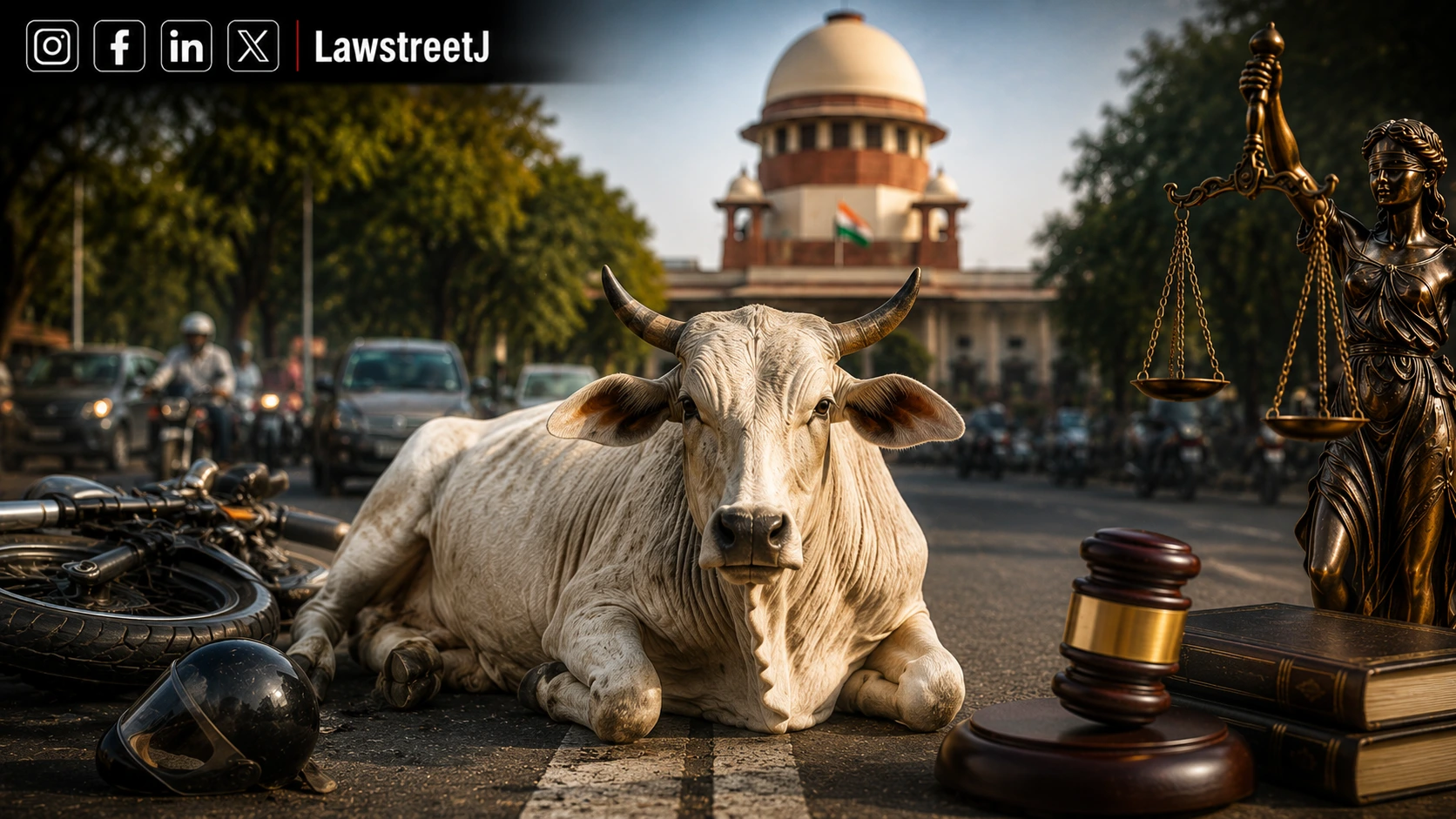
New Delhi: The Supreme Court on Friday expressed serious concern over the growing number of road accidents involving stray cattle and urged the Centre and State Governments to strengthen enforcement of existing laws while introducing a comprehensive mechanism to prevent such incidents and compensate victims.
A Bench of Justices Sanjay Karol and Nongmeikapam Kotiswar Singh was hearing an appeal filed by Nisha, widow of the deceased Vijay Kumar, against a Division Bench judgment of the Punjab and Haryana High Court, which had set aside a Single Judge's order granting her compensation of Rs. 29,32,000 with 6% interest per annum, on the ground that the writ petition involved 'disputed questions of fact' and was, therefore, not maintainable.
The case arose from an incident on 21st September 2007, when Vijay Kumar was struck by a stray bull while walking on the road, sustaining a head injury that rendered him unconscious. The incident was reported to the police and a DDR entry was recorded. During his lifetime, the deceased had unsuccessfully sought compensation from the Deputy Commissioner, Sangrur, whose office declined the claim on the ground that the Municipal Council 'does not receive any fund which can be given as compensation'. Following his death, his widow filed a writ petition before the High Court, and the Single Judge assessed compensation by applying the principles governing motor accident claims under the Motor Vehicles Act, 1988. The Division Bench, however, held that such disputed questions of fact could not be adjudicated under Article 226 jurisdiction and relegated the claimants to the civil court.
The Supreme Court found this approach unjust given that the writ petition had been filed in 2010 and the impugned judgment came only in November 2025 with a delay of over 15 years, after which relegating the claimants to a fresh civil suit would leave them, in effect, remediless. The Court further noted that the underlying facts, including the incident report, the DDR entry, and the unanswered legal notice sent by the deceased, were never disputed by the respondents.
"On that short ground alone, i.e., the efflux of time, the impugned judgment warrants interference and, in the interest of justice, adjudication on merits."
Going beyond the facts of the case, the Bench observed that incidents involving stray bovines causing injury or death to humans are 'not unique or unheard of' and called for the larger issue of accountability for such incidents to be addressed. The Court traced the constitutional basis for animal welfare to Article 48, which directs the State to organise agriculture and animal husbandry and to prevent the slaughter of cattle, and to Article 51-A(g), the fundamental duty of every citizen to have compassion for living creatures. It also referred to Entries 15 and 16 of the State List and Entry 17 of the Concurrent List of the Seventh Schedule, which empower legislation on cattle preservation and prevention of cruelty to animals, and to the Cattle Trespass Act, 1871, and the Prevention of Cruelty to Animals Act, 1960, as the principal statutes governing the field.
"...they are not meant to be natural speed breakers, placed willy-nilly on the National Highways, roads and streets."
The Court surveyed legislation across 24 States and Union Territories providing for gaushalas, cattle pounds, and welfare boards, and noted that while Punjab's municipal bye-laws of 2006 had established a compensation fund for victims of stray cattle, the fund's amount was not quantified until a 2023 notification fixed compensation at Rs. 5 lakhs for death and Rs. 2 lakhs for permanent incapacitation. Since the incident in this case predated that notification, and no other quantified mechanism applied, the Court held that the compensation principles applied by the Single Judge under the Motor Vehicles Act could not be treated as a rule of general application in such cases. Considering the prolonged pendency of the matter and the suffering endured by the deceased, the Bench awarded a lump sum of Rs. 15 lakhs, to be remitted within four weeks.
"This order has been passed in the attending facts and circumstances of the case and shall not be treated as a precedent."
The Court also issued a set of suggestions for the Centre and State Governments, including complete and immediate implementation of existing cattle-related legislation, framing of a mechanism for compensation in bovine-related accidents affecting both pedestrians and vehicles, mandatory tagging of animals to enable tracking and veterinary care, fixing responsibility on owners for the safe transfer of abandoned animals to authorised shelters, and the appointment of a nodal officer in every municipal corporation or department to oversee tagging, digitisation of records, and the running of shelters.
The Court directed that a copy of the judgment be sent to the Chief Secretaries of all States, the Administrators of all Union Territories, and the Member Secretary of the State Legal Services Authority for appropriate action.
Accordingly, the appeal was allowed and the compensation awarded to the appellant was restored in the modified sum, with no order as to costs.
Case Title: Nisha v. Municipal Council Sangrur & Ors., SLP(C) No. 4663 of 2026