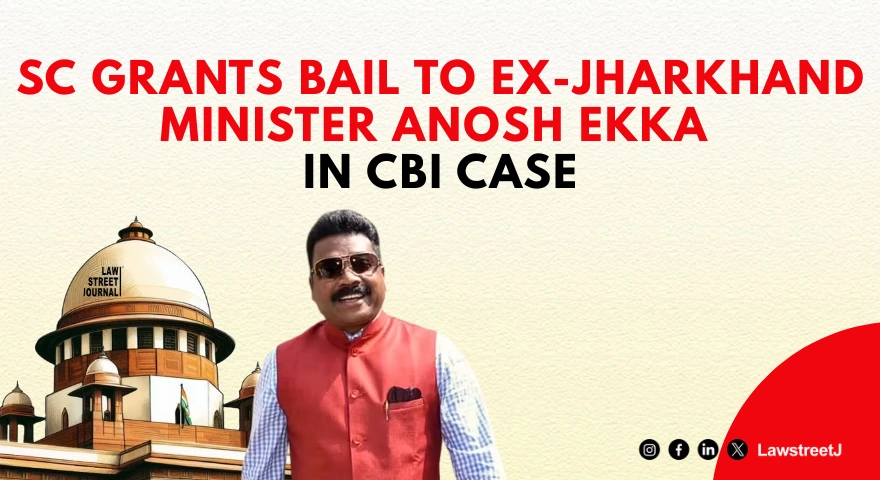
New Delhi: The Supreme Court of India on April 13, 2026, suspended the sentence of former Jharkhand Cabinet Minister Anosh Ekka and directed his release on bail during the pendency of his criminal appeal before the Jharkhand High Court, taking note that two separate prosecutions had been instituted by the Central Bureau of Investigation on substantially overlapping allegations arising from the same check period and the same set of transactions.
The appellant, a former Minister in the State of Jharkhand, was convicted by the trial court vide judgment dated 29.08.2025 in R.C. Case No. 04(A)/2010-AHD-R(C) for offences punishable under Section 120B read with Section 13(1)(d) of the Prevention of Corruption Act, 1988; Section 13(2) read with Section 13(1)(d) of the PC Act, 1988; and Section 120B read with Section 193 of the Indian Penal Code, 1860. By a separate order dated 30.08.2025, he was sentenced to undergo rigorous imprisonment of seven years each for the offences under the PC Act, 1988, along with a fine of Rs. 1,00,000/- each, and rigorous imprisonment of two years with a fine of Rs. 10,000/- for the IPC offence, with all sentences directed to run concurrently. His application for suspension of sentence and bail during the pendency of Criminal Appeal (SJ) No. 850 of 2025 was rejected by the Jharkhand High Court at Ranchi vide order dated 18.12.2025, leading to the present appeal by special leave.
The origin of the case traces back to an FIR registered as Vigilance Bureau P.S. Case No. 26 of 2008 on a complaint by one Kumar Binod, alleging that the appellant and another Minister had acquired assets disproportionate to their known sources of income. Pursuant to a High Court order in 2010, the investigation was transferred to the CBI. The agency alleged that, against a pre-check asset of Rs. 10,48,827/-, the appellant amassed assets worth approximately Rs. 57.01 crores, including large tracts of land around Ranchi and a palatial bungalow. The CBI further alleged that the appellant floated construction firms in his wife’s name, got them registered as Class-I contractors without fulfilling eligibility criteria, and had them awarded government contracts by departments under his direct control. It was also alleged that tribal lands protected under the Chota Nagpur Tenancy Act, 1908, were illegally acquired through false residential addresses and fabricated affidavits, in connivance with revenue officials.
The CBI submitted two separate chargesheets arising from the same FIR. The first chargesheet led to R.C. Case No. 04(A)/2010-AHD-R(B), in which the appellant was convicted and sentenced. This Court had suspended his sentence in that case and granted him bail vide order dated 28.04.2023 in SLP (Crl.) No. 5004 of 2023, after he had remained in custody for more than four years. The second, split chargesheet led to R.C. Case No. 04(A)/2010-AHD-R(C), which is the subject matter of the present proceedings.
Senior counsel appearing for the appellant argued that both prosecutions arose from the same check period, the same transactions, and the same alleged acquisition of disproportionate assets. He pointed out that the very properties listed in the earlier case, including properties at serial nos. 1 to 15 acquired in the name of the appellant’s wife, Mrs. Menon Ekka, were again made the subject matter of the split chargesheet. It was contended that this amounted to dual punishment for the same set of allegations, striking at the right against double jeopardy guaranteed under Article 20(3) of the Constitution of India. It was also urged that the appellant had already undergone more than ten months of custody in the present case; that the tribal lands had been confiscated by the Special Court under the PMLA vide order dated 21.03.2020; and that properties worth approximately Rs. 18 crores had been attached, with such attachment confirmed by the adjudicating authority.
The Additional Solicitor General, appearing for the CBI, opposed the grant of bail, submitting that the allegations were grave and involved serious misuse of public office. He, however, conceded, in response to queries from the Court, that assets worth nearly Rs. 18 crores had been attached and the attachment confirmed, and that the tribal land had been confiscated, though he noted that the State Government had not yet taken steps for cancellation of sale deeds and reversion of the land under the CNT Act.
The Bench, comprising Justices Vikram Nath and Sandeep Mehta, noted that both the chargesheets appeared to involve substantially overlapping allegations and that the question of whether two separate prosecutions were maintainable on such overlapping facts was a serious issue to be addressed by the High Court in the pending appeal. Without expressing any opinion on the merits, the Court observed that, since this Court had already suspended the sentence in the earlier case and the appellant had undergone more than ten months of custody in the present case as well, the same indulgence deserved to be extended.
The Court accordingly directed the appellant’s release on bail, subject to his filing an undertaking before the trial court within seven days of release that he shall assist in the process of restoration of the tribal land to its original status as and when required. The bail was further made subject to such other terms and conditions as the trial court may impose, upon furnishing bail bonds and sureties to its satisfaction. The impugned order of the High Court was set aside, and the appeal was allowed.
Case Title: Anosh Ekka v. State through Central Bureau of Investigation
Court: Supreme Court of India
Coram: Justice Vikram Nath and Justice Sandeep Mehta
Date of Order: April 13, 2026
Case Number: Criminal Appeal No(s). of 2026 (Arising out of SLP (Crl.) No(s). 891 of 2026)