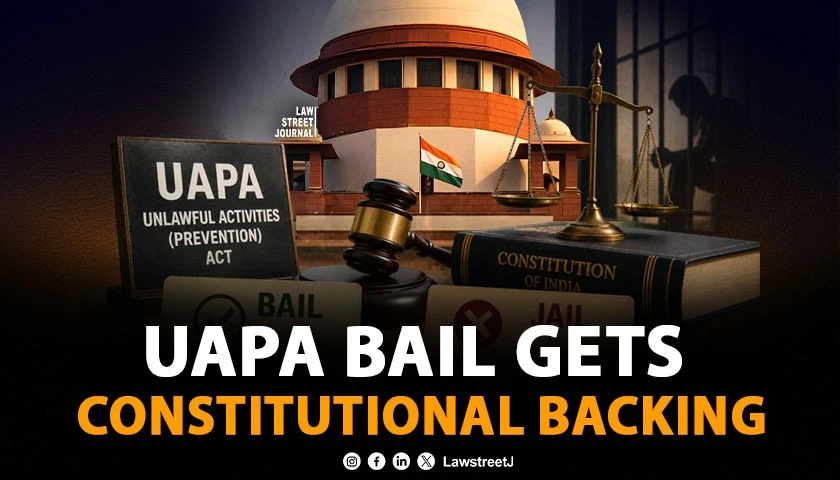
New Delhi: A Division Bench of the Supreme Court comprising Justice B.V. Nagarathna and Justice Ujjal Bhuyan has, while granting bail to one Syed Iftikhar Andrabi, who has been in custody for over five years and eleven months on charges under the Unlawful Activities (Prevention) Act, 1967 (UAPA) and the Narcotic Drugs and Psychotropic Substances Act, 1985 (NDPS Act), emphatically reaffirmed the binding authority of the three-Judge Bench decision in Union of India v. K.A. Najeeb, (2021) 3 SCC 713.
The Court simultaneously expressed serious reservations about the recent two-Judge Bench judgment in Gulfisha Fatima v. State (Govt. of NCT of Delhi), 2026 SCC Online SC 10, which had denied bail to two of the seven accused in the Delhi riots larger conspiracy case, holding that the judgment had impermissibly hollowed out the constitutional force of Najeeb without expressly disagreeing with it. The judgment, authored by Justice Bhuyan with inputs from Justice Nagarathna, was delivered on 18 May 2026 in Criminal Appeal No. of 2026, arising out of SLP (Crl.) No. 1090 of 2026 (2026 INSC 503).
The appellant was first taken into preventive detention on 07.08.2019 under the Jammu and Kashmir Public Safety Act, 1978, following the abrogation of Article 370, only to be released after the High Court quashed that detention. He was thereafter arrested on 11.06.2020 in connection with FIR No. 183/2020 registered at Handwara Police Station under the NDPS Act, based on allegations that heroin and cash were recovered from the bedroom of a co-accused at his disclosure. The case was subsequently taken over by the National Investigation Agency (NIA), which filed a chargesheet on 05.12.2020 arraying the appellant as accused No. 2, and further alleged that he had links with Pakistan-based Lashkar-e-Taiba (LeT) and Hizbul Mujahideen operatives, had visited Pakistan in 2016 and 2017, and had been involved in narco-terrorism by raising funds for proscribed terrorist organisations through drug proceeds. Charges were eventually framed by the Special NIA Court on 15.11.2023, after a two-year delay attributed by the trial court’s own orders to the prosecution’s failure to produce its Chief Investigating Officer. Both the Special NIA Court and the High Court of Jammu and Kashmir and Ladakh at Jammu dismissed the bail application and the appeal therefrom.
Before the Supreme Court, the appellant was represented by Mr. Shadan Farasat, Senior Counsel, who urged that the appellant had undergone over five years and nine months of incarceration, that more than 350 prosecution witnesses remained to be examined, rendering early conclusion of the trial well-nigh impossible, and that the delay was attributable almost entirely to the prosecution. Reliance was placed on the judgment in Najeeb for the proposition that the rigours of Section 43-D(5) of the UAPA would melt down when prolonged incarceration and delayed trial made continued detention constitutionally impermissible. It was also argued that bail having been granted to four co-accused, parity demanded the same relief for the appellant. The allegation of narco-terrorism, it was submitted, could not survive independently of the NDPS charges, and the entire prosecution case rested on a disclosure statement and inadmissible police confessions, with no recovery from the person, residence, or place of work of the appellant himself.
The respondent NIA, represented by Mr. S.D. Sanjay, Additional Solicitor General, resisted bail on the ground that the charges were extremely serious, that the trial was progressing with 38 witnesses already examined, and that any delay was attributable to the appellant. He offered to complete the trial within one year.
The Court, surveying the statutory provisions under the UAPA and the NDPS Act and the case law culminating in Najeeb, devoted a substantial portion of the judgment to addressing what it described as the progressive hollowing out of Najeeb by smaller benches. The Court noted that Najeeb, a three-Judge Bench judgment, had declared an authoritative constitutional limitation on Section 43-D(5) of the UAPA: that statutory restrictions would melt down where there is no likelihood of the trial being completed within a reasonable time and the period of incarceration has already exceeded a substantial part of the prescribed sentence. This, the Court held, was not an equitable exception crafted for peculiar facts but a binding declaration of law that Section 43-D(5) remains subordinate to Article 21 at all times.
The Court then examined the two-Judge Bench judgment in Gurwinder Singh v. State of Punjab, (2024) 5 SCC 403, and the recent Gulfisha Fatima judgment, finding both to have departed from the ratio in Najeeb without referring the matter to a larger bench, which judicial discipline required them to do. In Gurwinder Singh, the two-Judge Bench had distinguished Najeeb on facts and formulated a so-called twin-prong test, holding that Section 43-D(5) created a standalone rigorous limitation under which bail must be rejected as a rule, and that only if the prima facie threshold was answered in the accused’s favour could ordinary bail considerations arise.
The Court in the present judgment held that this test flowed neither from the text of Section 43-D(5) nor from Najeeb, and in fact ran directly contrary to Najeeb’s caution that Section 43-D(5) must not become the sole metric for denial of bail or for wholesale breach of the constitutional right to a speedy trial. The earlier reading of Watali, i.e., NIA v. Zahoor Ahmad Shah Watali, (2019) 5 SCC 1, as establishing a general rule of near-automatic denial of bail, was also found difficult to sustain in light of Najeeb’s own careful confinement of Watali to its peculiar context.
On Gulfisha Fatima, the Court expressed serious reservations, stating that the judgment would have the effect of treating Najeeb as only a narrow and exceptional departure from Section 43-D(5), justified in extreme factual situations. The Court found that Gulfisha Fatima, in addressing a proposition that Najeeb never advanced, had effectively reasoned against something invented and then destroyed. Najeeb, the Court clarified, had never warned against treating incarceration as the sole factor favouring bail; it had instead warned against treating the statutory embargo as the sole factor justifying continued detention by ignoring constitutional principles. The Court also noted that the foreclosure in Gulfisha Fatima of the two denied appellants’ right to seek bail for a period of one year raised additional concerns, particularly in light of the Constitution Bench judgment in High Court Bar Association, Allahabad v. State of Uttar Pradesh, (2024) 6 SCC 267, which had cautioned constitutional courts against fixing time-bound schedules for trial disposal, as doing so put undue pressure on trial courts already burdened with large pendency.
The Court proceeded to apply the ratio of Najeeb to the facts and granted bail, recording the following reasons: there was no recovery from the person, residence, or workplace of the appellant; all inculpatory material rested on statements made before the police which were prima facie hit by Section 25 of the Indian Evidence Act, 1872, which bars admission of confessions made to a police officer; the approver’s deposition had yielded nothing incriminating against the appellant; no prior antecedents connected to narcotics or terrorism had been placed on record; the appellant had honoured an earlier interim bail on medical grounds and surrendered on the appointed date; more than 350 prosecution witnesses remained to be examined and conclusion of the trial in the near future was impossible; and four co-accused facing similar allegations had already been granted bail by this Court and the High Court, including one who had spent five years and one month in custody.
The Court also noted, significantly, that the conviction rate under the UAPA in India between 2019 and 2023 hovered between two and six per cent nationally, while in Jammu and Kashmir it was less than one per cent annually, meaning that in over ninety-nine per cent of UAPA cases in Jammu and Kashmir, the accused were ultimately acquitted.
Emphasising that bail is the rule and jail is the exception as a constitutional principle flowing from Articles 21 and 22 and the presumption of innocence, and not merely a statutory slogan under the Code of Criminal Procedure, the Court directed the appellant to be produced before the Special NIA Court within seven days for fixation of bail conditions. Additional conditions imposed included surrender of passport and fortnightly reporting to Handwara Police Station. The Court also made clear that Najeeb is binding law entitled to the protection of stare decisis and cannot be diluted, circumvented, or disregarded by trial courts, High Courts, or Benches of lesser strength of the Supreme Court. Where a smaller bench doubts the ratio of a larger bench, the only permissible course is a reference to the Chief Justice for constitution of a still larger bench.
Case Title: Syed Iftikhar Andrabi v. National Investigation Agency, Jammu
Court: Supreme Court of India
Bench: Justice B.V. Nagarathna and Justice Ujjal Bhuyan
Case No.: Criminal Appeal No. of 2026 [arising out of SLP (Crl.) No. 1090 of 2026]
Citation: 2026 INSC 503
Date of Judgment: 18 May 2026