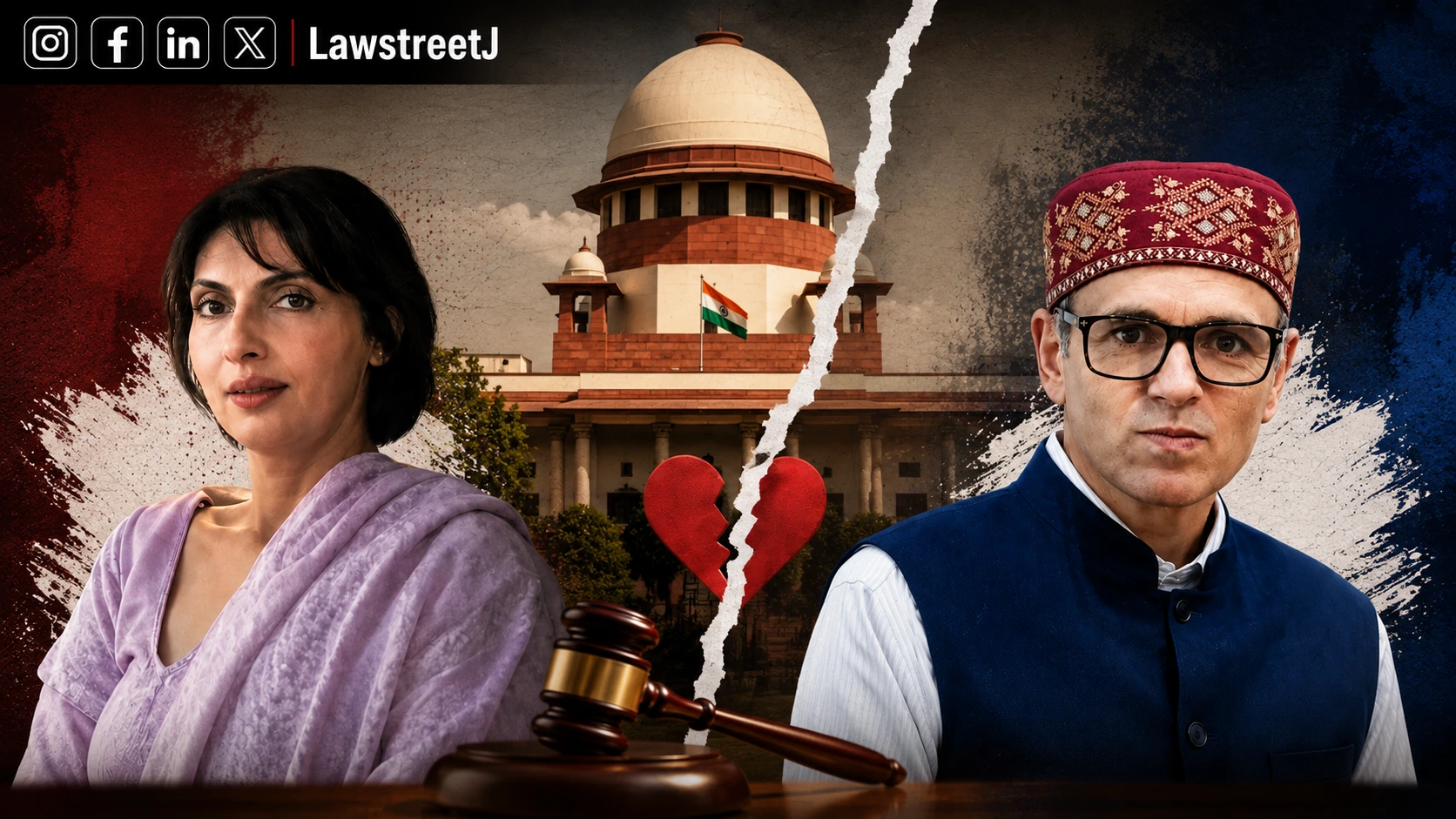
New Delhi: The Supreme Court of India on Friday officially brought a conclusion to the long-standing matrimonial dispute between Jammu and Kashmir Chief Minister Omar Abdullah and his estranged wife, Payal Abdullah.
A bench comprising Justice P.S. Narasimha and Justice Alok Aradhe granted the divorce after being informed that the parties had reached a comprehensive settlement through a court-mandated mediation process.
During the proceedings, Senior Advocate Kapil Sibal, representing the Chief Minister, informed the bench that the couple had resolved all their disputes and jointly sought the dissolution of their marriage. Sibal stated to the court that the parties have "embraced freedom" and requested the bench to grant the decree of divorce, noting that all other pending legal matters between the two would be withdrawn.
Recording the submissions, Justice Narasimha observed that the court would dispose of the proceedings in terms of the settlement reached between the parties. The court was further informed that a joint application under Article 142 of the Constitution had been filed on July 22, 2026, seeking a divorce by mutual consent.
This final judicial intervention marks the end of a marital relationship that began on September 1, 1994, when the couple was married under civil law. The marriage resulted in two sons, Zahir and Zamir. However, the couple has lived separately since 2009, leading to over fifteen years of physical separation prior to this final decree.
The legal journey toward this dissolution was protracted and traversed multiple judicial forums. Omar Abdullah initially approached the Family Court in 2016 seeking divorce on the grounds of cruelty and desertion. However, the Patiala House Court dismissed the petition on August 30, 2016, ruling that he had failed to substantiate his claims or prove an irretrievable breakdown of the marriage.
Following the Family Court’s decision, the Chief Minister moved the Delhi High Court in a further attempt to secure a legal separation. In December 2023, a division bench of the High Court upheld the lower court's dismissal, asserting that the allegations of cruelty were vague and that no acts of mental or physical cruelty had been established.
Parallel to the divorce litigation, the parties were involved in separate proceedings regarding maintenance and educational expenses. In August 2023, the Delhi High Court had increased the monthly interim maintenance payable by Omar Abdullah to Payal Abdullah to Rs 1.5 lakh. Additionally, the court had directed him to pay Rs 60,000 per month for the education of each son while they were enrolled in law school.
The trajectory of the case changed when the matter reached the Supreme Court via a Special Leave Petition challenging the High Court's refusal to grant a divorce. Recognizing the state of the marriage and the length of the separation, the apex court referred the dispute to its mediation centre in August 2024 to explore the possibility of a negotiated settlement.
The final decree was passed by invoking Article 142 of the Constitution of India, which empowers the Supreme Court with broad inherent powers to pass orders necessary to secure "complete justice" in any cause or matter pending before it. This extraordinary power is frequently invoked by the apex court to dissolve marriages that are considered "dead" or irretrievably broken down, even when statutory grounds are not fully met in lower courts.
The settlement brings an end to several years of litigation and ensures a clean break for both individuals. As part of the mediated agreement, both parties have agreed to withdraw all criminal and civil cases filed against each other. The Supreme Court expressed satisfaction with the resolution, stating that the terms of the settlement would be recorded as part of the final order.
Case title: Omar Abdullah v. Payal Abdullah (SLP(C) No. 7427/2024)