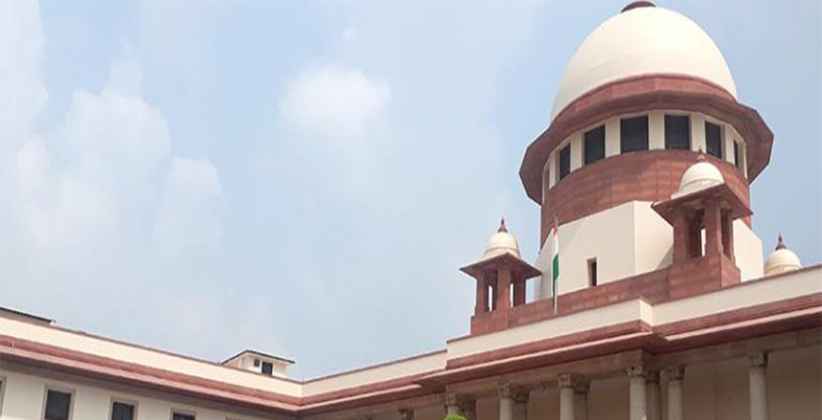
New Delhi: The Supreme Court has granted interim custody of a four-year-old boy to his unmarried mother, a German citizen working in Singapore, and permitted her to take him there, subject to a mirror order from a Singapore court, a deposit of Rs 1 crore and a detailed parenting plan.
Invoking its parens patriae jurisdiction in a habeas corpus matter, the Court held that the mother has a better prima facie claim, that the balance of convenience favours her, and that the child may suffer irreparable injury if custody is not given to her.
A Bench of Justice Nongmeikapam Kotiswar Singh and Justice N.V. Anjaria was hearing an appeal arising from SLP (Crl.) No. 11625 of 2026, against the pendency of a habeas corpuspetition before the Goa Bench of the Bombay High Court. The mother had filed it in February 2026 after she was denied access to the child. The father, an Indian citizen and a lawyer based in New Delhi, had meanwhile started guardianship proceedings, which are now pending before the Family Court, Patiala House Courts, New Delhi, as Guardianship Petition No. 37 of 2026, after transfer from Alipore, West Bengal, with the consent of both parents.
The parents, who are not married, began a relationship in 2019, and the child was born in New Delhi in July 2022. The family lived largely in Delhi and Goa. The relationship broke down, and between February and June 2026 the mother alleged that the father moved the child between Kolkata, Bangalore and Mysore, and cut off her communication with the child for over six weeks. The parents and the child were assessed at NIMHANS, Bengaluru, and its report was received on 21.09.2026.
Senior Advocate Ms. Geetha Luthra, for the mother, relied on Section 6 of the Hindu Minority and Guardianship Act, 1956, the tender years doctrine and ABC v. State (NCT of Delhi), (2015) 10 SCC 1, to argue that an unwed mother is the natural guardian. Senior Advocate Mr. Gopal Sankaranarayanan, for the father, argued that the Court’s jurisdiction was invoked fraudulently, that the habeas petition was infructuous, that the 1956 Act does not apply as the parents are not Hindus, and that moving the child to Singapore would dislocate him.
The Court held that the later guardianship petition could not render the habeas petition infructuous, and that it has jurisdiction to decide interim custody in this proceeding. On the prima facie case, it noted that under the Guardians and Wards Act, 1890, no provision disables the mother of a child of tender age, and that across jurisdictions, “in the case of a child born to unwed parents, the mother has a better prima facie claim of custody”. This does not exclude the father’s claim, which can be established before the proper forum.
The NIMHANS report found no psychiatric disorder in either parent and equal capacity and commitment to the child, but it recorded a high-conflict relationship between them as the main concern. It also showed a strong bond between mother and child, who speaks English and German. The Court held that a child of four is at a “malleable stage”, that his roots in any one Indian city are not established as he has moved between Delhi, Goa and Kolkata, and that the father’s apprehension of uprooting was “an overstatement”. It found the mother’s plan for his schooling in Singapore, with Hindi-speaking childcare and visits to India, to be the more concrete one.
Addressing the father’s fear that the mother may not cooperate with Indian courts once abroad, the Court relied on Smriti Madan Kansagra v. Perry Kansagra, (2021) 12 SCC 289, on mirror orders, and the mother’s undertaking to submit to the Singapore courts. It noted that Singapore has a “robust and efficacious” judicial system. The Court directed:
“The mother shall obtain a mirror order within a period of 3 weeks from the date of this order from an appropriate court in Singapore to reflect the directions in this order.”
Until the mirror order is filed, the child stays in Delhi under a weekly alternating custody schedule. After it is filed, the mother must deposit Rs 1 crore in an interest-bearing fixed deposit in the Registry for two years or until final disposal of the guardianship petition, and the passport and OCI card will be returned to her. The mother must enrol the child at UWCSEA or a back-up school, and the father must cooperate or be deemed to have consented. The father gets daily video access of at least 20 minutes, weekend custody when he visits Singapore, and custody in India during school vacations longer than seven days, when the mother must bring the child. The mother must obtain a child psychologist’s report every six months to ensure no parental alienation, and both parents must file undertakings within a week.
The Court, invoking Article 142, transferred the habeas corpus petition to itself and listed the matter on 07.12.2026. It clarified that the order does not influence the Family Court, which will finally decide the guardianship petition uninfluenced by its observations.
Appearances:
For the Mother: Ms. Geetha Luthra, Senior Advocate.
For the Father: Mr. Gopal Sankaranarayanan, Senior Advocate.
Assisting the Court: Ms. Aishwarya Bhati, Additional Solicitor General.
Case Title: XXX vs. State of Goa & Anr., Criminal Appeal arising out of SLP (Crl.) No. 11625 of 2026, 2026 INSC 1248