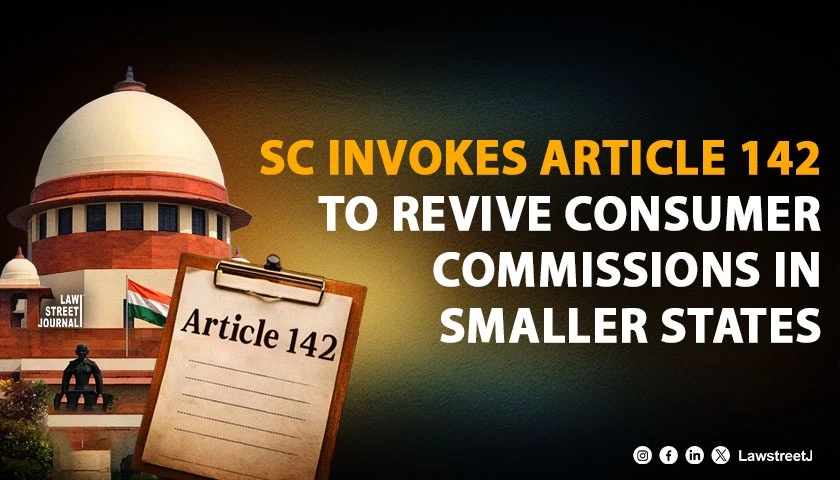
New Delhi: The Supreme Court has invoked its extraordinary powers under Article 142 of the Constitution to ensure that consumer grievances in smaller States and Union Territories are not left without remedy due to the non-functioning of State Consumer Disputes Redressal Commissions.
In a significant intervention on February 11, 2026, a Bench comprising the Chief Justice and Justice Joymalya Bagchi directed that High Court judges in several States and UTs will now adjudicate pending consumer complaints and appeals, effectively functioning as deemed Chairpersons of State Consumer Commissions.
The Court’s decision came after it emerged that several States were finding it financially unviable to constitute full-fledged State Consumer Commissions due to extremely low case pendency. The Bench noted that while implementing its earlier interim directions dated May 19, 2025, States had raised concerns about the disproportionate financial burden of maintaining Consumer Commissions for handling a limited number of cases.
The Court examined the ground reality across various smaller States and Union Territories. In Arunachal Pradesh, only 59 cases are pending across all consumer forums. Sikkim has 52 complaints at the District Commission level and merely 12 at the State Commission. Tripura reported 316 complaints across four District Commissions and 46 at the State level. Mizoram has 82 District-level complaints and 12 State-level matters, while Manipur has 123 and 43, respectively. The Union Territory of Lakshadweep has fewer than 10 pending cases, while the Andaman and Nicobar Islands reported 37 District-level and four State-level matters. Goa has 39 pending complaints and appeals before its State Commission.
The Bench observed that most of these States either lack a President of the State Commission with the mandatory qualification of being a sitting or former High Court judge, or have not established Commissions at all due to insufficient caseload. However, the pending complaints and appeals cannot be allowed to become infructuous, leaving consumers without legal recourse.
Under the directions issued by the Court, State Governments and UT Administrations must transfer all pending consumer complaint records to the Registrar General of their jurisdictional High Courts within two weeks. The Chief Justices of these High Courts have been requested to assign these matters to a Single Judge, who will be deemed the Chairperson of the State Commission for adjudication purposes. These judges will work alongside existing Technical Members to decide the cases, preferably within three months.
The Court has also addressed the appellate mechanism. If any party challenges an order passed by such a deemed State Commission, the President of the National Consumer Disputes Redressal Commission has been requested to personally hear such appeals, given that they would have been decided by a sitting High Court judge.
Several State counsels had pointed out the practical difficulties in implementing the Court’s earlier May 2025 directions. They argued that constituting full-time State and District Commissions for handling minimal caseloads was placing an extreme financial burden on State treasuries and could adversely impact the very existence of these bodies. Multiple States have filed interlocutory applications seeking modification of those directions, which the Court has scheduled for hearing on February 26, 2026.
The Bench emphasized that wherever Consumer Commissions are constituted, States and UTs must ensure strict compliance with relevant rules, particularly the mandatory inclusion of a woman member. States and UTs with fewer than 1,000 pending consumer complaints have been given liberty to propose alternative mechanisms for providing effective consumer grievance redressal.
Recognizing the complexity of the issues involved, the Court has sought the assistance of the Solicitor General of India. The Registry has been directed to provide the Solicitor General’s office with a copy of the May 19, 2025 order, particularly concerning the Model Rules circulated by the Central Government under Section 102(1) of the Consumer Protection Act, 2019.
The matter will be heard next on February 26, 2026, when the Court will consider various applications seeking modification of its earlier directions while examining the broader issue of ensuring effective consumer protection infrastructure across the country.
Appearances:
For the Petitioner: Mr. Gopal Sankaranarayanan, Senior Advocate (Amicus Curiae); Mr. Aditya Narain, Senior Advocate (Amicus Curiae)
For the Respondents: Mr. Gagan Gupta, Senior Advocate; Mr. Maninderjit Singh Bedi, Advocate General; Mr. Basava Prabhu S. Patil, Advocate General (Senior Advocate); Mr. Lokesh Sinhal, Senior Additional Advocate General; Ms. Kiran Suri, Senior Advocate; Mr. Biswajit Deb, Senior Advocate; Dr. Joseph Aristotle S., Senior Advocate; Mr. Ajay Tewari, Senior Advocate; Mr. Tushar Mehta, Solicitor General; Mr. K.M. Nataraj, Additional Solicitor General; Ms. Aishwarya Bhati, Additional Solicitor General
Case Title: In Re: Pay and Allowance of the Members of the U.P. State Consumer Disputes Redressal Commission



.jpeg)