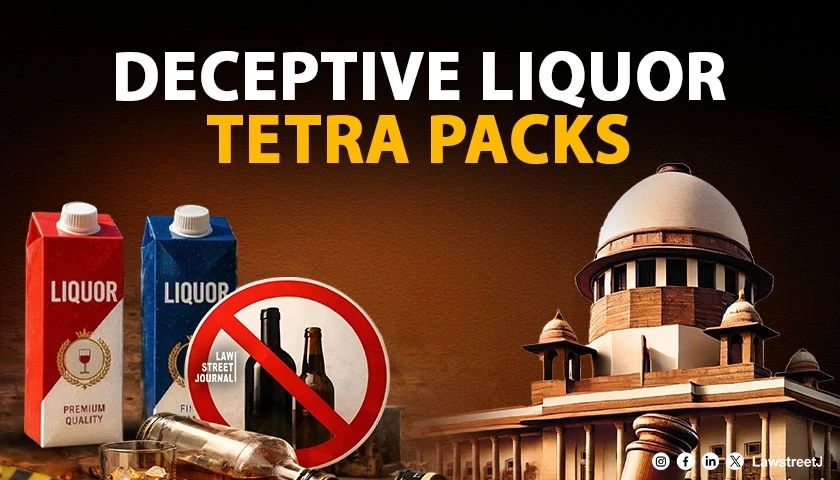
New Delhi: The Supreme Court of India on Wednesday took serious note of the increasing prevalence of alcoholic beverages being sold in packaging that closely resembles fruit juice cartons, and issued notices to the Central Government and various State excise departments.
A three-judge bench comprising Chief Justice of India Surya Kant and Justices Joymalya Bagchi and Vipul M. Pancholi was hearing a Public Interest Litigation (PIL) seeking an immediate nationwide ban on the sale of liquor in “inconspicuous” packaging such as tetra packs, sachets, and other portable containers.
The petition, filed by the organisation ‘Community Against Drunken Driving’ (CADD), contends that current packaging trends in the liquor industry are intentionally misleading and pose a grave risk to public health and safety. During the proceedings, Chief Justice Surya Kant described such packaging as “very deceptive,” reflecting the Court’s growing concern over the manner in which these products are marketed to the public. The bench agreed to examine the issue in depth, recognising the potential of such containers to facilitate unauthorised consumption.
Advocate Vipin Nair, appearing for the petitioner, presented several examples of alcoholic products currently available in the market that use vibrant colours and fruit imagery to disguise their contents. He referred to labels such as “Bunty Premium Vodka,” “Chelli Mango Vodka,” and “Premium Romanov Vodka – Apple Thrill,” noting that the packaging prominently features images of apples and mangoes. Nair argued that this is a deliberate marketing strategy aimed at passing off alcoholic beverages as fruit juices, thereby evading scrutiny from authorities and parents while targeting younger, often underage, consumers.
A primary contention raised in the PIL concerns the absence of standardised health warnings on these tetra packs and sachets. Unlike tobacco products, which are mandated to carry large and unmistakable warnings, the petitioner argued that these liquor cartons either lack warnings entirely or conceal them in fine print barely visible to the average consumer. According to the petition, this lack of transparency violates the State’s constitutional obligation to protect public health and discourage dangerous behaviour such as drunk driving.
The legal challenge also targets the “vague” definitions of “bottle” and “bottling” contained in various state excise laws. The petition points out that several state statutes permit alcohol to be packaged in a broad range of receptacles described as “flasks,” “pots,” “baskets,” or “wrappers.” According to the petitioner, this wide discretion granted to state excise authorities has resulted in a lack of uniformity across the country. The plea therefore seeks a harmonised national policy restricting liquor packaging to glass bottles or other visibly distinct and traditional containers.
Beyond the visual deception, the plea also highlighted the practical risks associated with portable and easily concealable liquor packaging. Since these tetra packs and sachets are lightweight and unbreakable, they can easily be carried into public spaces where alcohol consumption is prohibited, including parks, cinema halls, and educational institutions. The petitioner expressed particular concern over the possibility of school-going children gaining easy access to such products, as the packaging can easily be mistaken for a regular lunchbox drink and go unnoticed by teachers or parents.
Environmental and security concerns were also raised before the Court. The petition argued that the lightweight nature of these packs facilitates the smuggling of alcohol across state borders, as they are easier to conceal and transport than traditional glass bottles. It further contended that the increasing use of such materials ignores environmental risks and encourages public consumption in moving vehicles, directly contributing to incidents of drunk driving on national and state highways.
The Supreme Court’s present intervention follows earlier judicial concern over the issue. In November 2025, during a trademark dispute between liquor manufacturers involving the brands ‘Officer’s Choice’ and ‘Original Choice,’ the bench had criticised state governments for prioritising revenue generation over public health. On that occasion, the Court was shown physical samples of whiskey sold in tetra packs, prompting Chief Justice Surya Kant to remark, “What is this? Juice?” while noting how easily such products could be carried into schools.
Although the Court had recently declined to entertain a similar PIL concerning the state of Uttar Pradesh, it had permitted the petitioner in that matter to submit a representation before the relevant state authorities. The present petition, however, seeks a broader and uniform national policy to curb the proliferation of these “dangerous” packaging formats.
The petitioner, CADD, which has campaigned against drunk driving and underage drinking since 2001, further argued that the lower production costs of tetra packs make alcohol cheaper and more accessible to commercial vehicle drivers and juveniles, thereby exacerbating social risks.
By issuing notices to the Union Government and the excise departments of all states, the Supreme Court has indicated its intention to scrutinise the extent of discretion exercised by state authorities in permitting varied liquor packaging formats. The Court has sought comprehensive responses to the plea, which seeks to prioritise public safety over the commercial interests of the liquor industry and the revenue objectives of state governments.
Case Title: COMMUNITY AGAINST DRUNKEN DRIVING Vs THE UNION OF INDIA | W.P.(C) No. 475/2026