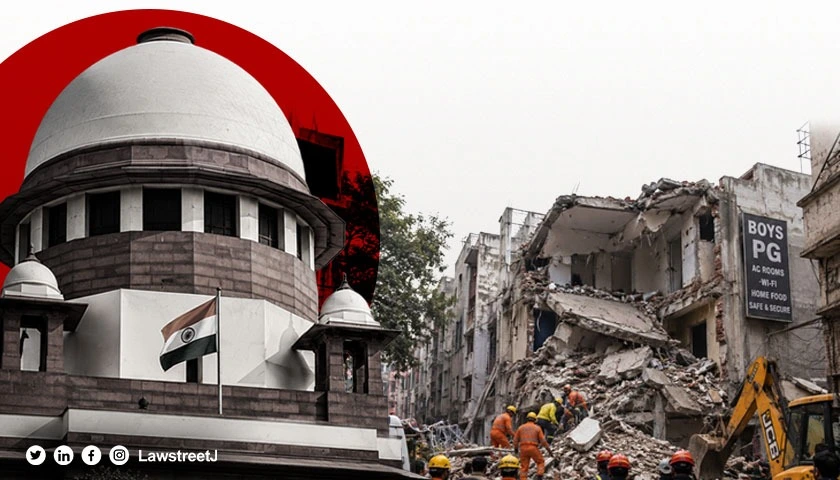
New Delhi: The Supreme Court of India on Thursday declined to transfer the Satya Niketan building collapse proceedings from the Delhi High Court to itself, observing that administrative and judicial action has already commenced before the High Court.
A division bench comprising Justice Ahsanuddin Amanullah and Justice R. Mahadevan directed the Delhi High Court to continue monitoring the matter at short intervals, while the apex court retained broader supervisory jurisdiction over city-wide illegal construction and the unauthorized commercial conversion of residential properties.
The proceedings stem from the tragic collapse of a five-storey paying guest (PG) accommodation in South Delhi’s Satya Niketan area on September 6, which resulted in seven fatalities and left twelve others injured. The building, located near Delhi University's South Campus, was reportedly being operated as a student hostel despite structural alterations, including the suspected removal of a ground-floor wall to accommodate a commercial shop. Following the incident, law enforcement authorities arrested the property owner, her husband, and their son, while the Municipal Corporation of Delhi (MCD) suspended five officials and initiated widespread inspections of student housing facilities.
During the hearing, Senior Advocate Ajit Kumar Sinha, serving as Amicus Curiae, submitted a status report highlighting two interconnected issues arising from the tragedy: rampant building bye-law violations and the systemic misuse of residential land. Sinha informed the court that residential premises across Delhi and neighboring regions were being illegally converted into PG accommodations, coaching centres, gyms, and BPOs without requisite structural stability certificates, fire safety compliances, or proper entry and exit points. He urged the bench to maintain continuous judicial oversight, warning that enforcement momentum might falter if monitoring ceased.
Addressing the severity of overcrowding in residential facilities, the bench expressed grave concern over safety risks and public nuisance. Justice Amanullah remarked that occupants are often "packed like sardines, hundreds in one room" without basic ingress and egress. The court further observed that commercial exploitation of residential zones severely disrupts community living, leaving children unable to play and residents unable to walk freely. Consequently, the bench specified that its primary focus would center on strictly enforcing permissible land-use norms and curbing non-conforming commercial activities in designated residential areas.
Appearing for the Delhi Government, Solicitor General Tushar Mehta, along with Senior Advocate Sanjeev Sen for the MCD, requested the apex court to permit the Delhi High Court to handle the localized enforcement. They submitted that civic authorities have stepped up targeted drives, conducting safety surveys of over 1,200 PG structures and executing demolitions of unauthorized constructions exceeding four storeys. Accepting the joint suggestions of the Amicus Curiae and law officers, the apex court decided against tagging the High Court proceedings, choosing instead to let parallel monitoring proceed.
The Supreme Court directed the MCD and the Delhi Government to file fresh compliance affidavits and status reports detailing city-wide measures taken against unauthorized structures and land misuse.
The authorities have been mandated to submit these comprehensive reports prior to the next scheduled hearing on September 15, 2026.
Case title: Loganathan v. The State of Tamil Nadu and Ors.