New Delhi: The Supreme Court of India has issued a landmark directive aimed at fundamentally overhauling public transport safety across the nation.
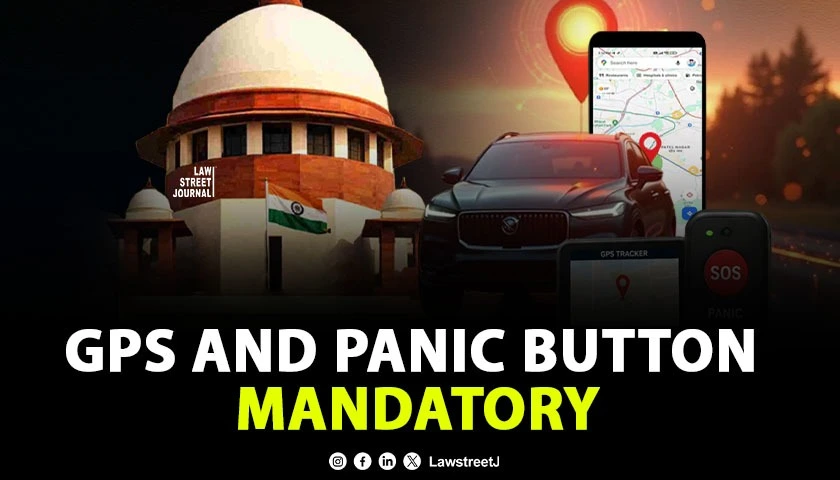
On Wednesday, May 13, 2026, a Bench comprising Justices JB Pardiwala and KV Viswanathan ordered that all States and Union Territories must strictly enforce the installation of vehicle location tracking devices (VLTDs) and emergency panic buttons in taxis, buses, and other public service vehicles.
This order establishes a direct link between vehicle safety technology and the legal right to operate. The Court made it clear that no public service vehicle can be granted a fitness certificate under Section 56 or a transport permit under Section 66 of the Motor Vehicles Act, 1988, unless it is fitted with these mandatory safety features.
A critical component of this mandate is the digital verification of compliance. The Bench directed that the installation and functionality of these tracking devices must be reflected in the Vahan application, which serves as the national database for vehicle registration. This integration is intended to ensure real-time monitoring and prevent the issuance of permits to non-compliant operators.
The Court also expressed deep frustration over the current state of safety compliance in the transport sector. During the proceedings, it was observed that less than one per cent of transport vehicles are currently equipped with vehicle location tracking systems. The Bench described this widespread non-compliance with existing rules as “disturbing” and “alarming,” especially given that these safety provisions have been part of the statutory framework for several years.
The legal basis for this enforcement lies in Rule 125H of the Central Motor Vehicles Rules, 1989. This rule mandates the installation of VLTDs and emergency buttons to provide live tracking and facilitate timely responses during emergencies. The Court underscored that such features are vital for the protection of vulnerable passengers, specifically women, children, and senior citizens.
In a move to address older vehicles, the Court further directed States and Union Territories to ensure the retrofitting of these devices in public service vehicles registered up to December 21, 2018. This ensures that the safety mandate is not limited to new vehicles but covers the vast majority of public transport currently in operation.
The Court also endorsed a forward-looking suggestion that these safety devices should be pre-installed by manufacturers before the sale of new vehicles. To explore the feasibility of this systemic change, the Bench directed the Central Government to hold consultations with automobile manufacturers across India. A report on these discussions must be submitted to the Court to determine whether liability for safety technology can be shifted to the manufacturing stage.
During the hearing, Amicus Curiae Gaurav Agarwal explained the operational mechanism of these systems. The VLTD uses Global Positioning System (GPS) technology to constantly transmit a vehicle’s location to a Central Command and Control Centre. In case of an emergency, such as medical distress or a security threat, the panic button sends an instant alert to police control rooms, allowing authorities to pinpoint the vehicle’s exact location.
The judicial intervention comes against a backdrop of high road accident fatalities in India. Data provided to Parliament indicated that in 2023 alone, there were over 480,583 road crashes resulting in 172,890 deaths. The Court noted that overspeeding remains a major cause of these accidents, yet only a small fraction of the 21.8 million transport vehicles in the country are fitted with mandatory speed-limiting devices.
Beyond tracking technology, the Bench raised concerns about the lack of lane discipline on Indian roads. Justice Pardiwala observed that there is effectively “no concept of lane driving in India,” which contributes significantly to accidents. The Court urged the government to focus on inculcating lane discipline as a low-cost measure to reduce fatalities.
The Court also took a stern view of the delay in establishing the National Road Safety Board. The Bench granted a “last opportunity” of three months for the formation of this board, which is intended to standardize safety policies and coordinate enforcement efforts nationwide.
The Court also criticized States for failing to submit status reports regarding the installation of speed governors, as required under Rule 118 of the Central Motor Vehicles Rules. The Court directed all States and Union Territories to file fresh affidavits providing updated statistics from the Vahan and Parivahan portals by the next hearing date.
Transport associations in States like Karnataka have previously questioned the pricing of government-empanelled vendors and the lack of functional emergency control centres to respond to panic button alerts. Operators have expressed concerns about the cost of installing multiple buttons in buses and the need for standardized operating procedures for police response.
In response to these implementation gaps, the Supreme Court’s latest order seeks to create a “verifiable and time-bound” mechanism for compliance. By linking the grant of permits and fitness certificates to digital records on the Vahan app, the Court aims to ensure that transport authorities at the regional level cannot bypass these safety requirements.
The proceedings are part of a long-standing Public Interest Litigation filed in 2012 by S Rajaseekaran, an orthopaedic surgeon concerned about the high number of road accident victims. Over more than a decade, the case has evolved into a comprehensive monitoring mechanism for nationwide road safety reforms.
The Court has posted the matter for further consideration in September. By that time, the Central Government and various States are expected to show substantial progress in enforcing these safety mandates and integrating compliance data into the national tracking infrastructure.
Case title: S Rajaseekaran vs. Union of India and Others.