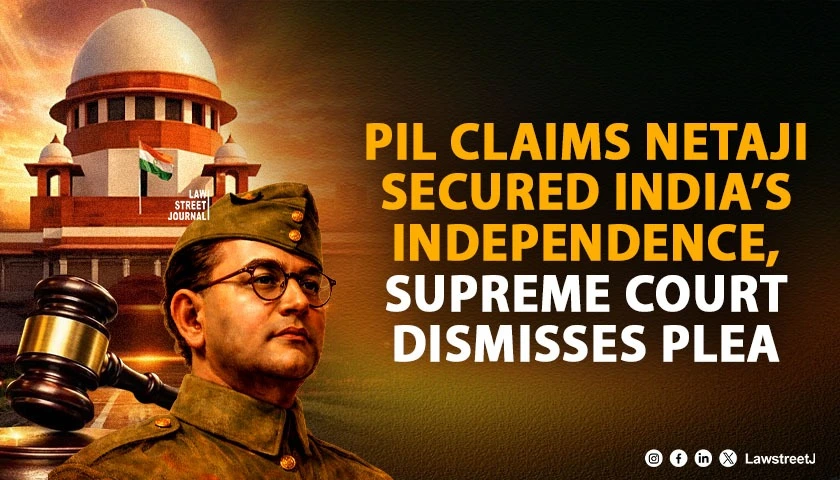
New Delhi: On April 20, 2026, the Supreme Court of India dismissed a Public Interest Litigation (PIL) that sought a judicial declaration crediting Netaji Subhas Chandra Bose and the Indian National Army (INA) with securing India’s independence from British rule.
The bench, comprising Chief Justice of India Surya Kant and Justice Joymalya Bagchi, expressed strong disapproval of the petition and the conduct of the petitioner, Pinakpani Mohanty. During the proceedings, the Court characterized the petitioner as “incorrigible” and warned that his repeated filing of similar, frivolous petitions could result in a total ban on his entry into the apex court premises.
The petition filed by Mohanty included a wide range of prayers, most notably seeking an official declaration recognizing Netaji Subhas Chandra Bose as the “National Son” of India. Furthermore, the petitioner requested the Court to direct relevant authorities to observe specific dates as national days, including Netaji’s birth anniversary on January 23, 1897, and the foundation day of the Indian National Army on October 21, 1943. Mohanty also sought recognition of Netaji’s birthplace in Cuttack, Odisha, as a national museum.
Beyond the recognition of Netaji, the PIL urged the Court to declare Neera Arya, described as the first woman spy of the INA, as the “National Daughter” and to mark her birth anniversary on March 5 as a national day. The petitioner further demanded that the government declassify what he termed the “actual truth report” on India’s independence in 1947. According to the petition, this report should detail the specific reasons for British withdrawal and highlight the roles of revolutionaries who did not follow the principle of “Ahimsa,” particularly emphasizing the contributions of the Azad Hind Fauj and the mutinies within the Indian Navy, Air Force, and Army during 1946 and 1947.
The petition also touched upon international historical perspectives, requesting reports involving the German government under Adolf Hitler, the Italian government, and the Japanese government, along with accounts of former British Prime Minister Clement Attlee regarding the transfer of power. The bench, however, noted that such factual and historical issues fall entirely outside the scope of judicial review. Chief Justice Surya Kant observed that the Court cannot determine historical narratives in exercise of its judicial powers and suggested that such matters are for the government or appropriate authorities to address.
The Court’s irritation stemmed from the fact that Mohanty had approached the bench with similar requests in the past. Records indicated that a similar petition filed by him had been rejected by the Supreme Court in 2024. On that occasion, a bench comprising Justices Surya Kant and KV Vishwanathan had questioned the petitioner’s bona fides and even asked whether the petitions were being filed at the behest of others ahead of elections. Although Mohanty claimed he was acting independently in the interest of human rights, the Court remained unconvinced, noting that he had previously made reckless allegations against deceased national figures, including Mahatma Gandhi and Jawaharlal Nehru.
When questioned by the Chief Justice during the present hearing, Mohanty responded in Hindi, stating, “Yeh baar alag hai,” implying that the current petition was different from his earlier attempts. When further pressed to disclose who had drafted the petition, he referred to a “Mukherjee sir,” which further irked the bench. The Court viewed the repetitive litigation as a blatant attempt to gain publicity rather than a genuine pursuit of public interest.
The Chief Justice issued a stern warning to Mohanty, stating, “Supreme Court mein entry bandh kar denge.” The Court also warned that heavy costs would be imposed if he did not leave the courtroom immediately. “Ab aap jaiye, nahi toh aur cost laga denge,” the CJI told the petitioner, emphasizing that the Court’s jurisdiction must be taken seriously. Consequently, the bench directed the Supreme Court Registry not to entertain any future writ petitions or PILs filed by Mohanty claiming to be in the public interest.
This dismissal aligns with previous stances taken by the apex court regarding Netaji Subhas Chandra Bose. In 2022, a bench led by then Chief Justice DY Chandrachud had rejected a PIL seeking to declare Netaji’s birth anniversary a national holiday, observing that the best way to honour his contribution is to work hard for the nation. More recently, the Court declined to entertain a petition seeking repatriation of Netaji’s ashes from the Renkōji Temple in Japan, suggesting that such matters should be pursued by his legal heirs rather than through third-party PILs.
The bench concluded that the present petition amounted to a misuse of PIL jurisdiction. Justice Joymalya Bagchi and Chief Justice Surya Kant reiterated that while the nation deeply respects Netaji’s sacrifice and leadership, the Court is not the appropriate forum to settle historical debates or confer national titles. The final order formalized the dismissal of the plea and imposed restrictions on the petitioner’s future filings to prevent further wastage of judicial time.
Case Title: Pinakpani Mohanty v. Union of India (W.P.(C) No. 295/2026)