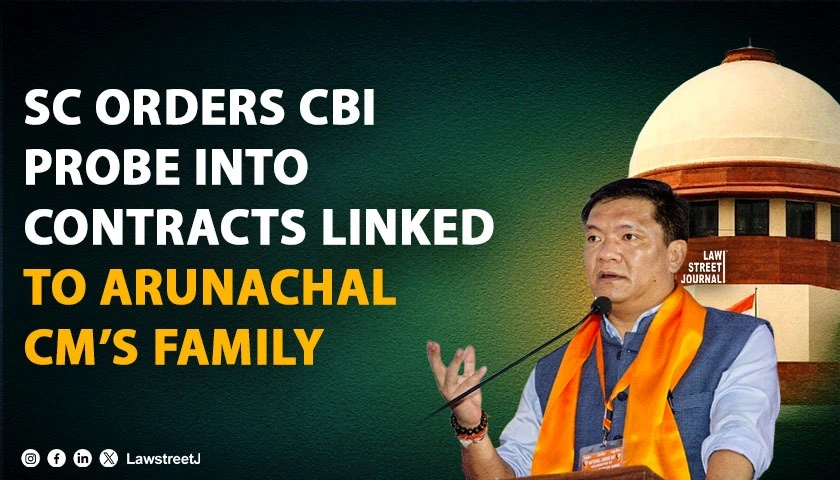
New Delhi: The Supreme Court of India, on Monday, April 6, 2026, directed the Central Bureau of Investigation (CBI) to conduct a preliminary inquiry into allegations concerning the irregular allotment of public works contracts in Arunachal Pradesh.
The probe centres on numerous government contracts allegedly awarded to firms owned by or linked to family members of the State’s Chief Minister, Pema Khandu.
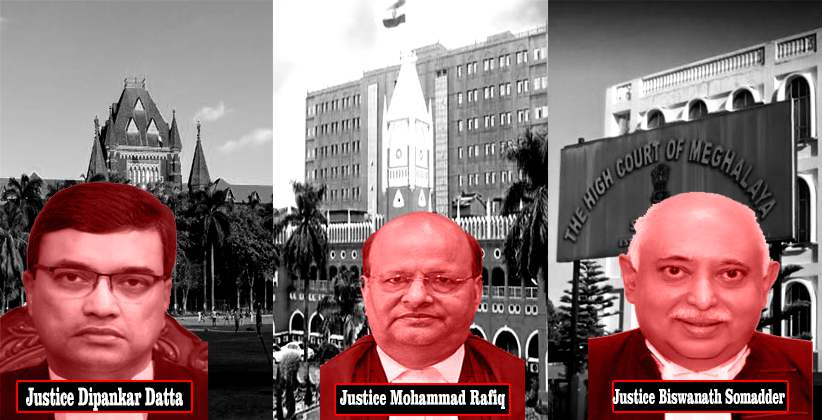
A three-judge bench comprising Justice Vikram Nath, Justice Sandeep Mehta, and Justice N.V. Anjaria issued the order after observing that the statistics and patterns in the award of these contracts appeared significant and indicative of potential cartelisation.
The proceedings originated from a Public Interest Litigation (PIL) filed by two non-governmental organisations, Save Mon Region Federation and Voluntary Arunachal Sena. The petitioners alleged that the State government, under Chief Minister Pema Khandu, had systematically awarded lucrative public works tenders to his close relatives, including his spouse, mother, brother, and nephew. Senior Advocate Prashant Bhushan, appearing for the petitioners, submitted that contracts worth approximately ₹1,270 crore had been illegally allotted to these family members over the past decade.
During the hearings, the court’s attention was drawn to the nature of the bidding process. Justice Vikram Nath remarked that the “remarkable coincidence” of differences between competing tenders being as minuscule as 0.01% strongly suggested cartelisation. The bench noted that such narrow margins raise serious concerns and warrant closer scrutiny into whether independent parties were effectively allowed to participate in the tender process.
The allegations specifically named several firms as beneficiaries. These include M/s Frontier Associates and M/s Brand Eagles, reportedly owned by the Chief Minister’s wife, Tsering Dolma; M/s RD Construction, owned by his brother Tashi Khandu; and M/s Alliance Trading Company, owned by Nima Drema, wife of the Chief Minister’s brother and Tawang MLA, Tsering Tashi. In Tawang district alone, an affidavit submitted by the State revealed that these four firms were awarded 146 contracts worth ₹383.74 crore between 2012 and 2023.
Of these 146 contracts, 59 were awarded directly through work orders without any competitive tender. While State policy permits contracts below ₹50 lakh to be awarded without tender to promote local entrepreneurs, the petitioners pointed out that at least 11 such contracts exceeded this threshold. For instance, a ₹2 crore contract for establishing a government college in Tawang was allegedly awarded to M/s Alliance Trading Company in 2018 without a tender process.
In its defence, the Arunachal Pradesh government filed an affidavit justifying the practice of awarding contracts through direct work orders, describing it as a “normal practice” in the region given its “historic development” and transition from a tribal society to a modern State. The affidavit further stated that local villagers prefer contractors recommended by elected representatives due to the “maximum trust” they repose in them.
The State also contended that 95% of the contracts awarded to the firms in question were processed through open tenders. However, the petitioners argued that, given the Chief Minister’s position, it would be impossible for the State police to conduct an impartial investigation.
The Supreme Court has now directed the CBI to register a preliminary inquiry into the award and execution of these contracts from January 1, 2015, to December 31, 2025. The court clarified that the agency may also examine transactions beyond this period if necessary. The CBI has been granted 16 weeks to submit a status report.
To facilitate the probe, the court directed the State government and its departments to fully cooperate and furnish all relevant records within four weeks. It further ordered that no records related to the contracts be destroyed. The Chief Secretary of Arunachal Pradesh has been directed to appoint a nodal officer within one week to coordinate with the CBI.
The matter has been under consideration for over a year, with the court earlier seeking responses from the Union Ministry of Home Affairs and the Ministry of Finance. The case also touches upon past allegations involving the Chief Minister’s late father, Dorjee Khandu.
During earlier hearings in March 2025, the court referred to the Code of Conduct issued by the Ministry of Home Affairs, which prohibits ministers from granting undue benefits to relatives. The petitioners argued that the scale of contract allocation—allegedly around 3% of total State contracts—constitutes a violation of this code as well as the Prevention of Corruption Act.
As the CBI commences its inquiry, scrutiny will focus on the contracts awarded to the firms named in the petition. The court’s decision underscores the seriousness of the allegations concerning favouritism and corruption in the allotment of public development projects across the State.
Case Title: Save Mon Region Federation & Anr. v. State of Arunachal Pradesh & Ors., W.P. (C) No. 54 of 2024.