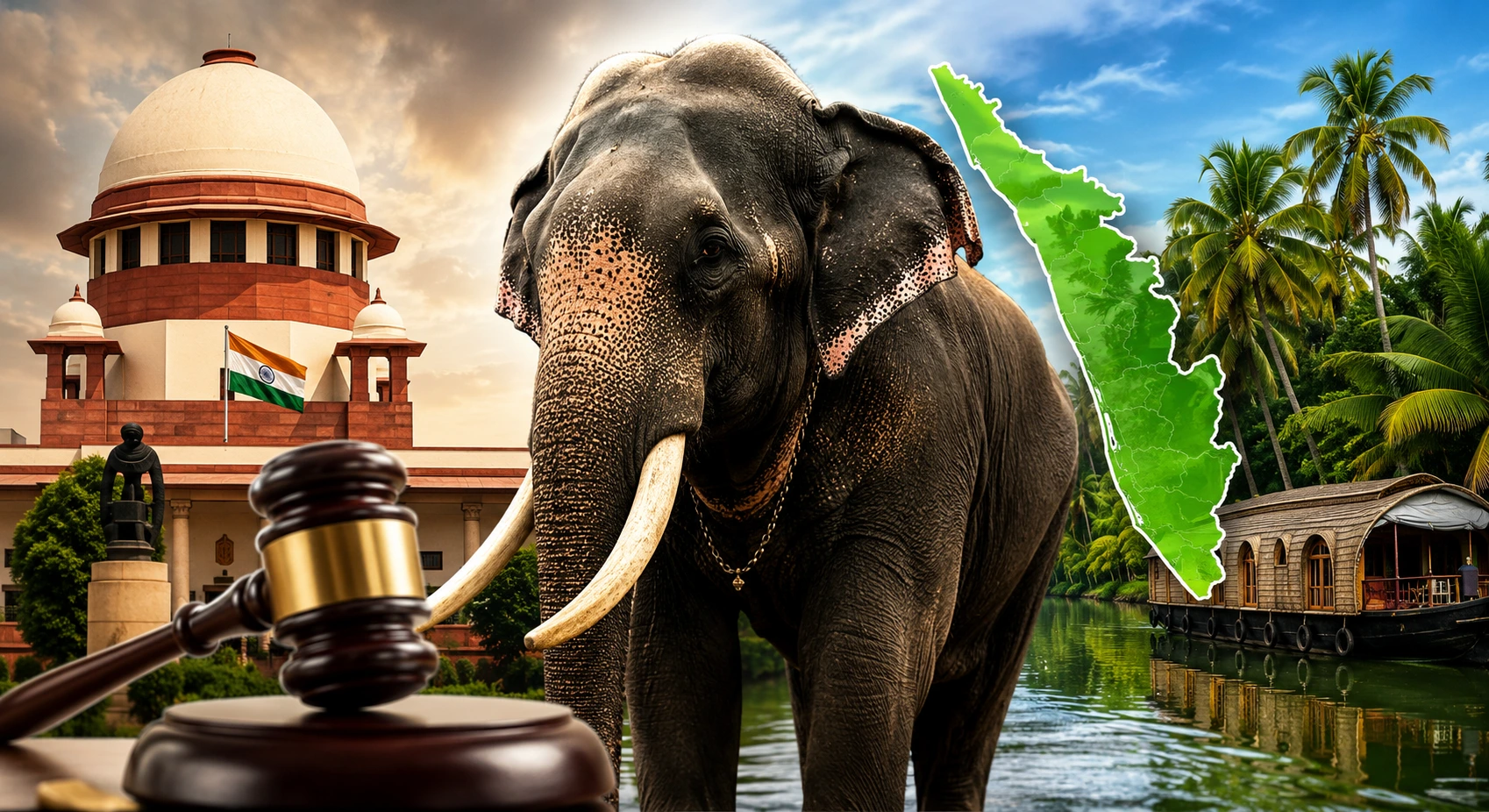
The Supreme Court directed Kerala to take custody of captive elephant Raman after holding the respondent guilty of contempt for violating a court-recorded undertaking.
The Supreme Court of India has directed the State of Kerala to take over the custody of a captive elephant named Raman and house it in an appropriate rescue or rehabilitation centre, observing that courts "cannot be a mute spectator" in matters pertaining to the welfare of voiceless animals.
A Bench of Justices Dipankar Datta and Satish Chandra Sharma passed the order while disposing of Contempt Petition, holding the first respondent guilty of wilful disobedience of an undertaking recorded before the Court.
The underlying dispute between the parties concerns competing claims over the custody and ownership of Raman, described in the judgment as the tallest elephant in the State of Kerala. The contempt petitioner maintained that Raman belongs to the Mata Amritanandamayi Mutt and was only temporarily entrusted to the first respondent for upkeep and care, but was thereafter unlawfully retained by him on the basis of forged and fabricated gift deeds dated 18.02.2017 and 28.02.2017. The first respondent, on the other hand, claimed that the elephant had been lawfully transferred to him by virtue of those gift deeds and that he had been continuously maintaining and caring for the animal for the last ten to twelve years.
Criminal proceedings were initiated before a competent court in Kerala, and Crime No. 1000 of 2023 was registered against the first respondent under Sections 406 and 420 of the Indian Penal Code, 1860, in connection with the alleged illegal retention and maltreatment of Raman. The question of interim custody eventually reached the Supreme Court in Criminal Appeal Nos. 4836-4837 of 2024, in which the Court had directed status quo with respect to the custody of the elephant vide an order dated 22.01.2024, extended from time to time.
On 06.08.2025, while considering an application filed by the contempt petitioner raising concerns about the physical condition and welfare of the elephant and its alleged use in temple festivals and public events, the Court directed the Principal Chief Conservator of Forests or the seniormost officer in-charge of wildlife conservation in Kerala to inspect the elephant and submit a health report within two weeks. On that occasion, counsel appearing for the original appellant stated and undertook before the Court that the elephant would not be used for any commercial or temple activities in the meanwhile.
On 21.08.2025, the Court took notice of a report from the Chief Wildlife Warden, Kerala, stating that a close examination had not been possible as the elephant was under musth and was very aggressive. The Court accordingly directed the Chief Wildlife Warden to conduct the examination from close quarters after the completion of the musth period and submit a detailed report on the elephant's health and physical condition.
The present contempt petitions were filed alleging that despite the specific undertaking recorded on 06.08.2025, the first respondent continued to use Raman in temple festivals, public processions, and commercial activities. The contempt petitioner placed on record photographs, posters, social media posts, and other publicity materials to substantiate the allegation. It was additionally alleged that the State authorities had failed to conduct the close-quarter examination directed by the Court even after the elephant had emerged from musth.
While the first respondent denied the allegations and contended that the materials relied upon by the contempt petitioner either pre-dated the order or were independently circulated by temple committees without actual participation of the elephant, it was conceded in the written arguments filed on behalf of the first respondent that on one occasion, Raman was taken to a temple for an event, purportedly in the absence of another scheduled elephant and for a brief ceremonial religious purpose. An unconditional apology was tendered before the Court in that regard.
The Court noted that a report dated 03.02.2026 filed by the State authorities revealed that an inspection attempted on 11.11.2025 had been unsuccessful as the elephant remained in musth and that a subsequent inspection was conducted on 03.02.2026 by a three-member committee comprising the Chief Forest Veterinary Officer, Assistant Conservator of Forests, and Assistant Forest Veterinary Officer at Chavakkad, where the elephant had been brought for participation in a festival ceremony of a temple near Chavakkad. The Court found it evidently clear from this report and the written submissions of the first respondent that Raman had been used in ceremonial processions and rituals in defiance of the undertaking.
Holding the first respondent guilty of contempt, the Court observed that it would be failing in its duty towards the voiceless if it were to turn a blind eye to such defiance. In the interest of justice, the Court imposed a fine of Rs. 2,000 on the first respondent, directing its deposit with the Registry within four weeks. With respect to the State authorities, respondents 2 to 9 the Court found that they had made an endeavour to conduct the inspection in November 2025 and that the delay was attributable to the elephant remaining in musth; the inspection was ultimately conducted on 03.02.2026. Accordingly, the Court discharged the State authorities from the contempt proceedings.
Directing the State of Kerala to take over interim custody of Raman and house it in a suitable rescue or rehabilitation centre, the Court clarified that the arrangement is temporary and will be subject to the final orders to be passed in the underlying criminal appeals on the issue of interim custody. The State was also permitted to temporarily care for the elephant at its own expense and pass appropriate administrative orders in accordance with the statutory safeguards under the Wildlife (Protection) Act, 1972.
The contempt petitions were disposed of accordingly.
Case Title: Jayakrishna Menon v. Krishnankutty & Ors., (Contempt Petition (Civil) Nos. 59-60 of 2026 in Criminal Appeal Nos. 4836-4837 of 2024; 2026 INSC 631)