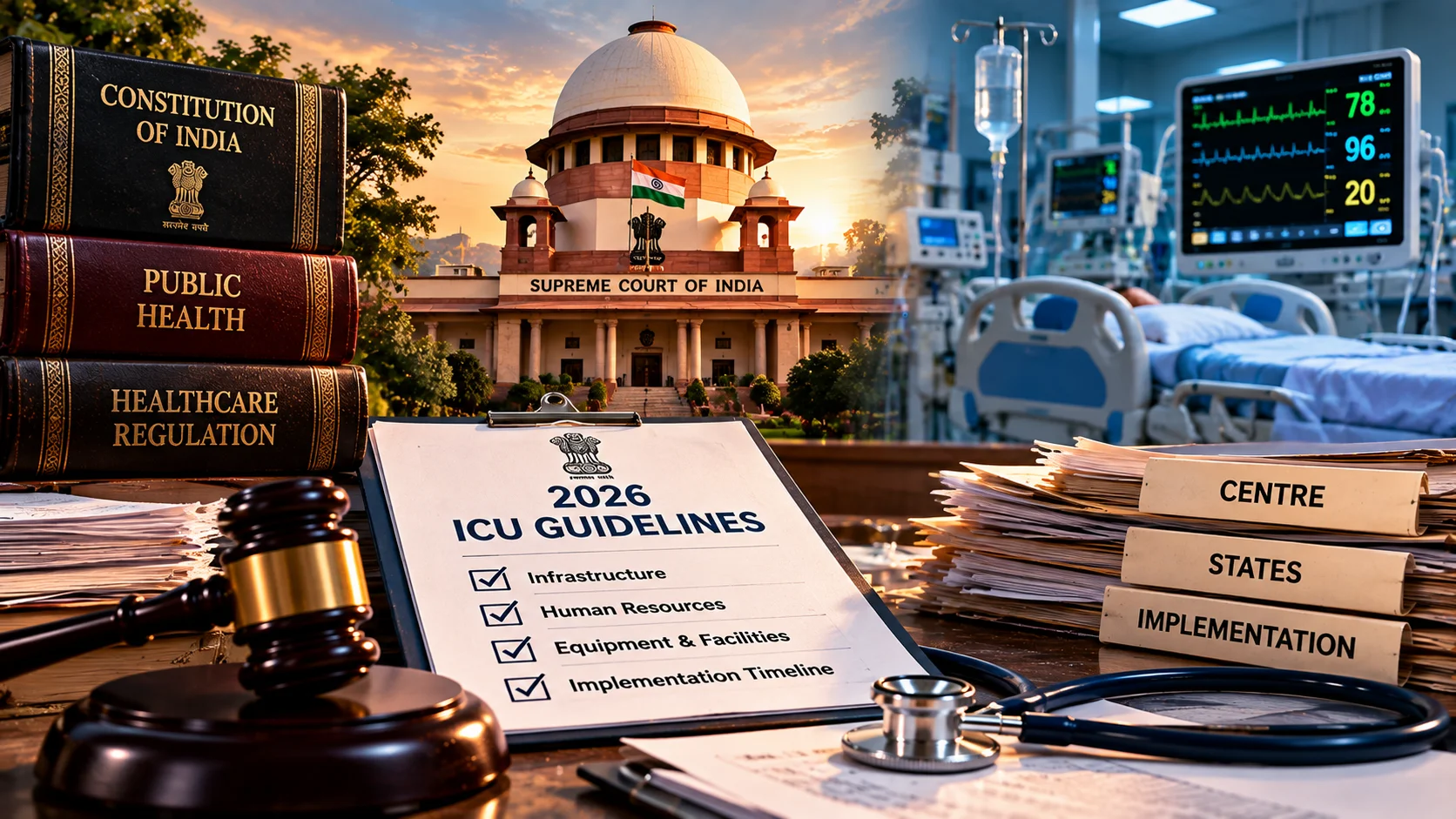
New Delhi: The Supreme Court has issued a mandamus directing the Union of India, all States and Union Territories, and hospitals across the country to comply with the Guidelines for Organization and Delivery of Intensive Care Services within fixed time frames, reducing every proposed 12-month compliance period to 9 months and warning that any laxity or default would invite a strict view from the Court.
Justice Ahsanuddin Amanullah and Justice R. Mahadevan were hearing Miscellaneous Application No. 1364/2026 in Civil Appeal No. 8402/2016, Asit Baran Mondal & Anr. v. Dr. Rita Sinha & Ors., along with a connected special leave petition, in the course of continuing proceedings concerning the nationwide implementation of Intensive Care Unit standards. Pursuant to the Court's earlier order dated 13.08.2026, a Court-appointed Committee, comprising Ms. Aishwarya Bhati, learned Additional Solicitor General, and Mr. Karan Bharihoke, learned Amicus Curiae, placed before the Bench a detailed proposal titled "Guidelines for Organization and Delivery of Intensive Care Services - Time Frames for Compliance", setting out phased timelines for States and hospitals to align existing ICUs with the Guidelines earlier notified by the Directorate General of Health Services, Ministry of Health and Family Welfare, pursuant to the Court's orders dated 18.05.2026 and 20.05.2026.
The Committee's proposal differentiated between categories of compliance: infrastructure changes such as relocation, resizing and nursing stations were assessed as needing up to 12 months given the design and construction involved; procurement of utilities, non-emergency equipment and laboratory services was to be completed within 3 months; emergency equipment, given its sophistication and possible import requirements, was to be procured within 3 months with a further 3 months permissible for installation; infection control and safety measures were to be immediate; and additional services were to be completed within 1 month, while desirable equipment and services, being non-essential by definition, were left without a fixed timeline. On healthcare personnel, the Committee found the 12 to 24 months sought by most States for recruiting ICU specialists, trained doctors, nurses and allied staff to be excessive, while documentation and audit requirements were to be complied with immediately.
Broadly accepting the Committee's recommendations, the Court modified them by substituting every reference to a 12-month period with 9 months, and accordingly issued a mandamus for compliance with the Guidelines for Level I ICUs within the timelines so modified. It further directed that hospitals or institutions claiming to be centres of excellence or speciality institutions, and therefore required to maintain Level III ICU facilities, must simultaneously comply with the requirements for Level III ICUs under the 2026 Guidelines, in addition to the mandatory Level I compliance.
The Court directed the Union of India, the States and the Union Territories to file status reports by 05.11.2026, with a copy to the Committee, which would examine them and place its comments before the Court, with the matter listed next on 16.11.2026. States were permitted to seek relaxation of the timelines for hilly, remote or otherwise difficult areas, supported by particulars of work already undertaken, but the Court cautioned that it would not grant unlimited time or extensions beyond what was reasonably necessary.
On the question of manpower, the Court issued a further mandamus directing the Union, the States, Union Territories and hospitals not under government control to commence the recruitment process for ICU personnel forthwith and complete it within six months, to be strictly complied with by the Governments concerned, particularly the Chief Secretaries and Union Secretaries.
The Court observed: “Any laxity or default noticed by this Court in adherence to the aforesaid Guidelines and the time frames stipulated herein may result in the Court taking a strict view against the defaulting parties.”
Case Title: Asit Baran Mondal & Anr. vs. Dr. Rita Sinha MBBS MS (Obst. Gynae) & Ors., M.A. No. 1364/2026 in C.A. No. 8402/2016, with SLP(C) No. 38704/2025