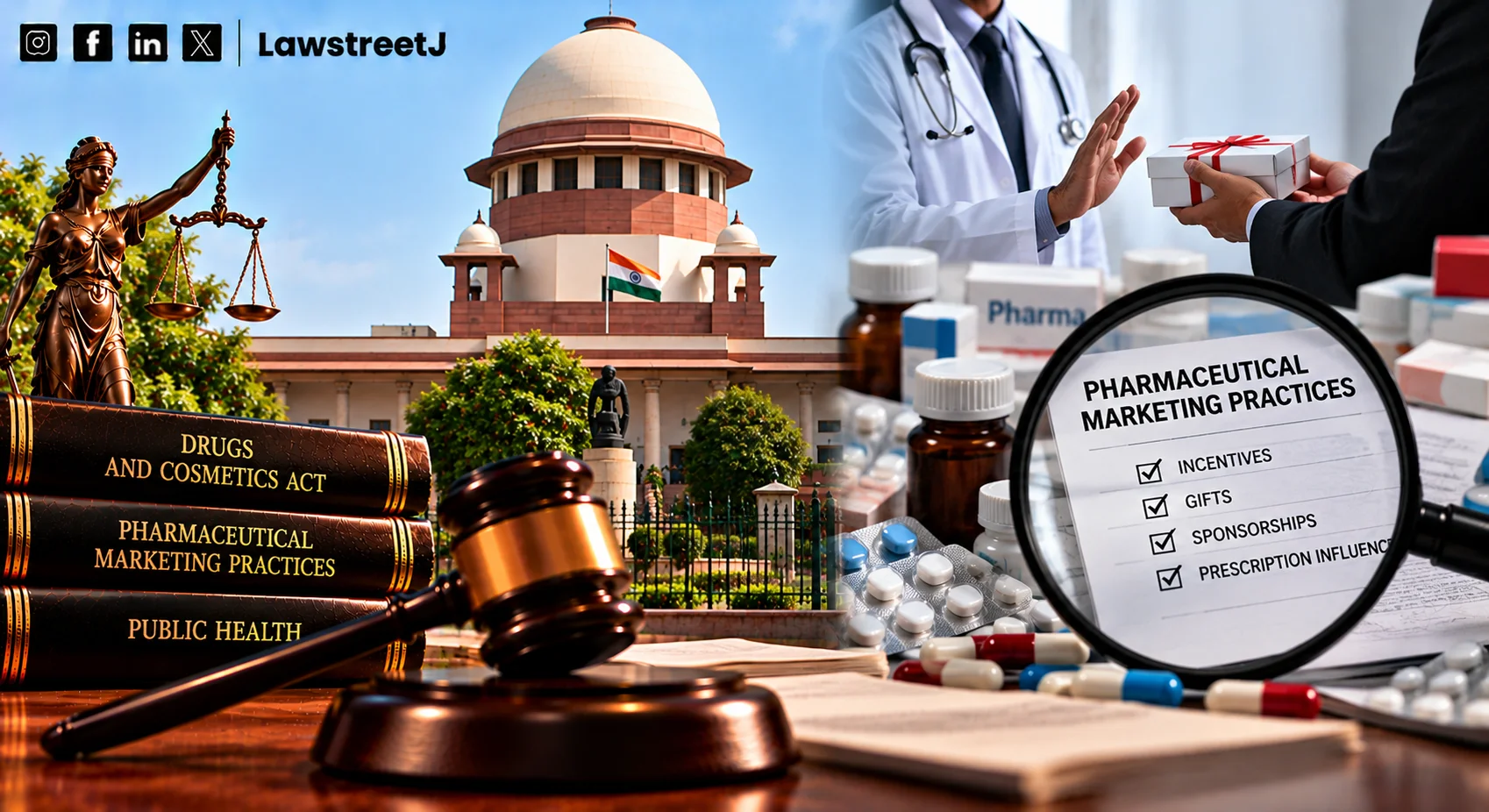
New Delhi: The Supreme Court has directed the Union of India to constitute, within two weeks, the Committee it proposed to examine unethical marketing practices by pharmaceutical companies. The Committee must submit its recommendations on an appropriate statutory and regulatory framework within two months of its first meeting. The Court declined to enter the domain of policy but said it would facilitate a meaningful and effective consultative process.
A Bench of Justice Vikram Nath and Justice Sandeep Mehta passed the order on 8 October 2026 in Writ Petition (C) No. 323 of 2021, filed by the Federation of Medical & Sales Representatives Association of India and others. The order was authored by Justice Mehta. The petition under Article 32 seeks enforcement of the right to health under Article 21.
The petitioners alleged that pharmaceutical companies offer doctors monetary benefits, gifts, hospitality, sponsored travel and entertainment to influence their prescribing. They argued this leads to over-prescription, irrational drug combinations, a preference for high-priced branded medicines, adverse drug reactions and antimicrobial resistance. While doctors are bound by statutory ethical restrictions, they said, there is no enforceable regime under which pharmaceutical companies can be proceeded against for inducing such conduct. They contended that the voluntary nature of the Uniform Code for Pharmaceutical Marketing Practices, 2015 (UCPMP, 2015) had left it ineffective. They sought either statutory force for the Code or guidelines from the Court under Articles 32, 141, 142 and 144 until legislation is enacted.
The Court issued notice on 11 March 2022. On 28 July 2026, it gave the Union a last opportunity to place the outcome of its deliberations on record. The Union’s affidavit, filed by the Department of Pharmaceuticals and the Ministry of Health and Family Welfare, recorded meetings on 7 and 10 August 2026 with departmental secretaries and with industry bodies IDMA, IPA and OPPI. It relied on Regulation 6.8.1 of the Indian Medical Council (Professional Conduct, Etiquette and Ethics) Regulations, 2002, which restricts doctors from accepting gifts, travel, hospitality and cash from the pharmaceutical industry. It further stated that a three-member Committee would be constituted to recommend a framework for regulating pharmaceutical companies, and that the UCPMP, 2024 would govern marketing practices in the meantime.
Senior Advocate Sanjay Parikh, for the petitioners, pointed out that a High-Level Committee under the Member (Health), NITI Aayog had been constituted on 12 September 2022 with a 90-day timeline, yet no concrete outcome had emerged. He nonetheless had no objection to the new Committee, acknowledged that the issues involve matters of policy, and asked that the petitioners’ suggestions be considered and stakeholders heard before recommendations are finalised. The intervenors adopted these submissions.
Solicitor General Tushar Mehta disputed this, submitting that the issue had been under the Union’s consideration for years. Options such as the Essential Commodities Act, 1955 and the Drugs and Cosmetics Act, 1940 had been examined, and the 2022 High-Level Committee under Dr. V.K. Paul had recommended strengthening the existing framework instead of making the UCPMP, 2015 statutory. He said this led to the UCPMP, 2024, which introduced CEO self-declarations, stricter rules on gifts, brand reminders, physician samples and CME activities, defined complaint timelines, and the Apex Committee for Pharma Marketing Practices (ACPMP).
The Court observed that the existing framework “has not proved entirely effective in preventing and curbing unethical practices” in the pharmaceutical sector. It held that a regulatory framework must be judged by its implementation and enforcement, and not merely by the norms it prescribes.
On the limits of its role, the Bench said the choice of statutory framework and the extent of regulatory oversight fall primarily within the domain of the Union. The Court must remain mindful of separation of powers and cannot substitute its own policy determination for that of the executive. It added, however, that judicial restraint cannot mean remaining indifferent where the material discloses concerns bearing directly on public health and the right to health. At this stage, it said, its role is to facilitate “a meaningful and effective consultative process.”
Exercising its powers under Articles 32 and 142, the Court issued the following directions:
- The Union shall constitute the proposed Committee within two weeks of the order, if not already constituted.
- The Committee shall undertake a holistic examination of unethical pharmaceutical marketing practices, including the adequacy of the existing framework and the mechanisms for monitoring, oversight and enforcement.
- It shall consider the material placed on record by the petitioners and intervenors, give them a reasonable opportunity to present their views, and give other stakeholders an appropriate opportunity to make representations.
- It may seek the assistance of technical, professional and domain experts, institutions or bodies.
- It shall endeavour to submit its recommendations to the Union within two months of its first meeting.
- The Union shall consider the recommendations and take an appropriate, reasoned decision at the earliest, having regard to Article 21.
The Union must also file a compliance affidavit within two weeks of the expiry of the Committee’s period. It must record the constitution of the Committee, the date of its first meeting, how consultation was conducted, the Committee’s recommendations, the decision taken and the further measures proposed.
The matter was listed on 29 January 2027 as part-heard for consideration of the compliance affidavit.
Case Title: Federation of Medical & Sales Representatives Association of India & Ors. vs. Union of India & Ors., Writ Petition (C) No. 323 of 2021 [2026 INSC 1097]