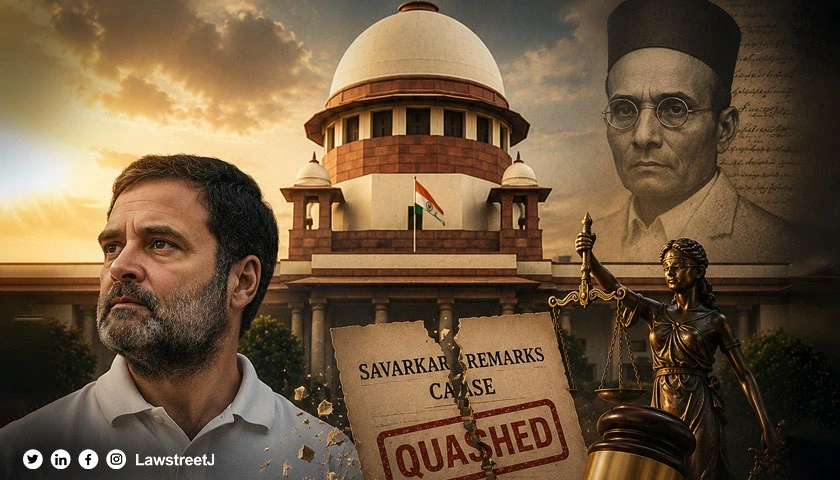
New Delhi: The Supreme Court of India on Friday quashed a private criminal complaint and the subsequent summons issued against Congress MP and Leader of the Opposition, Rahul Gandhi, over remarks he made against ideologue Vinayak Damodar Savarkar.
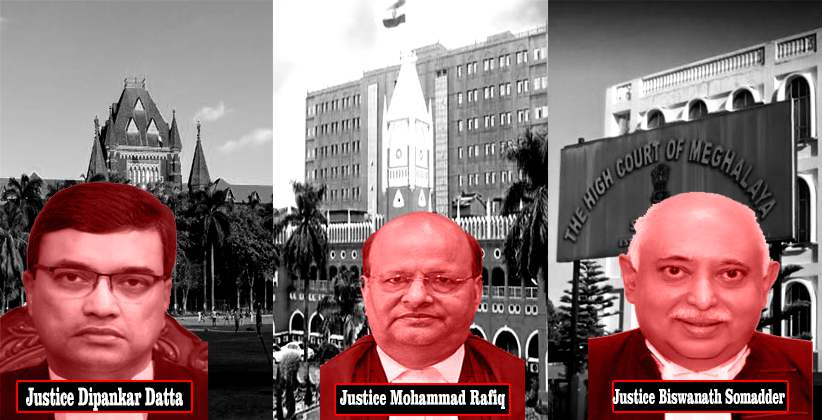
A division bench comprising Justices Dipankar Datta and Sheel Nagu allowed Gandhi's appeal and set aside the ongoing proceedings before a Lucknow magistrate court. The apex court based its decision on a crucial procedural requirement, noting that the mandatory state government sanction required to prosecute Gandhi under the law had not been obtained.
The controversy originated from remarks Gandhi made on November 17, 2022, during a Bharat Jodo Yatra rally in Akola, Maharashtra. In his speech, Gandhi allegedly described Savarkar as a collaborator and servant of the British who received a pension. Following this, advocate Nripendra Pandey filed a complaint in Lucknow, claiming the remarks spread hatred and insulted the nation.
In December 2024, a Lucknow magistrate court found a prima facie case and summoned Gandhi to face trial under Sections 153A (promoting enmity between groups) and 505 (public mischief) of the Indian Penal Code. Gandhi challenged the summons before the Allahabad High Court, which declined to quash the proceedings on April 4, 2025, and directed him to seek revisional remedies in the sessions court. Gandhi subsequently appealed to the Supreme Court.
During the Friday hearing, the Supreme Court turned its focus to the legal prerequisites for the prosecution. Under Section 196 of the Code of Criminal Procedure, prior sanction from the state government is mandatory for a court to take cognizance of an offence punishable under Section 153A of the IPC.
Justice Dipankar Datta asked the state’s counsel if the necessary sanction had been granted. Additional Solicitor General K.M. Nataraj, appearing for the state of Uttar Pradesh, confirmed that the government's affidavit disclosed no such sanction.
Counsel representing the complainant requested the court to set aside the summons and remand the matter back to the magistrate to allow them to take the necessary steps to seek sanction. The bench, however, rejected this request, reiterating that the statutory requirement of obtaining sanction is a mandatory prerequisite before cognizance can be taken. Justice Datta observed that the absence of the state government’s sanction marked the end of the matter.
While the Supreme Court had previously stayed the proceedings in April 2025, it had orally expressed strong disapproval of Gandhi's comments at that time, questioning whether freedom fighters should be spoken of in such a manner. The bench had cautioned Gandhi against repeating such remarks. Despite those prior oral observations, the final ruling was decided strictly on the procedural ground of the missing government sanction, bringing the criminal proceedings to an end.
Case title: Rahul Gandhi v. State of U.P. and Anr., SLP(Crl) No. 6196/2025.