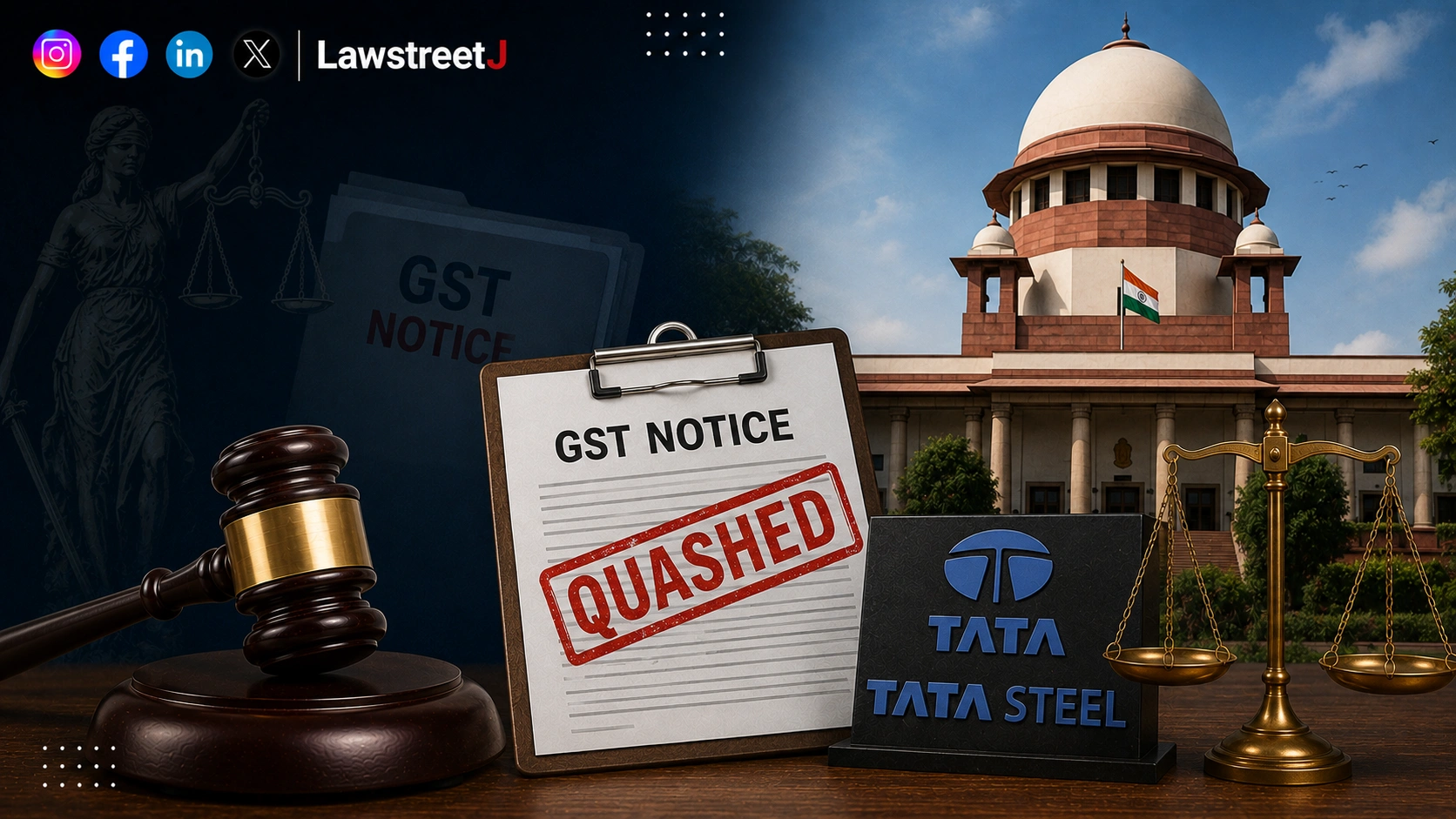
New Delhi: The Supreme Court has set aside a Show Cause Notice issued to Tata Steel Limited under Section 74 of the Central Goods and Services Tax Act, 2017, along with the consequential Order-in-Original, holding that a bare recital of suppression of facts, unaccompanied by foundational facts disclosed in the notice itself, cannot justify invoking the extended five-year limitation period.
The Bench of Justices J.B. Pardiwala and K. Vinod Chandran, was hearing an appeal against a Show Cause Notice issued for the financial years 2018-19 to 2020-21, purportedly in pursuance of an objection raised on an audit by the office of the Comptroller and Auditor General of India, alleging a mismatch of input tax credit and short payment of tax.
Senior Counsel Dr. A.M. Singhvi and Mr. Kavin Gulati, appearing for the appellant, contended that there was no allegation of fraud, wilful misstatement or suppression of facts, in the absence of which Section 74 which provides an extended limitation of five years, as opposed to three years under Section 73 could not be invoked. It was further submitted that the Assessing Officer himself had not been convinced by the audit objection and had placed it in the departmental 'call book', meaning kept in abeyance, and that a fresh notice was issued only because the limitation period was closing, purportedly as a protective measure a concept the appellant contended was alien to the GST regime.
Mr. S. Dwarakanath, learned ASG appearing for the Department, submitted that the proceedings had commenced even before the limitation under Section 73 expired, and that they clearly indicated suppression of material facts and wilful misrepresentation. Reliance was placed on Explanation 2 to Section 74 to contend that suppression could include even a mere non-declaration of facts an assessee was obliged to disclose.
Examining the statutory scheme, the Court traced the timelines for furnishing annual returns under Section 44 and Rule 80 of the CGST Rules, 2017, for the three financial years in question, and the successive notifications extending those deadlines. Applying the exclusion of limitation directed by this Court's suo motu order in In Re: Cognizance for Extension of Limitation, covering the period from 15.03.2020 to 28.02.2022, the Court held that the three-year limitation for issuing a notice under Section 73 stood extended to 28.02.2025 for all three financial years, and that the impugned Show Cause Notice dated 13.06.2025 was issued well beyond this period.
Tracing the chronology, the Court noted that the proceedings began with an audit communication dated 27.05.2024 regarding mismatch of ITC and short payment of tax, followed by an exchange of replies and a request for supporting documents. The Show Cause Notice was eventually issued on 13.06.2025, after which the Additional Commissioner intimated that the notice had been transferred to the 'call book', and that the Department had itself taken up the underlying audit objection with the Public Accounts Committee. A fresh notice reviving the earlier one and proposing a 'protective demand' was then issued on 01.07.2025.
The Court held that proceedings under Sections 73 or 74 could be initiated only on the satisfaction of the Assessing Officer, and that for invoking Section 74, the Officer had to be independently satisfied that fraud, wilful misrepresentation or suppression had led to the mismatch or short payment of tax, and not merely note the occurrence of such mismatch or shortfall. It rejected the ASG's reliance on Explanation 2 to Section 74, noting that the provision itself stood omitted with effect from 01.11.2024, and also rejected the contention regarding timely initiation under Section 73, clarifying that the limitation under Section 73(10) governs the issuance of the order, not the notice, which is separately required to be issued at least three months in advance under Section 73(2).
The Court observed that the Department's own act of contesting the audit objection before the Public Accounts Committee indicated an absence of satisfaction on the part of the Assessing Officer regarding the alleged mismatch, short payment, or suppression. It found that, apart from a bland assertion of availing ITC without documentary evidence and suppressing facts, the notice contained no foundational facts to substantiate the allegation of suppression.
Emphasising that an extended limitation period could not be invoked as a matter of course, the Court held that "the words are not to be mechanically recited in the notice" to enable recovery beyond the normal limitation period, and that the foundational facts giving rise to an inference of fraud, wilful misrepresentation or suppression had to be evident from the notice itself.
Finding no such factual foundation disclosed in the notice to establish a deliberate device to evade tax or avail excess ITC, the Court held that "the SCN on the above reasoning, cannot be sustained", and set aside both the Show Cause Notice and the consequential Order-in-Original dated 26.12.2025.
The Court, however, granted liberty to the Department to initiate fresh proceedings under Section 74, disclosing the foundational facts in the notice itself, and to pass an order before 28.02.2027, noting that the extended two-year period under Section 74 had not yet lapsed for any of the three financial years. The appeal was accordingly allowed, subject to this reservation and liberty.
Appearances:
For the Appellant: Dr. A.M. Singhvi, Senior Advocate, and Mr. Kavin Gulati, Senior Advocate.
For the Respondents: Mr. S. Dwarakanath, Additional Solicitor General.
Case Title: M/s Tata Steel Limited vs. Union of India through the Secretary, Ministry of Finance and Ors.