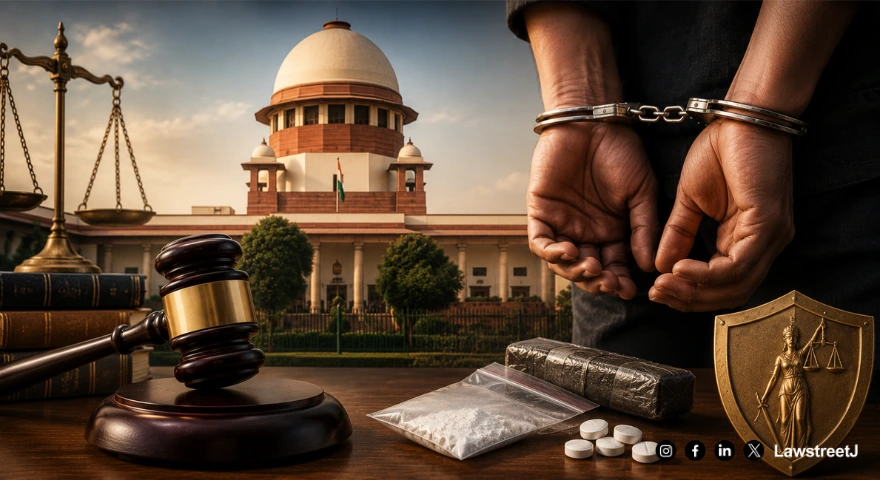
New Delhi: The Supreme Court on Tuesday observed that the protection under Section 50 of the Narcotic Drugs and Psychotropic Substances Act, 1985, to be searched in the presence of a Gazetted Officer or a Magistrate, would be available during the personal search of an accused and does not extend to searches when the accused was carrying a bag, container, or any other object.
A Bench of Justice Sanjay Karol and Justice Nongmeikapam Kotiswar Singh was dealing with an appeal filed by Mehboob Shah, who had been convicted under Sections 8 and 21 of the NDPS Act by the Court of Additional Sessions Judge, Garoth, District Mandsaur, and sentenced to fourteen years of rigorous imprisonment along with a fine of Rs.1 Lakh, a conviction and sentence later affirmed by the High Court of Madhya Pradesh. The prosecution's case was that on 23.06.1996, ASI Indrabhan Singh Parihar, examined as PW-9, acting on confidential information that the appellant was carrying smack concealed in a water bottle and was about to board a train to Delhi, apprehended him and recovered 100 grams of smack from the bottle, drawing two representative samples of 5 grams each at the spot before arresting him.
Before the Supreme Court, the appellant's counsel argued that the prosecution had failed to comply with Sections 50 and 52A of the NDPS Act, that the independent witnesses to the seizure had turned hostile, and that, in any event, the appellant was entitled either to the benefit of the quantity-based sentencing regime introduced by the Narcotic Drugs and Psychotropic Substances Amendment Act, 2001, or, failing that, to the minimum sentence of ten years prescribed under the unamended Section 21.
Reiterating that its jurisdiction under Article 136 is not ordinarily exercised to disturb concurrent findings of fact save in exceptional circumstances, the court, relying on Ganga Kumar Srivastava v. State of Bihar, proceeded to examine the record. On the argument that the case rested only on police witnesses after the independent seizure witnesses turned hostile, the court held that “the testimony of official witnesses cannot be disregarded or distrusted merely on account of their official status or for want of corroboration by independent witnesses,” and found the evidence of PW-3, PW-6, PW-9 and PW-10 to be reliable and trustworthy despite rigorous cross-examination.
On Section 50, the court held that the safeguard “is confined to cases where the recovery is sought to be effected through the personal search of the accused” and “has no application where the search is of an article, such as a bag, container, suitcase or any other object.” Since the contraband here was recovered from a water bottle and not from the appellant's person, the provision had no application. The court nonetheless noted that the appellant had, as a matter of fact, been informed of his right to be searched before a Magistrate or Gazetted Officer, referring to the Report for Grant of Consent, Exhibit P-1, which recorded the ASI informing the appellant that “if you wish you can give your search to any Magistrate or Gazetted Officer or I in their presence,” a fact corroborated by the testimony of PW-6 and PW-9.
On the alleged non-compliance with Section 52A, since the representative samples were drawn by the investigating officer at the spot rather than before a Magistrate, the court held that “mere delayed compliance or non-compliance of the procedure envisaged under Section 52A does not, by itself, entitle the accused to claim acquittal,” relying on its recent decisions in Bharat Aambale v. State of Chhattisgarh and Narcotics Control Bureau v. Kashif. It noted that documents such as the panchnama, seizure memo and arrest memo prepared on the spot constitute primary evidence in their own right, and that the samples in this case had been duly sealed, sent to the Forensic Science Laboratory, and confirmed to be diacetylmorphine, with no allegation that the chain of custody had been broken.
On the plea for the benefit of the amended, quantity-based Section 21, the court held that Section 41 of the 2001 Amendment Act extends its benefit only to cases pending trial or investigation as on 02.10.2001, expressly excluding cases where the trial had concluded and the matter was pending only in appeal, following Basheer v. State of Kerala. Since the appellant had already been convicted by the Trial Court in 1997 and his appeal was pending before the High Court when the amendment came into force, this benefit was unavailable to him.
However, accepting the appellant's alternative plea, the court found that since the unamended Section 21 prescribed a minimum sentence of ten years and no aggravating circumstances existed to justify a higher term, “the ends of justice would be adequately met if the sentence awarded to the appellant is reduced to the minimum prescribed thereunder.” The court accordingly affirmed the conviction under Sections 8 and 21 of the NDPS Act, but modified the sentence from fourteen years to ten years of rigorous imprisonment, while maintaining the fine of Rs.1 Lakh, directing that if unpaid, it be deposited within three months, failing which the appellant would undergo a further year of rigorous imprisonment in default.
The court appreciated the efforts of the learned amicus curiae in the matter.
Mr. Sushil Kumar Jain, Senior Advocate, appeared for the appellant, Mr. Pashupathi Nath Razdan, Advocate-on-Record, appeared for the respondent State of Madhya Pradesh, and Mr. Sidharth Luthra appeared as amicus curiae.
Case Title: Mehboob Shah v. State of Madhya Pradesh





.jpeg)