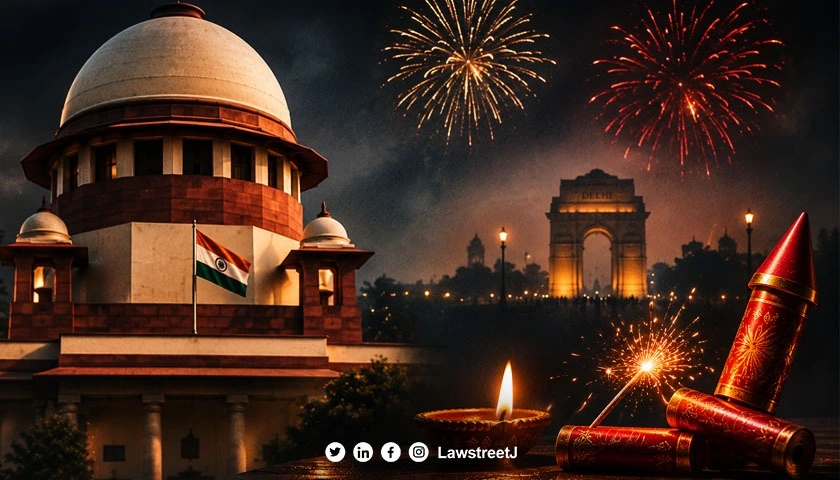
New Delhi: The Supreme Court has temporarily relaxed the complete ban on firecrackers in Delhi-NCR for Diwali 2026, permitting only CSIR-NEERI-approved green crackers to be sold and burst on 7 and 8 November 2026, within fixed time slots, and has directed that the complete ban be restored from 9 November 2026.
A Bench of Justice M.M. Sundresh and Justice Prasanna B. Varale passed the order on 29 October 2026, in I.A. Nos. 245432/2026, 251493/2026, 245387/2026, 264010/2026, 325852/2025 and 103495/2026 in Arjun Gopal & Ors. v. Union of India & Ors. (W.P.(C) No. 728/2015), heard with Suo Motu W.P.(C) No. 15/2026.
The Court traced the history of the orders, from the 2018 Arjun Gopal ruling permitting reduced-emission and green crackers, to the perpetual ban imposed by the Delhi Government with effect from 01.01.2025 on the Supreme Court’s directions, the orders of 03.04.2025 and 26.09.2025, and the temporary relaxation of 15.10.2025 in M.C. Mehta v. Union of India. It said that the efforts made so far had not improved the situation, as there was neither effective implementation nor adequate material placed before it.
The Court allowed the interventions of the Delhi Fireworks Shopkeepers Association and the Federation of Fireworks Traders, and heard the Amicus Curiae, the petitioners, the intervenors and the Additional Solicitor General. The amicus and the petitioners sought a complete ban and a comprehensive health assessment of Delhi-NCR residents. The intervenors, licensed traders and manufacturers, argued that withholding restoration of licences would facilitate the business of illegal firecrackers from across the border, and sought stricter enforcement through registration and QR codes. The ASG said that an action plan to mitigate pollution would be implemented from November 2026.
On the law, the Court held that the right to practise religion under Article 25(1) is subject to public order, morality and health, and that the right to life under Article 21 includes the right to a healthy, pollution-free environment. It accepted that bursting crackers contributes enormously to pollution in Delhi-NCR, but noted that Diwali has a religious, social and emotional significance, and that degradation of the environment defeats the purpose of the festivities.
The question, it said, was whether to impose a complete ban or to regulate. Although a blanket ban seems ideal, the Court said that it lacks adequate data to decide whether the 2024 ban has served its purpose, as there has been no significant improvement in AQI. It found that “the problem lies in the implementation”, that the State had utterly failed to comply with the directions of 15.10.2025, and that despite the ban there was a spike in AQI on Dussehra and conventional crackers were being sold under the guise of green crackers. It held that the complete ban was facilitating illegal sales and preventing the purchase of legitimate green crackers.
The Court accordingly permitted bursting only between 6 AM and 7 AM and 8 PM and 10 PM on 7 and 8 November 2026, and declared a 300-metre radius around hospitals, nursing homes, health centres, old-age homes, notified silence zones and educational institutions as No-Cracker Zones. Certified manufacturers may make only green crackers listed on the CSIR-NEERI website, from 02.11.2026 to 06.11.2026, in sealed boxes with product-and-batch-specific QR codes. Firecrackers joined in series (ladis) and garlands, and those with barium, remain barred, and sale of QR codes will lead to cancellation of licences.
Cancelled licences of traders are restored only from 04.11.2026 to 06.11.2026 for sale of approved green crackers, and will be cancelled immediately on any violation. Authorities must require manufacturers and traders to furnish a monetary security that stands forfeited on violation, designate sale locations in the NCR, prohibit sale elsewhere including online, check vehicles entering Delhi-NCR, and put up banners telling the public how to identify approved crackers and where to complain.
The Court directed police patrolling teams to confiscate illegal firecrackers and prosecute offenders, and directed the CPCB, with the State Pollution Control Boards, to prepare pre-Diwali (02-06 November), Diwali (7-8 November) and post-Diwali (9-30 November) AQI reports, with sand and water samples. Non-functional AQI monitoring stations are to be re-inspected, post-festival waste is to be cleared, and the Winter Action Plan 2026, Air Pollution Mitigation Plan 2026 and CAQM Annual Action Plan are to be published widely.
The State machinery must file affidavits on compliance, on prosecutions and on the increase in hospital admissions till 30.11.2026 on or before 14.12.2026, failing which contempt action will be taken against responsible officials. The Court said it will monitor implementation through periodic hearings, urged members of the Bar and public figures to join a voluntary awareness campaign, and listed the applications for compliance on 16 December 2026.
Appearances: Ms. Uttara Babbar, Amicus Curiae. For the Petitioners: Mr. Gopal Sankaranarayanan, Senior Counsel. For the Intervenors: Mr. J. Sai Deepak, Senior Counsel. For the Union of India, GNCTD and CAQM: Ms. Aishwarya Bhati, Additional Solicitor General.
Case Title: Arjun Gopal & Ors. v. Union of India & Ors., I.A. Nos. 245432/2026 and connected applications in W.P.(C) No. 728/2015, with Suo Motu W.P.(C) No. 15/2026