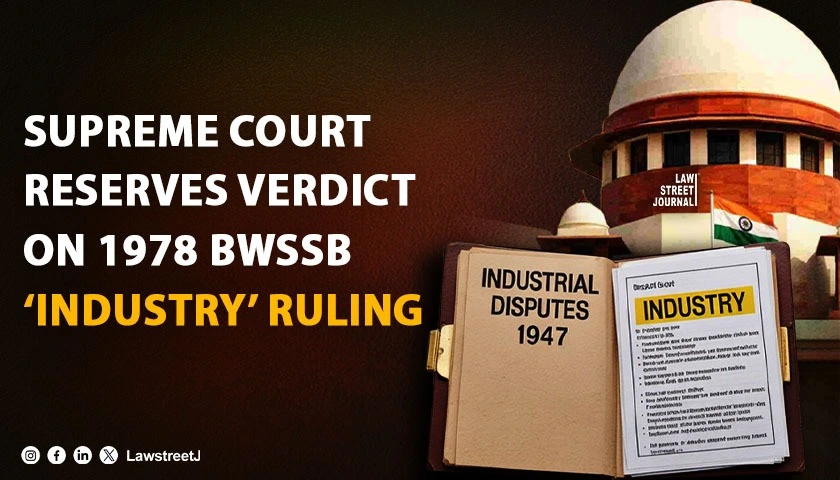
New Delhi: A nine-judge Bench of the Supreme Court has reserved its judgment on a reference questioning the correctness of the Court’s seven-judge Bench decision in Bangalore Water Supply and Sewerage Board v. R. Rajappa and Others, pronounced in 1978, which held that the term ‘industry’ under the Industrial Disputes Act, 1947, must be given a wide interpretation.
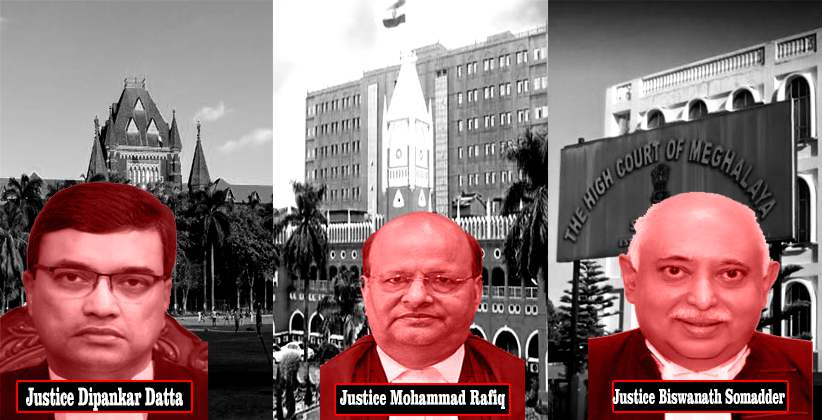
The Bench, comprising Chief Justice of India Surya Kant and Justices B.V. Nagarathna, P.S. Narasimha, Dipankar Datta, Ujjal Bhuyan, Satish Chandra Sharma, Joymalya Bagchi, Alok Aradhe, and Vipul M. Pancholi, reserved judgment on March 19, 2026, after hearing extensive arguments over three days.
In 1978, the seven-judge Bench in the Bangalore Water Supply case held that the term ‘industry’ must be given a wide interpretation in light of the broad definition under the Industrial Disputes Act, including every profession within the ambit of ‘industry’, regardless of profit motive. The decision subsequently faced a series of challenges calling for a more restrictive interpretation confined to manufacturing units. A five-judge Constitution Bench in 2005 referred the Bangalore Water Supply decision for reconsideration, noting that the majority judgment was not unanimous. In 2017, a seven-judge Bench ordered that a nine-judge Bench be constituted to hear the matter. The hearing finally commenced on March 17, 2026.
On the day judgment was reserved, Senior Advocate C.U. Singh, representing a federation of unions, contended that governments already possess the power under Section 36B of the Industrial Disputes Act to exempt industries from its provisions and argued that seeking a restrictive interpretation through a court order amounted to shifting responsibility away from the executive. He said, “If some States feel that some class of industries are protected and they don’t need protection under the Industrial Disputes Act, they have all the power. They can issue a Section 36B notification. But they are doing it by shooting from the shoulders of the Supreme Court.” He added that workers could not be let down after 48 years.
Senior Advocate Gopal Sankaranarayanan, representing the All India Trade Union Congress, submitted that in the 1978 judgment, Justice V.R. Krishna Iyer had carved out a limited exception in respect of clubs, distinguishing between institutions like the Madras Gymkhana and small self-serving community clubs formed for personal recreation, with only the latter category falling outside the scope of ‘industry’. He proposed that the Court adopt an approach examining only the nature of the activity, ignoring who carries it out and the motive behind it, so long as the activity is lawful. He submitted that a charitable activity cannot be permitted to remain unregulated and that the balance between the rights under Articles 19(1)(g) and 21 of both employers and employees must be kept in mind.
Advocate Shivam Singh, also supporting the Bangalore Water Supply decision, submitted that the Industrial Disputes Act reflects a clear legislative intent to operate as a standalone code in its domain, distinct from State Shops and Establishments Acts, which serve different purposes. He argued that the contention that workers should pursue remedies under other statutes rather than under the Industrial Disputes Act deserved to be rejected.
Justice Bagchi remarked during the hearing that settlement is at the core of the Industrial Disputes Act and that the statute is neither pro-workman nor pro-employer, but pro-peace. He added that a non-expansionist definition of ‘industry’ would exclude various human activities involving an employer-employee interface from the scope of this ameliorative law aimed at industrial peace.
Senior Counsel J.P. Cama, addressing queries on forums dealing with industrial disputes, submitted that where the law is intended to provide a forum, it has done so, and that absence of a remedy cannot be a ground to alter the statutory scheme. He argued that unless an activity is relatable to business, it would fall outside the expression ‘industry’, and that the legislative balance must not be disturbed in the name of social welfare.
Attorney General R. Venkataramani, concluding the arguments, submitted that the Court should not go beyond the text of the law even in the case of social welfare legislation, and stated that the government is not anti-labour, but that India’s move towards a globalised economy requires careful consideration of how to manage labour affairs. The Central Government and State Governments had argued against the expansive definition throughout the hearing.
The Court had, on March 18, 2026, rejected arguments against the maintainability of the reference and made clear that it would examine the correctness of the 1978 verdict.
Case Details:
- Case Reference: Reference against Bangalore Water Supply and Sewerage Board v. R. Rajappa and Others (1978)
- Court: Supreme Court of India
- Bench: Chief Justice of India Surya Kant, Justice B.V. Nagarathna, Justice P.S. Narasimha, Justice Dipankar Datta, Justice Ujjal Bhuyan, Justice Satish Chandra Sharma, Justice Joymalya Bagchi, Justice Alok Aradhe, and Justice Vipul M. Pancholi
- Date of Reservation: March 19, 2026
- Senior Advocate for Federation of Unions: Mr. C.U. Singh
- Senior Advocate for All India Trade Union Congress: Mr. Gopal Sankaranarayanan
- Advocate (supporting BWSSB decision): Mr. Shivam Singh
- Senior Counsel: Mr. J.P. Cama and Mr. P.S. Sengupta
- Attorney General of India: Mr. R. Venkataramani