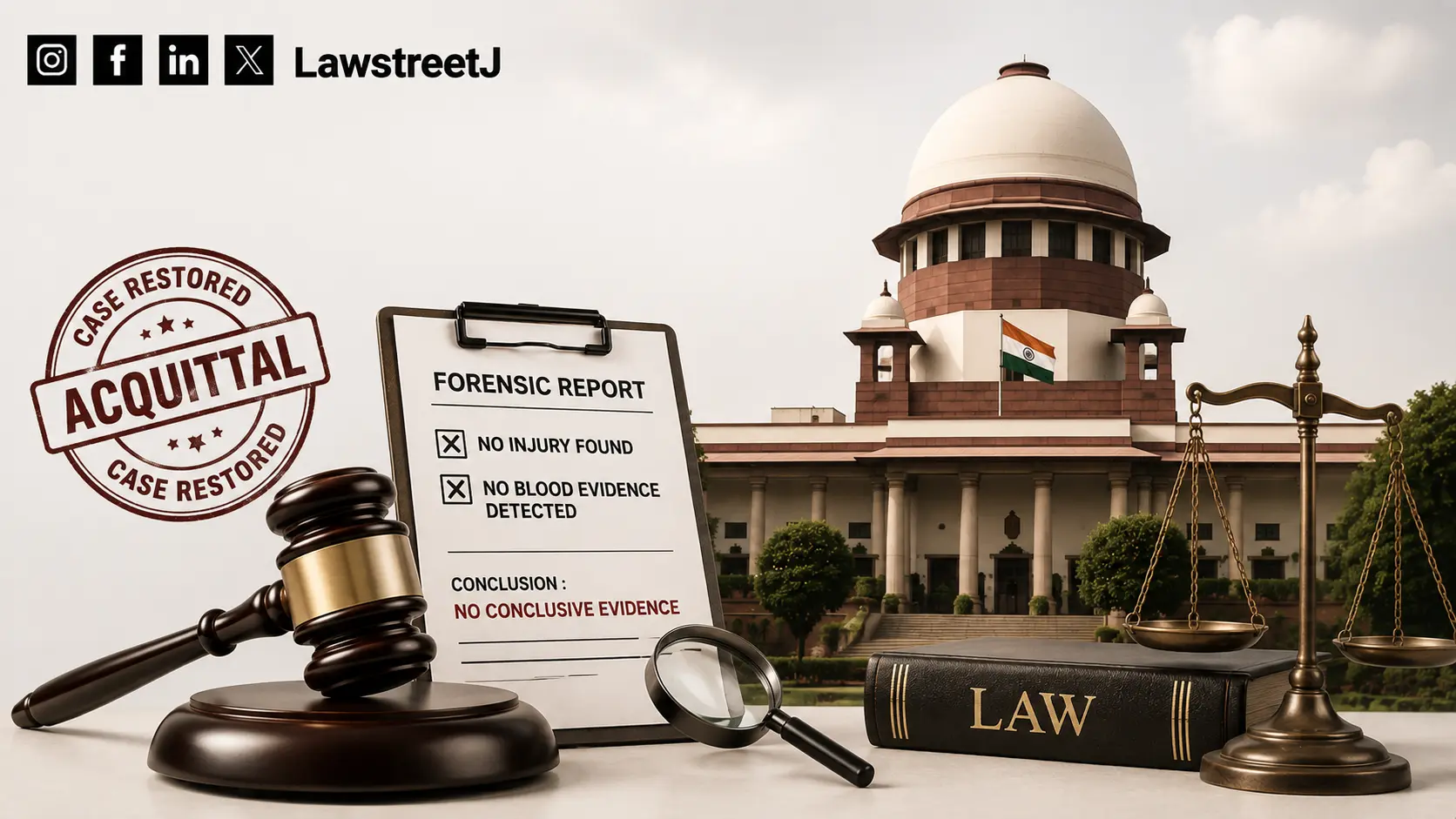
New Delhi : The Supreme Court has restored the acquittal of a man accused of raping a four-and-a-half-year-old girl, holding that the absence of any injury on the victim's body and the negative forensic findings on bloodstains created a grave doubt about the prosecution's version of events.
A bench of Justices Ujjal Bhuyan and Atul S. Chandurkar was hearing an appeal filed by the appellant against a 2016 judgment of the Himachal Pradesh High Court, which had reversed his acquittal by the trial court and convicted him under Section 376 of the Indian Penal Code. The trial court had acquitted the appellant in 2010, finding the prosecution evidence insufficient, but a Division Bench of the High Court overturned that acquittal and sentenced him to ten years' rigorous imprisonment along with a fine of ₹50,000.
As per the prosecution's case, the appellant was residing with the victim's uncle, with whom he was serving. On June 28, 2009, it was alleged that he raped the child, and her mother later found bloodstains on her clothes after the child returned home. An FIR was lodged the same evening, and the appellant was tried on the strength of the testimony of the informant, the uncle, and the victim herself, along with medical and forensic evidence.
Counsel for the appellant, Ms. Sonam Gupta, argued that the High Court had erred in reversing a well-reasoned acquittal without adequately considering the medical report, which found no injury on the victim, and the report of the State Forensic Science Laboratory, which found no trace of blood or semen on the victim's clothes or on the chatai and baithak recovered from the site of the alleged offence, despite the Benzidine test used being reliable even after multiple washings. The State, represented by Additional Advocate General Mr. Vaibhav Srivastava, contended that the ocular testimony of the victim was credible on its own and that the medical evidence could not override it, and that the High Court was right to find the trial court's view perverse.
Examining the record, the Court noted that the medical examination of the victim, conducted within twelve hours of the alleged incident, found no sign of any injury, inflammation, redness, bruising or laceration on her body, and that her hymen was intact. The final medical opinion, given after gynaecological assessment, confirmed there was no evidence to suggest that penetration had taken place. The forensic report similarly found no blood or semen on the victim's clothes, the chatai or the baithak. The Court also noted a discrepancy regarding the place of occurrence, with the Investigating Officer stating the offence occurred in a kitchen where there was no cot or bed, contrary to the victim's account that it took place on a cot.
The Court was critical of the High Court's approach in overturning the acquittal:
“The High Court, in our view, failed to refer to the medical reports as well as the report of the FSL while overturning the acquittal of the appellant. We do not find the material on record sufficient to hold that the prosecution has proved its case beyond reasonable doubt.”
The bench held that when the depositions of the prosecution witnesses were weighed alongside the Final Medical Report and the FSL report, a serious doubt arose regarding the consistent claim of the informant and the victim that there were bloodstains on the victim's clothes and that she had suffered pain as a result of the alleged assault:
“The medical examination conducted within twelve hours of the alleged occurrence, however, belies the presence of any injury whatsoever on her body... In addition, the report of the FSL rules out the presence of blood and semen on the clothes of the victim. Traces of semen on the undergarment of the appellant, by itself, is not found relevant in these circumstances.”
The Court concluded that the trial court had rightly acquitted the appellant and that the High Court's material on record fell short of proving the prosecution's case beyond reasonable doubt. Accordingly, it set aside the High Court's 2016 judgment, restored the acquittal, and directed that the appellant's bail bonds stand cancelled.
Appearances: Ms. Sonam Gupta appeared as counsel for the appellant, while Mr. Vaibhav Srivastava, Additional Advocate General, appeared for the respondent State of Himachal Pradesh.
Case Title: Appellant vs. The State of Himachal Pradesh, Criminal Appeal No. 1052 of 2016