The Supreme Court held that a High Court in second appeal cannot substitute a decree for mandatory injunction with monetary compensation where the plaintiff never sought such relief, and cannot direct an Executing Court to assess value where no decree subsists.
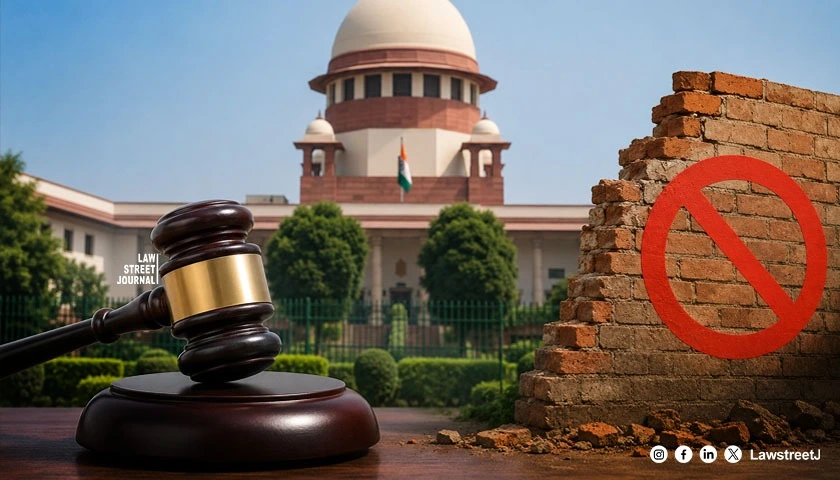
The Supreme Court of India has set aside a judgment of the Punjab and Haryana High Court that converted a decree for mandatory injunction directing removal of an illegally erected wall into a direction for monetary compensation, without any prayer to that effect having been made by the plaintiff.
The Court held that imposing such a direction on a party who never claimed compensation, and whose legal heirs had not consented to it, amounted to a miscarriage of justice.
The judgment was delivered by the bench of Justice S.V.N. Bhatti and Justice Atul S. Chandurkar in Civil Appeal Nos. 19552-19553 of 2017 filed by Rajat Kumar and others, the legal heirs of the original plaintiff Om Parkash.
Background
Om Parkash filed two civil suits against S.D. Adarsh Jain Kanya Maha Vidyalaya Sadhaura and others.
In the first suit, he sought mandatory injunction for removal of a wall illegally erected by the defendants on the common open space beyond his house. The wall blocked his ventilators and obstructed water drainage.
In the second suit, he sought removal of a lintel of the school building that the defendants had placed on the wall of his house.
The Trial Court decreed both suits in his favour. The first Appellate Court upheld both decrees on appeal. The defendants then approached the Punjab and Haryana High Court in second appeal.
The High Court, instead of deciding the second appeals on merits, directed the defendants to pay half the construction cost of the walls to the plaintiff by treating the walls as ‘common’ on such payment. The Supreme Court had previously set aside these directions in 2013 on the ground that the High Court had modified the decrees without framing substantial questions of law, and remanded the matters for fresh consideration.
On remand, the High Court again set aside the Trial Court decrees. This time, it directed the Executing Court to assess the value of the offending walls and compensate the legal heirs of Om Parkash in monetary terms. This order was challenged before the Supreme Court.
Arguments
Advocate Sangeeta Kumar, appearing for the appellants, submitted that Om Parkash had never prayed for monetary compensation in either suit. His only prayer was for mandatory injunction directing removal of the illegal constructions.
It was argued that the legal heirs had not consented to accepting compensation in lieu of the decree, and that the High Court could not impose such a course upon them. It was further submitted that once the Trial Court decrees were set aside, no decree remained in the field for the Executing Court to act upon.
The respondents did not appear before the Supreme Court despite service since April 23, 2019.
Analysis
The Court, per Justice Atul S. Chandurkar, identified four distinct errors in the High Court’s judgment.
First, the original plaintiff had sought only mandatory injunction and never claimed compensation and that the High Court could not compel the legal heirs to accept monetary relief that was never prayed for, especially without their consent.
Second, once the Trial Court decrees were set aside by the High Court, no decree survived for execution. Hence, directing the Executing Court to assess the value of the walls in the absence of any subsisting decree had no support under Order XXI of the Code of Civil Procedure, 1908.
Third, the Supreme Court had already set aside a similar exercise by the High Court in the first round. Despite this clear direction, the High Court repeated the same error on remand.
Fourth, the High Court’s impugned order proceeded on a factually incorrect premise that the Trial Court had found the wall to be a common wall. In fact, the Trial Court had ordered its removal. The High Court also referred to three questions as substantial questions of law but never formally framed them, yet concluded by answering them in favour of the defendants and setting aside the plaintiff’s decrees. This rendered the entire exercise legally unsustainable.
Conclusion
The Supreme Court allowed the appeals and set aside the High Court’s common judgment dated May 2, 2016 in RSA Nos. 363 and 364 of 2008.
Since neither second appeal had been adjudicated on merits, the Court directed the High Court to reconsider both appeals in accordance with Section 100 of the Code of Civil Procedure and decide them on their own merits. The Court requested the High Court to take up the matters expeditiously, noting that the second appeals have been pending since 2008. No order as to costs was made.
Case Title: Rajat Kumar and Others v. S.D. Adarsh Jain Kanya Maha Vidyalaya Sadhaura and Others (Civil Appeal Nos. 19552-19553 of 2017 | 2026 INSC 648)