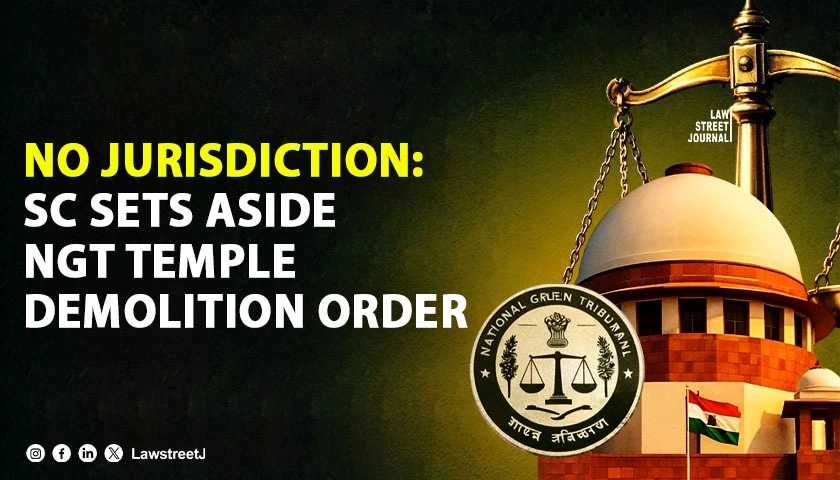
New Delhi: The Supreme Court of India has set aside an order passed by the National Green Tribunal (NGT) directing the removal of a temple constructed on land earmarked as an open space in Ghaziabad. The Court held that the NGT has no jurisdiction to direct the removal of an alleged encroachment raised in violation of municipal and town planning laws, as these do not fall within the statutes specified in Schedule I of the National Green Tribunal Act, 2010.
The Court observed that the conditions precedent for empowering the Tribunal to exercise jurisdiction under Section 14 of the Act were not fulfilled in the present case.
A Bench comprising Justice Pamidighantam Sri Narasimha and Justice Alok Aradhe was hearing two civil appeals filed against the judgment and order passed by the National Green Tribunal, Principal Bench, New Delhi. By the impugned order, the Tribunal had directed the District Magistrate, Ghaziabad, and the Municipal Corporation, Ghaziabad, to remove the temple and its associated structures, which were allegedly constructed on land designated as open space or a park in Sector 16A, Vasundhara, District Ghaziabad.
The dispute arose when Respondent No. 1, a Residents Welfare Association, filed an application before the NGT under Section 14 of the National Green Tribunal Act, 2010, alleging encroachment and illegal construction of a temple on land earmarked for a park. It sought removal of the structure along with consequential directions. The appellant, in response, contended that the temple had existed even as per the Revised Layout Plan dated 14.07.2004 prepared by the Uttar Pradesh Housing Board, and denied any encroachment.
The Tribunal constituted a Joint Committee comprising officials of the District Administration and other authorities to inspect the site. Based on the Committee’s report, the Tribunal concluded that the temple had been constructed on open space and that the construction took place sometime in 2016. It accordingly directed the removal of the temple and allied structures. Aggrieved by this order, the appellants approached the Supreme Court.
Before the Supreme Court, counsel for the appellants raised two submissions. First, it was contended that the order constituting the Committee was passed without issuing notice to the appellants, thereby violating the principles of natural justice. Second, and more fundamentally, it was argued that under Section 14 of the Act, the Tribunal had no jurisdiction to direct the removal of an encroachment, rendering the impugned order without jurisdiction.
On the other hand, counsel for Respondent No. 1 submitted that the temple had been constructed on land earmarked for a park. Reliance was also placed on the counter affidavit filed by the official respondents, which confirmed that the construction stood on open land designated for a park. It was therefore urged that no interference with the Tribunal’s order was warranted.
The Supreme Court examined the scope of Section 14 of the National Green Tribunal Act in detail. The provision confers jurisdiction on the Tribunal over all civil cases involving a substantial question relating to the environment, where such question arises out of the implementation of the enactments specified in Schedule I of the Act. The Court noted that the term “substantial question relating to environment” is defined under Section 2(m) of the Act and is intrinsically linked to the statutes listed in Schedule I, including the Water Act, 1974; the Forest (Conservation) Act, 1980; the Air (Prevention and Control of Pollution) Act, 1981; the Environment (Protection) Act, 1986; the Public Liability Insurance Act, 1991; and the Biological Diversity Act, 2002.
The Court further noted that Respondent No. 1 had invoked the jurisdiction of the Tribunal for the removal of an alleged encroachment claimed to be in violation of municipal and town planning laws. However, neither of these falls within the ambit of Schedule I to the Act.
Accordingly, the Court held that the jurisdictional prerequisites for the Tribunal to exercise powers under Section 14 were absent. Since the alleged construction was in violation of laws not specified in Schedule I, the Tribunal lacked the authority to direct its removal.
The impugned order was therefore quashed and set aside for want of jurisdiction.
The Court, however, granted liberty to the Residents Welfare Association to approach the competent authority under the appropriate law for redressal of its grievance. It further directed that no action shall be taken against the appellants without issuing prior notice to them and other affected parties.
The appeals were accordingly disposed of.
Case Title: Narender Bhardwaj v. M/s 108 Super Complex R.W.A. & Ors. (Civil Appeal Nos. 5921 of 2022 and 9082 of 2022)