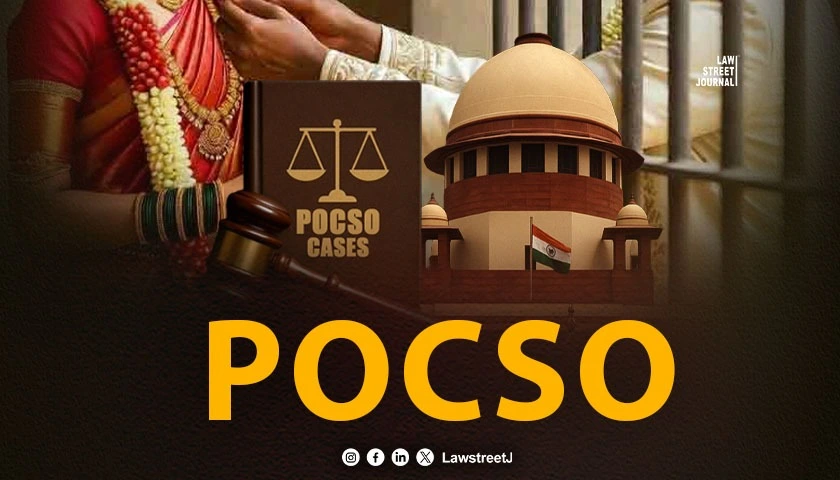
New Delhi: The Supreme Court of India has set aside a conviction under the Protection of Children from Sexual Offences Act, 2012 (POCSO Act), invoking its plenary powers under Article 142 of the Constitution, after the convict and the victim solemnised their marriage and the convict paid compensation of ₹10,00,000 to the victim.
A Bench comprising Justice J.K. Maheshwari and Justice Atul S. Chandurkar passed the order in the criminal appeals filed by the appellant, challenging his conviction and a High Court order that had rejected his application for recording additional evidence.
The Fast Track Mahila Court, Dharmapuri, had convicted the appellant under Section 5(l) read with Section 6 of the POCSO Act, 2012, and sentenced him to ten years’ imprisonment and imposed a fine. The conviction was challenged before the Madras High Court, which suspended the jail sentence vide order dated June 3, 2019.
The case arose from allegations that the appellant, who belonged to a village near that of the victim, had engaged in sexual intercourse with her on a false promise of marriage when she was a minor studying in the twelfth standard. After he refused to marry her, the victim attempted suicide by consuming Arali seeds, following which she was hospitalised and a complaint was lodged at the Harur All Women Police Station.
After the sentence was suspended, the victim filed an application under Section 482 read with Section 391 of the Code of Criminal Procedure seeking further examination, stating that she wished to express the untold truth before the Court. She filed an affidavit in favour of the appellant on February 8, 2021, claiming that they had settled the matter and were living together. The High Court rejected this application vide the impugned order dated March 16, 2021, prompting the present appeals before the Supreme Court.
During the pendency of the appeals, the Court took note of the evolving circumstances between the parties. Vide order dated November 22, 2022, the Court directed the victim to record her statement before a Judicial Magistrate under Section 164 Cr.P.C., accompanied by a probation officer, while specifically directing the appellant not to accompany or influence her. The Magistrate was also directed to ascertain the circumstances of any alleged marriage between the parties.
In her statement recorded on December 2, 2022, the victim disclosed that after the appellant refused to marry her, she had subsequently married one Mukesh Kumar from Salem in a match arranged by their families. However, Mukesh Kumar abandoned her within three days of the marriage upon learning of her relationship.
Since no disclosure regarding an alleged marriage with the appellant was made in the first statement, the Court, vide order dated November 28, 2024, directed a further inquiry into the current status of both parties. In her subsequent statement recorded before the Magistrate, the victim disclosed that, due to the intervention of her father and villagers, she and the appellant were married on December 5, 2024.
Thereafter, the Court directed both parties to appear before it on March 11, 2026. On April 6, 2026, after interacting with the victim, it recorded that if the appellant paid ₹10,00,000 towards securing her future, she would not contest the litigation further and wished to have the conviction set aside. The appellant agreed to the proposal. However, on May 11, 2026, only ₹2,00,000 had been deposited, and time was sought for payment of the remaining amount. By May 22, 2026, the victim confirmed receipt of ₹7,05,000, with ₹2,95,000 remaining to be paid.
The victim’s statement was recorded before the Registrar (Judicial) of the Supreme Court, wherein she confirmed receipt of ₹7,05,000 and expressed her willingness to bring the litigation to a quietus upon receipt of the remaining amount. During a virtual interaction with the Court on the date of the order, the victim, with the assistance of counsel Ms. G. Priyadharshini, who is conversant with Tamil, acknowledged all her prior statements and confirmed receipt of the full compensation of ₹10,00,000, expressing no objection to the conviction being set aside.
The State counsel, while not disputing the factual position, urged the Court to pass such orders as it deemed fit, adding that the State Government had no objection to the conviction being set aside in the peculiar facts of the case, provided it was not treated as a precedent.
Taking note of the totality of the circumstances, the Bench observed that the victim was a minor at the time of the offence and that the conviction had followed a full-fledged trial. It further noted that the victim and the appellant had solemnised their marriage after attaining majority and that the appellant had paid compensation for the offence committed against the victim when she was a minor. Exercising its plenary powers under Article 142 of the Constitution, the Court set aside the conviction and sentence and acquitted the appellant of the charge under Section 5(l) of the POCSO Act.
Allowing the appeals on the basis of subsequent events, the Bench left the appellant and the victim free to live their lives peacefully as spouses. It expressly clarified that the order had been passed in the peculiar facts of the case and would not be treated as a precedent for any other purpose. Since the substantive jail sentence had already been suspended by the High Court, the appellant was not required to surrender, and his bail bonds stood discharged.
Case Title: Maruthupandi v. State Represented by the Inspector of Police & Anr., Criminal Appeal Nos. of 2026 (arising out of SLP (Crl.) Nos. 2782 and 4907 of 2021).