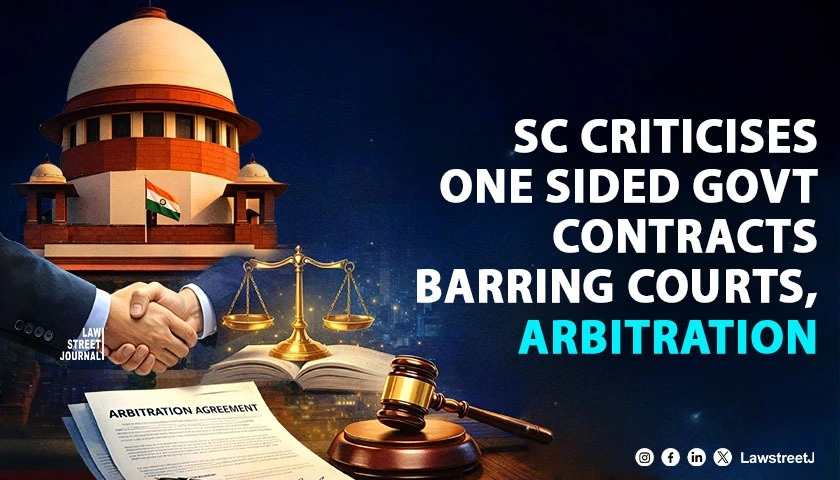
New Delhi: The Supreme Court of India has strongly deprecated one-sided clauses found in government contracts that limit or take away a private party’s right to access justice by approaching courts of law or an arbitrator.
A Bench of Justices JB Pardiwala and KV Viswanathan held that such clauses, when interpreted in the manner contended by the State, would be opposed to all canons of the Rule of Law, and that the legal maxim “ubi jus ibi remedium”—that there is no wrong without a remedy—cannot be abrogated by a contractual provision.
The Court further held that one party to a contract cannot decide whether the other party has committed a wilful breach or neglect when liability is disputed. Any such determination, where liability is contested, must be made by an independent adjudicatory forum, either a court or an arbitral tribunal. Accordingly, the Court allowed the appeals filed by M/s ABS Marine Services, set aside the judgment of the Division Bench of the High Court at Calcutta (Circuit Bench at Port Blair) dated 11.07.2018, and restored the arbitral award dated 08.05.2017.
The appeals arose from the judgment of the Division Bench of the High Court at Calcutta (Circuit Bench at Port Blair) in CAN No. 054 of 2018 with FMA No. 002 of 2018, whereby the Division Bench had set aside the award of the sole arbitrator dated 08.05.2017, as well as the order of the District Judge dated 08.01.2008, which had upheld the said award. The Division Bench held that the arbitral award was without jurisdiction and in derogation of the prohibitory clause contained in Clause 3.20 of the Manning Agreement between the parties.
On 26.12.2008, a Manning Agreement was entered into between the appellant, M/s ABS Marine Services, and the Andaman and Nicobar Administration for manning 17 vessels. Under the agreement, the appellant was responsible for providing the complement of officers on board the vessels at all times (Clause 2.1). The period of the contract was from 01.10.2008 to 30.09.2009 (Clause 3.14), and the fee payable was Rs. 12,67,200 per month per ship (Clause 3.15). By a separate agreement, the Shipping Corporation of India Ltd. was appointed as the Technical Manager for the vessels.
On 06.07.2009, the vessel M.V. Long Island, while on its way back to Campbell Bay from Mazahua, drifted from its intended track due to rough seas and struck a submerged rock. At high tide, it refloated on its own and proceeded to Campbell Bay under its own engines. On 15.02.2013, the respondent administration issued a show cause notice to the appellant as to why a penalty should not be imposed and recovery initiated. The appellant denied liability by reply dated 12.03.2013. On 25.09.2014, the respondent unilaterally recovered a sum of Rs. 2,87,84,305 towards penalty for grounding of the vessel from the appellant’s pending bills.
The matter was thereafter referred to arbitration pursuant to a Section 11 application. By order dated 02.11.2015, the Supreme Court appointed Hon’ble Mr. Justice S.S. Nijjar, a former Judge of the Supreme Court, as the sole arbitrator. By award dated 08.05.2017, the arbitrator held that Clause 3.20 of the agreement was void as it contravened Section 28 of the Indian Contract Act, 1872, since it placed a total restraint on any challenge in a court of law and also prohibited invocation of arbitration. The arbitrator harmoniously construed Clauses 3.20 and 3.22 and held that Clause 3.22 (the arbitration clause) would prevail. The arbitrator directed payment of Rs. 2,87,84,305 with interest at 9% from the date of recovery till the date of the award, along with costs of Rs. 27,21,222.
The respondent challenged the award under Section 34 of the Arbitration and Conciliation Act, 1996, but the application was dismissed by the District Judge, who also held that Clause 3.20 was contrary to Section 28 of the Indian Contract Act. On further appeal, the Division Bench of the High Court set aside the award, holding that the arbitrator, being a creature of the agreement, could not sit in judgment over the validity of the agreement’s clauses; that parties could decide which disputes are arbitrable; and that Clauses 3.20 and 3.22, read together, demarcated the limits of arbitral jurisdiction. It further held that, in view of Clause 3.20, the dispute fell within the “excepted matter” beyond the arbitrator’s jurisdiction.
Before the Supreme Court, the main question for consideration was whether the High Court’s reasoning in allowing the respondent’s Section 37 appeal was correct in law. The Court framed three principal lines of analysis.
First, the Court held that whether there was a wilful act of omission or negligence on the part of the appellant, when liability was disputed, could not be decided by the respondent administration itself. Relying on State of Karnataka v. Shree Rameshwara Rice Mills and J.G. Engineers Private Limited v. Union of India, the Court reiterated that a party cannot be an arbiter in its own cause.
Second, the Court held that the interpretation advanced by the respondent would strike at the very heart of the maxim “ubi jus ibi remedium”. Accepting such an interpretation would leave the appellant entirely without a remedy, as it would be barred from approaching both courts of law and an arbitrator—an outcome anathema to the Rule of Law.
Third, the Court held that no construction of a contract can be placed which leads to a vacuum in legal remedies. Relying on Sri Vedagiri Lakshmi Narasimha Swami Temple v. Induru Pattabhirami Reddi, the Court observed that any such construction would be incongruous. It also referred to Section 9 of the Code of Civil Procedure and Section 28 of the Indian Contract Act, which render void agreements placing an absolute restraint on enforcement of rights.
The Court clarified that Clause 3.20, on a correct reading, applies only where liability is not disputed and the administration merely quantifies the loss. It expressed reservations even about denying access to courts on the issue of wrongful quantification but refrained from a final determination on that aspect.
The Court further held that the only category of “excepted matter” under Clause 3.20 is where liability is admitted and only the quantum is in dispute—something that did not arise in the present case.
Delivering a strong message to State instrumentalities, the Court observed that such clauses foreclosing legal remedies should not be incorporated in contracts. It held:
“Matters may be ‘excepted’ from arbitration, for that is a well-recognized concept, but a vacuum in legal remedies cannot result. ‘Except’ matters one may, but ‘exclude’ justice, one cannot.”
Finding no grounds to interfere, the Court upheld the arbitral award and restored it. No order as to costs was made.
Case Title: M/s ABS Marine Services v. The Andaman and Nicobar Administration (2026 INSC 274)