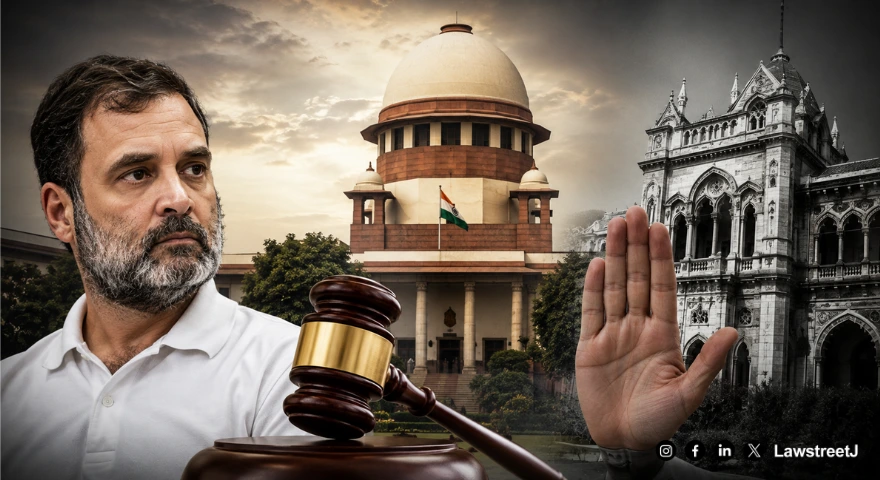
New Delhi/Allahabad : The Supreme Court of India on Monday granted significant relief to the Leader of the Opposition in the Lok Sabha, Rahul Gandhi, by staying proceedings before the Allahabad High Court in a case alleging possession of disproportionate assets.
A three-judge bench comprising Chief Justice of India Surya Kant, Justice Joymalya Bagchi, and Justice V. Mohana deferred the scheduled August 20, 2026, hearing before the High Court until further orders. The apex court also issued notices to the central investigative agencies and the complainant on Gandhi's plea challenging the High Court’s directions. Additionally, the bench restrained the Central Bureau of Investigation (CBI) and the Enforcement Directorate (ED) from submitting any investigative reports to the High Court in the interim.
During the hearing, the Supreme Court strongly questioned the procedural propriety of the Allahabad High Court in issuing directions without hearing the affected party first. Chief Justice Surya Kant observed that while investigative agencies possess independent statutory powers to act on prima facie evidence without court permission, courts must adhere to the principles of natural justice when issuing directions. Further, he also remarked that if a court wants to compel an investigation, it is expected to provide the party concerned with an opportunity to be heard.
The bench also turned its scrutiny toward the central agencies, questioning why they had remained inactive if the allegations were indeed serious. Justice Joymalya Bagchi pointedly asked Additional Solicitor General (ASG) S.V. Raju, representing the central agencies, why the CBI had kept quiet and whether it required an impetus or direction from the court to act. The court noted that if an agency has substantial information or material regarding disproportionate assets, it can proceed independently in accordance with the law rather than waiting for judicial intervention. Justice Bagchi observed that the agencies are fully empowered under their statutory duties to initiate action suo motu if they possess any verified material.
Senior Advocate Kapil Sibal, appearing for Rahul Gandhi, vigorously challenged the maintainability of the petition and described the proceedings as an unfortunate "witch-hunt". Sibal argued that the proceedings before the High Court were completely "unknown to law" and violated established legal principles laid down by the Supreme Court. He strongly questioned the locus standi and credentials of the complainant, S. Vignesh Shishir, accusing him of suppressing his background as an RSS worker and launching repetitive legal challenges against Gandhi. Sibal also raised serious concerns over the confidentiality of the proceedings, asking how details of in-chamber hearings and sealed-cover documents were routinely being leaked to the press.
In response, the complainant, S. Vignesh Shishir, who appeared virtually, argued that the case was still at a pre-FIR stage where the accused has no right of audience. Shishir cited Supreme Court precedents, including the three-judge bench ruling in CBI v. Devendra Ammal, to assert that an accused does not have the right to be heard before the formal registration of a First Information Report. Meanwhile, ASG S.V. Raju submitted that the CBI had not yet registered an FIR and had merely verified the received complaint. However, Raju contended that if the allegations in the complaint were correct, the matter would amount to a gross case of disproportionate assets that required proper investigation.
The ongoing legal dispute originated from a criminal writ petition filed under Article 226 of the Constitution by S. Vignesh Shishir, a BJP worker from Karnataka. In May 2026, the Lucknow Bench of the Allahabad High Court directed the CBI and ED to verify Shishir's claims that Gandhi and his family members possessed assets disproportionate to their known sources of income. On July 20, 2026, a division bench of Justice Rajesh Singh Chauhan and Justice Brij Raj Singh expressed deep dissatisfaction with the CBI's counter-affidavit, stating that the agency's response failed to clearly show the progress of its inquiry. The High Court subsequently ordered a senior Joint Director of the CBI to file a fresh status report. Gandhi challenged these directions in the Supreme Court, while also filing a transfer petition to move the case to the Delhi High Court.
Case title: Rahul Gandhi v. S. Vignesh Shishir and Others