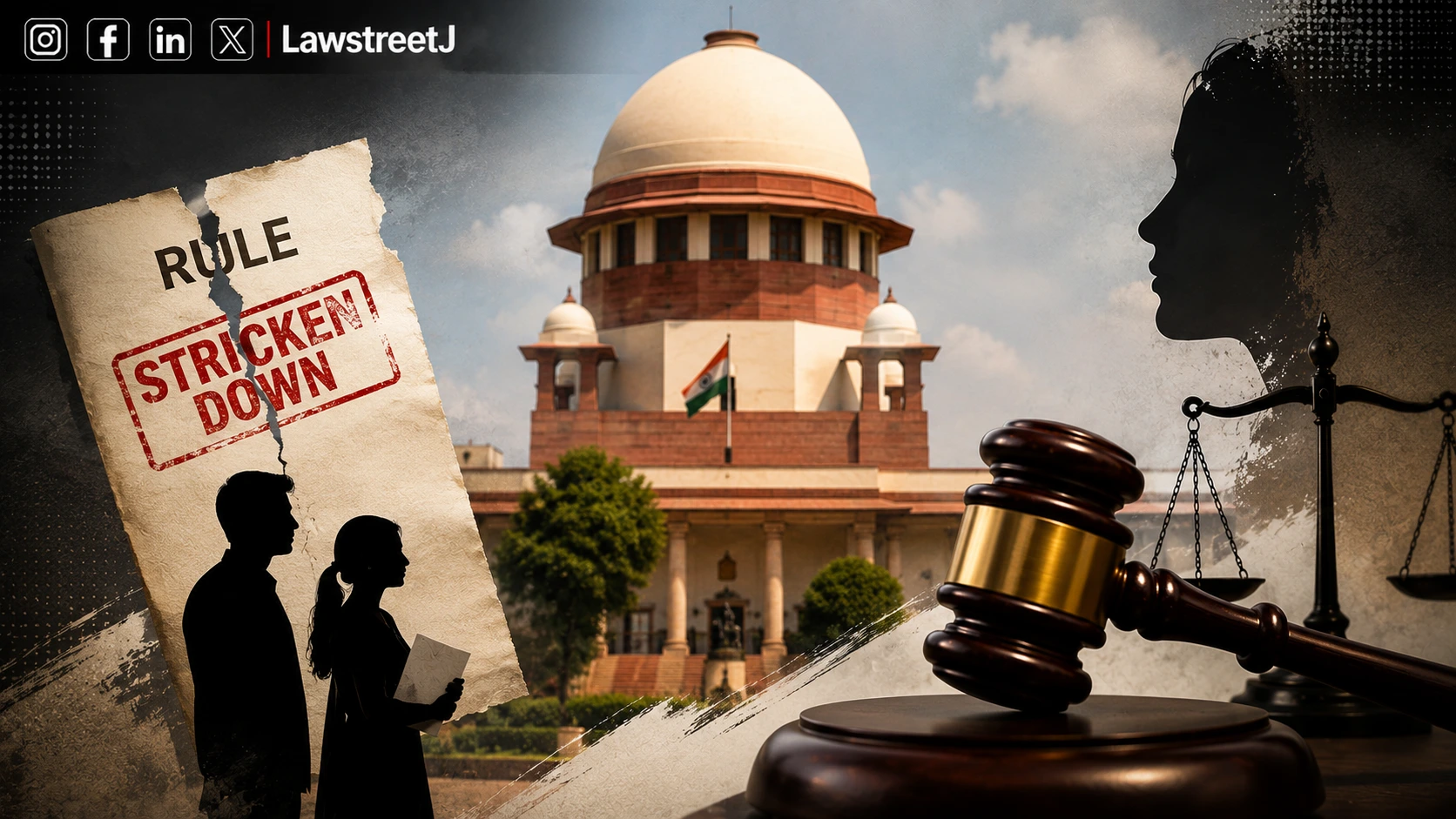
New Delhi: The Supreme Court has set aside a Patna High Court order denying compassionate appointment to a daughter, holding that a Bihar Government policy restricting such appointment to a 'divorced or deserted daughter' cannot be sustained in law, as any classification differentiating a daughter from a son is, per se, unconstitutional.
A Bench of Justices M.M. Sundresh and Prasanna B. Varale was hearing an appeal filed by Sayara Khatoon @ Shayara Khatoon and her daughter against the High Court's refusal to direct the State of Bihar to consider the daughter's appointment on compassionate grounds, following the death of the appellant's husband and the second appellant's father.
The High Court had rejected the claim on two grounds: an objection raised by the brother of the first appellant, and the Bihar Government's policy dated 10th December 2014, which confines eligibility for compassionate appointment of a daughter to cases where she is divorced or deserted.
Appearing for the appellants, counsel submitted that the brother in question had since furnished a no-objection certificate, so that ground no longer survived. On the policy itself, it was contended that restricting eligibility to a divorced or deserted daughter was violative of Article 14 of the Constitution, since it presumed that a married daughter ceases to be part of her parental family unless her marriage had formally broken down. The State, in response, submitted that the policy had not been under challenge, and that compassionate appointment was not a matter of right but was governed entirely by the terms of the policy, which proceeded on the rationale that a daughter is ordinarily expected to leave her parental home upon marriage.
The Court held that this rationale could not survive constitutional scrutiny.
"This Court has repeatedly held that any classification differentiating a daughter from a son is, per se, unconstitutional... There cannot be a presumption in law that, after marriage, a daughter severs her ties with her parental family and resides with husband in her matrimonial home."
The Court noted that although the first appellant's divorce had not been formally recognised in law, she had continued to live with her parental family and had the support of her mother and brother. It held that adopting a hyper-technical approach could not be a ground to deny consideration of her daughter's claim for compassionate appointment on merits, particularly since the brother's objection no longer survived.
Accordingly, the Court set aside the High Court's order as well as the order rejecting the claim for compassionate appointment, and directed the State to consider the appellant's case on merits within eight weeks from receipt of the order. The appeal was allowed.
Appearances:
For the Petitioner(s): Ms. Rashmi Singh, Advocate; Mrs. Priyansha Sharma, AOR; Mr. Subhan Shankar Gogoi, Advocate.
For the Respondent(s): Mr. Manish Kumar, AOR; Mr. Divyansh Mishra, Advocate; Mr. Kumar Saurav, Advocate.
Case Title: Sayara Khatoon @ Shayara Khatoon & Anr. v. State of Bihar & Ors., SLP(C) No. 11623 of 2026