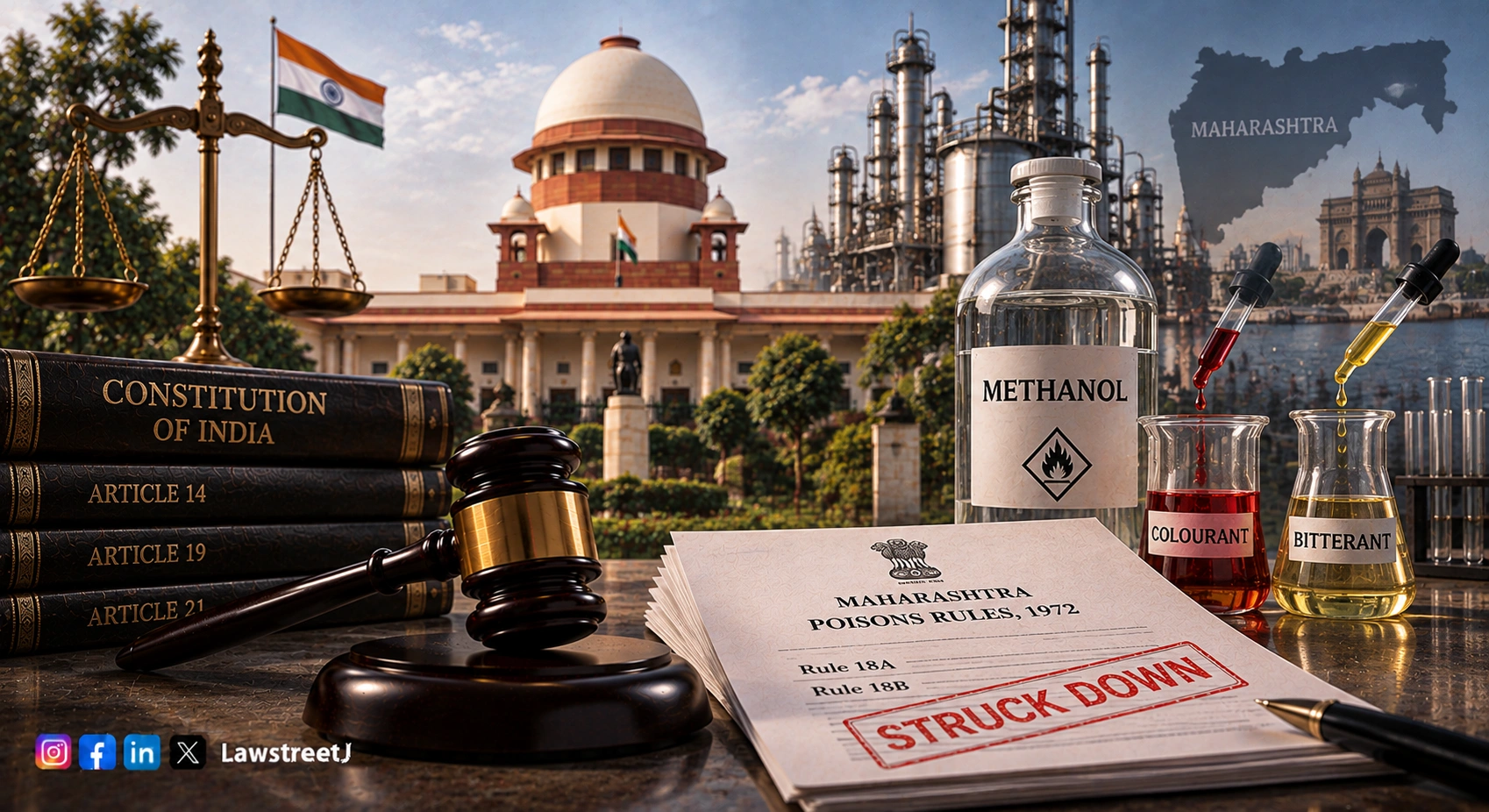
New Delhi: The Supreme Court has struck down Rules 18A and 18B of the Maharashtra Poisons Rules, 1972, which mandated licence-based verification and the addition of a bitterant and colourant to methanol before its sale to non-drug manufacturers, holding the provisions to be manifestly arbitrary, disproportionate, and violative of Articles 14 and 19(1)(g) of the Constitution.
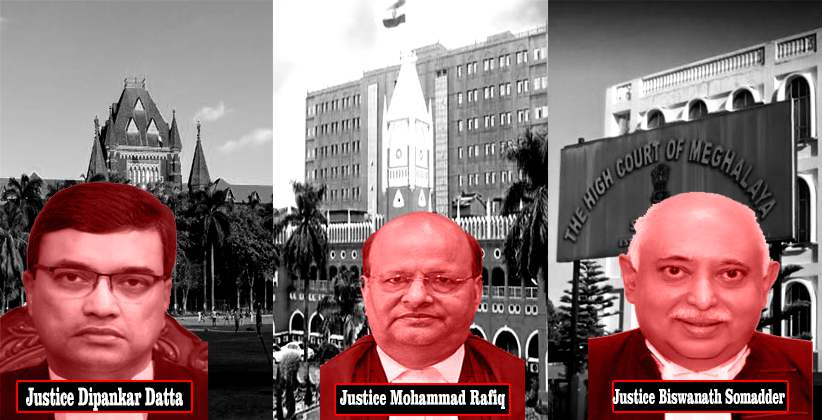
A Bench of Justices J.B. Pardiwala and K. Vinod Chandran was hearing Writ Petition (C) No. 893 of 2019 and Writ Petition (C) No. 1059 of 2019, filed by methanol-consuming manufacturers, along with Civil Appeal No. 13008 of 2026 arising from a judgment of the Bombay High Court which had upheld the impugned rules, all raising a common challenge to Rules 18A and 18B inserted into the Maharashtra Poisons Rules by a 2011 notification.
The dispute arose from Notification No. DRG 2006/1006/C.R. 659/06/DRUGS-2 dated 21.01.2011, issued after a 1991 hooch tragedy in which around 250 persons consumed spurious liquor from a bar in Andheri, Mumbai, and 93 died. A Committee headed by P.R. Parthasarthy, Additional Director General of Police, examined the causes and recommended measures, one of which was translated into the notification. Rule 18A required a licensee selling methanol to verify the purchaser's Form A licence and to mix a colourant and bitterant into methanol before sale, barring sale for certified drug manufacture, while Rule 18B provided for confiscation of methanol held without a Form A licence. The rules were challenged before the Bombay High Court, which upheld their validity, prompting the present appeal, while two connected writ petitions were filed directly before the Supreme Court by industries using methanol as a raw material. The High Court had earlier granted interim relief permitting purchase by non-drug manufacturers subject to submission of purchase orders to the Food and Drug Administration, an arrangement that continued for roughly fourteen years by the time of this decision.
Mr. Balbir Singh, senior counsel for the petitioners, submitted that methanol was a key raw material for products such as formaldehyde, disinfectants, paraformaldehyde, decorative laminates, paints and resins, and that mandatory denaturation rendered these end-products commercially unacceptable to downstream industries, including pharmaceutical and dye manufacturers. He argued that the 2011 notification was disproportionate and arbitrary, violating Article 14, and was not a reasonable restriction on the fundamental right to carry on trade or business under Article 19(1)(g). He pointed out that methanol was already comprehensively regulated under the Petroleum Rules as a Class 'A' hazardous product, requiring licensed storage, approved transport tankers, and mandatory survey and sealing at dispatch, safeguards that already guarded against pilferage and made the impugned rules superfluous. He contended that producers would effectively be forced either to export methanol out of Maharashtra or halt production altogether. On Rule 18A, he submitted that Form A did not record a purchaser's actual end-use or business, making the ascertainment exercise contemplated by the rule practically unworkable, and he further alleged that the prescribed colourant contained carcinogenic material capable of promoting cancer-causing cell formation. On this basis, the petitioners urged that the impugned rules were an unreasonable and disproportionate exercise of power, liable to be struck down as violative of Articles 14 and 19(1)(g).
Mr. Anand Dilip Landge, counsel for the State of Maharashtra, submitted that the real question was whether a rule enacted to keep colourless, odourless methanol from being mistaken for potable alcohol could be struck down merely because a commercial user preferred a different regulatory method. He argued that since methanol could be indistinguishably mixed with liquor with fatal consequences, the notification bore a direct nexus with preventing such misuse through visual and taste-based identification, and that the rules regulated sale alone without prohibiting manufacture or import. He submitted that the State's power to regulate sale under Sections 2 and 8 of the Poisons Act permitted it to prescribe conditions making methanol identifiable and less prone to misuse, relying on Goodwill Paint & Chemical Industry v. Union of India, 1992 Supp (1) SCC 16, to argue that inherently dangerous consequences of trade in poisons justified statutory restriction. He maintained that the restriction was proportionate since other safeguards, such as sealed tankers and petroleum-safety licences, served different purposes and did not prevent diversion after transport, unlawful resale, substitution, or the making of illicit liquor. He accordingly prayed for dismissal of the petitions and vacation of interim protection, or, alternatively, that issues of additive specification, certification and licensing be left to the competent authority for a time-bound decision without disturbing the notification's validity.
The Court held that Rule 18A(1) was disproportionate, since verification of a Form A licence, meant for sellers and possessors of poison rather than end-users, could not actually establish the ultimate use of methanol, and that the rule effectively rendered the separate Form B permit for purchasers redundant.
On Rule 18A(2), the Court found that the Parthasarthy Committee itself had identified multiple causes of hooch tragedies, including illegal diversion, pilferage, corruption, and confusion between ethyl and methyl alcohol, most of which occurred outside the point of lawful sale that the rule sought to regulate. Affidavits filed by industries such as Balaji Formalin, Aarti Industries, Akyl Chemicals, Balaji Amines, and Thermo Fisher Scientific showed that the additives damaged catalysts, left residues incompatible with pharmaceutical and dye applications, and rendered high-purity products commercially unusable.
Emphasising that denaturation only enabled identification and did not prevent diversion, pilferage, or the making of spurious liquor with other adulterants, the Court remarked that the exercise was “like rearranging the deck chairs on the Titanic”, addressing only a surface-level aspect of the problem.
Applying the four-part proportionality test laid down in K.S. Puttaswamy (Privacy-9 J.) v. Union of India, (2017) 10 SCC 1, the Court found that while the aim of preventing methanol-related liquor deaths was legitimate, the impugned rules were not suitable to achieve it, that less restrictive alternatives such as stricter transport and storage safeguards already existed but remained unimplemented, and that the burden on industry was disproportionate to the speculative benefit of mere identification.
The Court further held that Rule 18B, providing for confiscation of methanol held without a Form A licence, rendered the Form B permit route unworkable and otiose for persons lawfully in possession of methanol as raw material.
Accordingly, the Court declared Rules 18A and 18B of the Maharashtra Poisons Rules to be violative of Articles 14 and 19(1)(g) of the Constitution, allowed the writ petitions, and disposed of the civil appeal in similar terms. The Bench also issued a set of non-binding suggestions to States on curbing hooch tragedies, including inter-departmental coordination, stricter licensing and stock-reconciliation norms, tamper-evident sealing of methanol transport, and strengthening of health, de-addiction and awareness infrastructure, directing the Registry to forward copies of the judgment to all High Courts and Chief Secretaries.
Appearances:
For the Petitioners/Appellant: Mr. Balbir Singh, Senior Advocate.
For the Respondent-State: Mr. Anand Dilip Landge, Advocate.
Case Title: M/s Balaji Formalin Pvt. Ltd. & Anr. vs. Union of India & Anr., Writ Petition (C) No. 893 of 2019, with Writ Petition (C) No. 1059 of 2019, and Indian Chemical Council vs. State of Maharashtra, Civil Appeal No. 13008 of 2026 (@ SLP(C) No. 16236 of 2019)