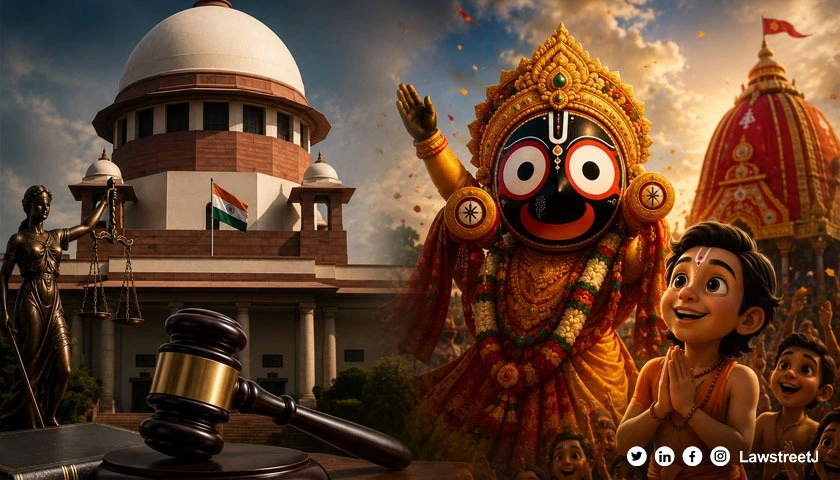
New Delhi: The Supreme Court of India has firmly rejected a plea to ban the animated film "Mahaprabhu Jagannath," asserting that the judiciary cannot be used as a tool to stifle creativity or artistic expression based on the sensitivities of a few individuals. A bench comprising Justices B.V. Nagarathna and R. Mahadevan dismissed a modification application filed by the Odisha government and the Shree Jagannath Temple Administration (SJTA), which sought to reconsider a prior order allowing the film’s nationwide release after the conclusion of the Rath Yatra festival.
The controversy began with a Public Interest Litigation (PIL) filed in the Orissa High Court by Mahesh Kumar Sahu, which alleged that the film’s depiction of Lord Jagannath was inconsistent with religious scriptures like the Skanda Purana and the Brahma Purana. The petitioners raised serious objections to fictionalized portrayals of the deity’s childhood, personal adventures, and battle sequences. They contended that presenting Lord Jagannath in an animated "cartoon" format was offensive and had the potential to shatter the religious sentiments of millions of devotees.
In response to these concerns, the Orissa High Court initially granted an interim stay on the film’s release, which had been scheduled for July 17, 2026. The High Court observed that while films enjoy constitutional protection under Article 19(1)(a), this freedom must be balanced against the need to maintain public order and religious harmony. The court noted that screening the film during the commencement of the Rath Yatra, a period of massive congregation, would be "counterproductive" and could lead to societal unrest.
The producer of the film, Ele Animations Pvt. Ltd., subsequently approached the Supreme Court to challenge the stay. The producer argued that the film had already received 'U' (Universal) certificates from the Central Board of Film Certification (CBFC) for its Hindi, Telugu, and Odia versions. Highlighting an investment of approximately Rs 10 crore, the producer stated that a last-minute ban would result in irreparable financial and reputational injury. They further maintained that the animated feature was a fictional work intended for children and carried an express disclaimer to that effect.
On July 17, 2026, the Supreme Court modified the High Court's direction. While the bench declined to permit an immediate release during the sensitive festival period, it ordered that the film could be exhibited nationwide on or after July 28, following the completion of the Rath Yatra rituals in Puri.
Despite this, the Odisha government moved the Apex Court again just before the new release date, seeking further modifications. The state's Advocate General, Pitambar Acharya, submitted that a special screening for religious heads and temple authorities had led to widespread dissatisfaction. He alleged that the producers had failed to incorporate promised changes and argued that portraying the deity in a "cartoon form," which he compared to characters like "Doraemon" or "Spider-Man," was inherently disrespectful to the established traditions of Sanatan Dharma.
Justice Nagarathna, however, expressed strong reservations regarding the use of judicial power to suppress art. She remarked that if courts were to entertain every objection based on subjective sensitivity, it would lead to a situation where no art form including television versions of the Ramayana or Mahabharata could exist in India. The bench noted that animation is a vital tool for introducing children to mythology in a digital age and questioned whether the faith of devotees was truly so fragile as to be diminished by an animated film.
The Court emphasized the role of the CBFC as an expert statutory body that had already cleared the film after considering all relevant parameters. Citing established legal principles, the bench held that once a statutory body clearing a film has considered its public impact, a state government cannot use potential law-and-order issues as a justification to review or suppress that decision. The judiciary, the bench clarified, cannot sit in judgment over a filmmaker’s research or creative prerogatives.
Ultimately, the Supreme Court dismissed the application for modification, reiterating that creative depictions do not erode religious devotion. The bench concluded that artists must not be "taken to ransom" by isolated objections and that the film's release should proceed. While the court noted that any voluntary modifications would be a matter for the filmmaker’s own conscience, it refused to impose any further judicial curbs on the project.
Case title: Ele Animations Pvt. Ltd. v. Mahesh Kumar Sahu and others