

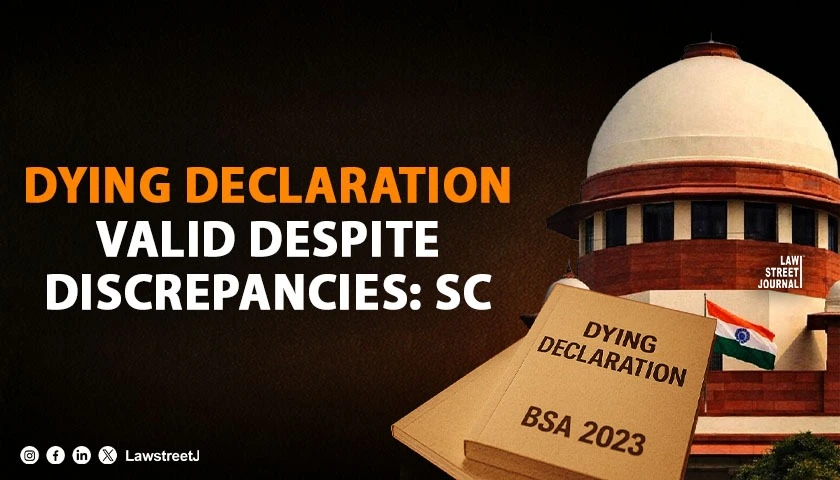
New Delhi: The Supreme Court of India has held that minor discrepancies in the statements of certain witnesses, including the investigating officer, would not be sufficient to discredit a dying declaration when the attending doctor had certified the deceased to be in a fit condition to make it.
A Bench comprising Justice Pankaj Mithal and Justice S.V.N. Bhatti held that the dying declaration of the deceased was reliable and adequately proved. The High Court’s reversal of the trial court’s acquittal was upheld in its entirety.
The Court noted that Subramani and Chennamma had been married for seventeen years and had four children. Their marriage had turned troubled after the first three years. The appellant was alleged to have frequently beaten the deceased and made persistent demands for money from her family. On the night of July 20, 2000, a quarrel broke out between them. The appellant left the house, returned with kerosene, poured it on the deceased inside their bathroom, and set her ablaze using a lit candle. He then fled the scene. Neighbours who heard the deceased’s screams came to her aid and doused the fire. She was taken to Victoria Hospital, Bangalore, around midnight and died three days later, on July 24, 2000, from septicaemia caused by burn injuries covering 80 to 90 percent of her body.
The Court placed significant weight on the testimony of PW-3, the sixteen-year-old eldest daughter of the couple. She was an eyewitness to the incident and had clearly stated that she saw her father bring the kerosene, pour it on her mother, and set her on fire at around 11:00 p.m. The Court found no inconsistency in her account. It also found no reason why she would falsely testify against her own father. Her testimony was treated as clinching evidence against the appellant.
The dying declaration of the deceased, recorded as Exhibit P-12, was recorded by a Head Constable of SR Nagar Police Station. The statement was recorded over approximately half an hour. Since the deceased was unable to sign, she placed her left thumb impression on it. The doctor endorsed and signed the statement, certifying that she was in a fit mental state to make it. The deceased stated that her husband used to quarrel with her, demand money from her parents, beat her, and had, on the night of the incident, poured kerosene on her and set her on fire.
The Court took note of the evidence of two treating doctors. PW-11, Dr. H.C. Ramanna, had examined the deceased upon her admission and confirmed that she was conscious. He gave permission to the police to record her statement after being satisfied with her condition. PW-10, Dr. Gurumurthy, who was in charge of the burns ward, also treated her and confirmed that the deceased herself had told him that her husband had quarrelled with her, assaulted her, poured diesel on her, and set her on fire. PW-4, Dr. S. Rudramurthy, who conducted the post-mortem, confirmed that the death occurred due to septicaemia resulting from the burn injuries and that the injuries were ante-mortem in nature.
On the question of the dying declaration’s reliability, the Court addressed the argument that the deceased could not have made a coherent statement given the extent of her injuries. The Court held that although the deceased may have momentarily lost consciousness due to sedation, the burns were superficial in nature and she was conscious for most of the time. The doctor’s certification was found to be credible. The absence of a nurse during the recording of the statement was held not to be fatal to the dying declaration. The Court, therefore, found no adverse material to suggest that the statement was not recorded properly or that the deceased was not in a fit state.
The Court also addressed the discrepancy arising from the OPD case sheet, which recorded that the deceased had set herself on fire. The attending doctor stated that he did not know who had recorded that entry. The Court did not treat this as sufficient to discredit the dying declaration, particularly since the doctor had later certified that she was fit to make a statement and had separately recorded her account implicating the appellant.
The trial court had acquitted the appellant primarily on the grounds that the bathroom was too small for the incident to have taken place as described, that family witnesses were unreliable, and that the extent of injuries made it unlikely that the deceased was in a state to make any declaration.
The Supreme Court rejected these findings. It held that the High Court was fully justified in reversing the acquittal and convicting the appellant under Sections 302 and 498A of the Indian Penal Code.
The sentence of life imprisonment for murder and two years of simple imprisonment for cruelty, along with the respective fines, was confirmed.
The appeal was dismissed. The appellant, who had been on bail, was directed to surrender forthwith to serve the remaining portion of his sentence.
Case Title: Subramani v. State of Karnataka (2026 INSC 249)