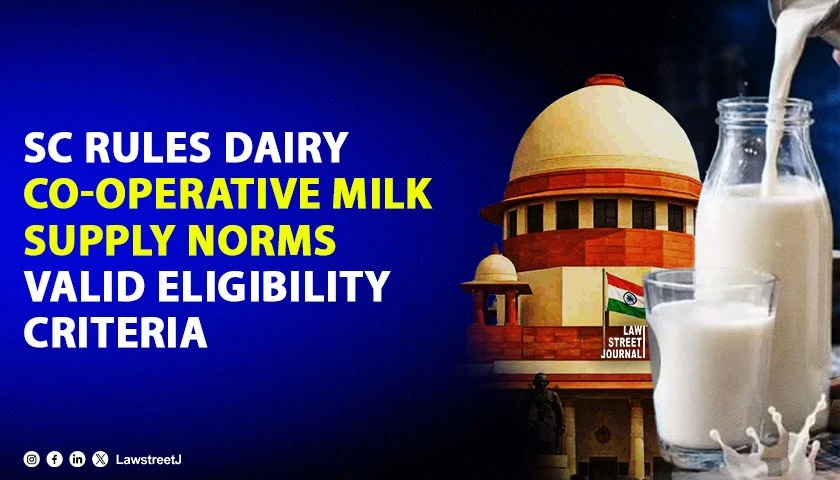
New Delhi: Supreme Court of India has held that bye-laws framed by District Milk Producers’ Co-operative Unions in Rajasthan, prescribing minimum milk supply days, audit classification standards, and operational continuity requirements as conditions for contesting elections to the Board of Directors, constitute valid eligibility criteria and do not amount to statutory disqualifications under the Rajasthan Co-operative Societies Act, 2001.
The Court further held that the writ petitions challenging these bye-laws were not maintainable before the High Court, as the District Milk Unions do not qualify as “State” within the meaning of Article 12 of the Constitution, and an efficacious statutory remedy under the Act was available but not exhausted. Additionally, the Court found that the High Court committed a jurisdictional error by striking down the bye-laws in their entirety without hearing several affected Co-operative Unions that were not impleaded in the proceedings.
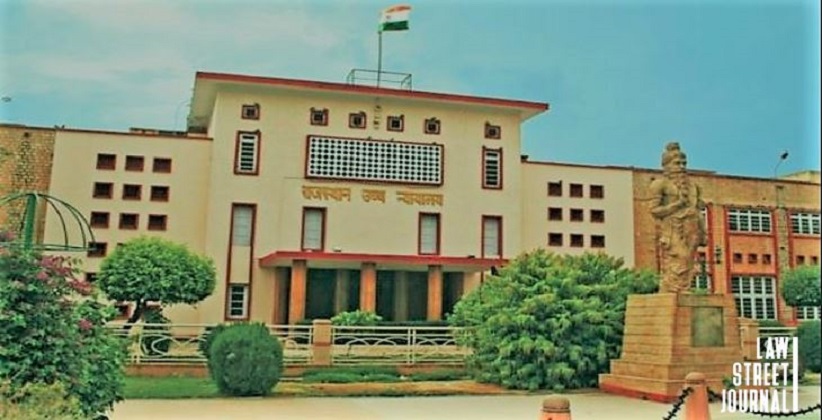
The present Civil Appeal arose out of a judgment dated 18.05.2022 passed by the Division Bench of the High Court of Rajasthan at Jodhpur, which dismissed the State’s intra-court appeal and affirmed the Single Judge’s order dated 24.07.2015, which had declared Bye-law Nos. 20.1(2), 20.1(4), 20.2(7), and 20.2(9) to be ultra vires the Act, 2001.
The impugned bye-laws prescribed that the President of a primary society would not be entitled to contest elections to the Board of Directors of the District Milk Union if: the society was classified below the prescribed audit category (Bye-law 20.1(2)); the society remained closed for more than 90 days, except in cases of natural calamity (Bye-law 20.1(4)); the society had not supplied milk for at least 270 days to the Sangh (Bye-law 20.2(7)); or the society had failed to supply the minimum prescribed quantity of milk (Bye-law 20.2(9)).
The appellants, Chairpersons of five District Milk Producers’ Co-operative Unions, were not parties to the original writ proceedings before the High Court but were directly affected by the judgment. The Court held that they had locus standi to prefer the appeal, reiterating that a person aggrieved by a judgment, even if not formally impleaded, may maintain an appeal where the decision has civil consequences or prejudicially affects their rights. Reliance was placed on Ram Janam Singh v. State of U.P., (1994) 2 SCC 622.
On the preliminary issue of maintainability of writ proceedings, the Court held that the District Milk Unions are autonomous, member-driven co-operative bodies not owned, financially controlled, or administratively dominated by the State in any manner that would render them instrumentalities of the State under Article 12. Relying on Thalappalam Service Co-operative Bank Ltd. v. State of Kerala, (2013) 16 SCC 82, and Federal Bank Ltd. v. Sagar Thomas, (2003) 10 SCC 733, the Court held that mere regulatory oversight by the Registrar or supervisory control under the statute does not transform an independent co-operative into an instrumentality of the State. A writ under Article 226 lies against a non-State entity only where it is shown to be discharging a statutory or public duty of a public law character, which was absent here.
The Court further held that even if maintainability were assumed, the writ petitioners had bypassed a comprehensive statutory dispute resolution mechanism under the Act, 2001. Section 58(2)(c) categorically deems any dispute arising in connection with the election of an officer of a co-operative society to be a dispute touching its constitution or management, vesting exclusive jurisdiction in the Registrar. The Act provides a full hierarchy of remedies, including appeals under Sections 104 and 105, review under Section 106, and revision under Section 107. The Court held that, in the absence of any challenge to the vires of the parent Act, or any allegation that the statutory remedies were illusory, the High Court ought to have rejected the writ petitions at the threshold. Reliance was placed on Titaghur Paper Mills Co. Ltd. v. State of Orissa, (1983) 2 SCC 433.
On merits, the Supreme Court held that the High Court had fundamentally erred in conflating the right to vote with the distinct right to contest elections. The Court reiterated that neither the right to vote nor the right to contest an election is a fundamental right. The two rights are distinct, and the right to contest is subject to stricter regulations, such as qualifications, disqualifications, and institutional requirements. Relying on Jyoti Basu v. Debi Ghosal, AIR 1982 SC 983; K. Krishna Murthy v. Union of India, (2010) 7 SCC 202; and Supreme Court Bar Association v. B.D. Kaushik, (2011) 13 SCC 774, the Court reaffirmed that the right to contest is a purely statutory right subject to eligibility conditions. The impugned bye-laws did not restrict the right to vote; they regulated who may stand as a candidate or continue in office based on functional participation thresholds.
The Court further distinguished between eligibility conditions and statutory disqualifications under Section 28 of the Act, 2001. Disqualifications operate as statutory disabilities that render an otherwise eligible person ineligible due to a supervening or disabling factor. Eligibility conditions, by contrast, are threshold qualifications governing entry into the electoral arena—positive, objective, and performance-oriented.
The impugned bye-laws requiring audit classification, continuity of operations, minimum days of supply, and minimum quantity of supply were uniformly applicable, intrinsically linked to the functional performance of the primary society, and did not carry any stigma or permanent exclusion. They were, therefore, eligibility criteria and not disqualifications.
On the source of power to frame the bye-laws, the Court held that they were directly traceable to Section 8 read with Schedule B of the Act, 2001, specifically Clause (da), which permits prescription of norms regarding minimum essential utilisation of services, and Clause (v), which authorises a society to send a representative to another society. Section 18 of the Act further recognises that a member’s exercise of membership rights may be conditioned on minimum participation. The Court rejected the contention of excessive delegation, finding the policy clearly discernible from the Act’s scheme and Schedule B. Relying on State of T.N. v. P. Krishnamurthy, (2006) 4 SCC 517, and Naresh Chandra Agrawal v. ICAI, (2024) 13 SCC 241, the Court held that the bye-laws were intra vires, supplemented rather than supplanted the Act, and were rationally connected to the object of ensuring democratic and effective management by genuinely participating members.
The Court also held that the High Court had committed a jurisdictional and procedural error by striking down the bye-laws across all District Milk Unions in the State, including those not impleaded in the writ proceedings. Such a determination, operating in rem, could not be rendered without affording all affected parties an opportunity of hearing. Relying on Dattatreya v. Mahaveer, (2004) 10 SCC 665, and High Court Bar Association Allahabad v. State of U.P., (2021) 7 SCC 77, the Court held that this was a substantive violation of audi alteram partem and not a mere technical defect. This transgressed the limits of writ jurisdiction, which is structured around adjudication of rights inter partes.
Allowing the appeal, the Court set aside the impugned judgment and order of the High Court and upheld the validity of the bye-laws. There was no order as to costs.
Case Title: Ram Chandra Choudhary & Ors. v. Roop Nagar Dugdh Utpadak Sahakari Samiti Limited and Others, Civil Appeal No. 4352 of 2026 [Arising out of SLP (C) No. 38579 of 2025]