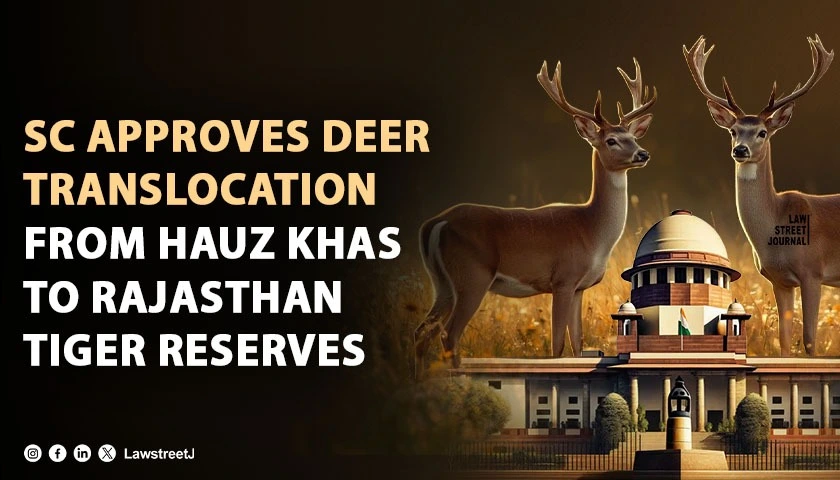
New Delhi: The Supreme Court of India has upheld the decision to translocate hundreds of deer from A.N. Jha Deer Park, Hauz Khas, New Delhi, to Ramgarh Vishdhari Tiger Reserve (RVTR) and Mukundara Hills Tiger Reserve (MHTR) in Rajasthan, accepting in their entirety the recommendations of the Central Empowered Committee (CEC).
The bench comprising Justice Vikram Nath and Justice Sandeep Mehta directed that the translocation be carried out in a time-bound, scientifically supervised manner. The Court further directed the Ministry of Environment, Forest and Climate Change (MoEFCC) to implement the comprehensive wildlife translocation guidelines framed by the CEC within six months and to accord them statutory status.
The petitioner, New Delhi Nature Society through Verhaen Khanna, had challenged before the Supreme Court the orders of the Delhi High Court which had permitted the translocation of deer from A.N. Jha Deer Park. By its order dated 19 July 2024, the Delhi High Court had accepted an affidavit filed by the Delhi Development Authority (DDA) proposing that approximately two dozen deer be retained at the park, subject to renewal of its “mini zoo” recognition by the Central Zoo Authority (CZA), with the remaining deer being translocated to forest areas in neighbouring States. The High Court had accordingly permitted resumption of the translocation process. An application by the petitioner seeking recall of this order was dismissed by the High Court on 24 January 2025, giving rise to the present special leave petitions.
By its earlier order dated 26 November 2025, the Supreme Court had taken cognisance of the manner in which the translocation had been carried out and issued several directions, noting that the exercise had been undertaken without adequate scientific safeguards. The Court had directed the Central Empowered Committee to conduct an on-ground survey of A.N. Jha Deer Park to assess its carrying capacity, inspect the release sites in Rajasthan, and prepare a comprehensive roadmap for future translocations in conformity with the domestic statutory regime and International Union for Conservation of Nature (IUCN) Guidelines. The Court had also imposed a moratorium on any further translocation of deer pending receipt of the CEC’s report and directed the DDA to refrain from organising commercial events within the park precincts.
In compliance with those directions, the CEC submitted a detailed report dated 6 March 2026 running into 428 pages, along with suggested Standard Operating Procedures (SOPs) for translocation. The CEC assessed the carrying capacity of the existing deer enclosure by reference to the Guidelines for Establishment and Scientific Management of Zoos in India, 2008 issued by the Central Zoo Authority, which prescribes a minimum outdoor enclosure area of 1,500 sq. metres per pair of spotted deer. Treating approximately 70% of the gross enclosure area as net usable space, the CEC concluded that the existing enclosure of about 10.26 acres can sustainably accommodate approximately 38 deer, with an optimal sex ratio of 15 males to 23 females.
The CEC further noted that the Central Zoo Authority had, in exercise of its powers under Section 38H(6) of the Wild Life (Protection) Act, 1972, cancelled the recognition of A.N. Jha Deer Park as a “mini zoo” on account of persistent non-compliance with zoo management norms, failure to regulate the deer population, and the expiry of its licence in August 2021. The CEC observed that the deer population had increased exponentially in the absence of effective population control and sterilisation measures, and that continued retention of the deer without a duly recognised statutory authority to ensure their proper management was impermissible in law.
The CEC examined whether intra-park or inter-park relocation within Delhi could serve as an alternative to translocation to Rajasthan. After inspecting certain additional areas within A.N. Jha Deer Park and visiting Arun Jaitley Park, Siri Fort Road, New Delhi, as suggested by the petitioner, the CEC concluded that such relocation would merely shift, rather than resolve, the existing management concerns, and could not be regarded as a sustainable long-term solution in the absence of substantive improvements in habitat quality, enclosure design, staffing, and veterinary infrastructure.
On the question of translocation to tiger reserves, the CEC found that when undertaken with appropriate scientific and regulatory safeguards, the translocation of captive-managed spotted deer into ecologically suitable tiger reserves is scientifically justified, ethically defensible, and consistent with applicable national and international conservation norms. It observed that natural predation upon translocated prey species represents successful ecological integration and contributes to population regulation, genetic fitness, and trophic balance. The CEC also prepared a comprehensive roadmap for future wildlife translocations with the involvement of former officials of the Central Zoo Authority and the MoEFCC, laying down standardised procedures grounded in statutory requirements, international best practices, and animal welfare considerations.
On behalf of the petitioner, it was contended that the decision to translocate was unjustified and that there exists sufficient contiguous land around A.N. Jha Deer Park which could be utilised for accommodating the increased deer population. It was urged that habitat expansion within the existing precincts would ensure continuity of a controlled and familiar environment for the deer while addressing concerns of overcrowding, without exposing the animals to the stress and survival challenges of relocation to unfamiliar forest ecosystems.
The Supreme Court, however, declined to accept this contention. The Court noted that the CZA had already cancelled the recognition of the park as a mini zoo, and that the local authorities lacked the requisite financial resources and infrastructural capacity to effectively sustain the objectives for which the deer park was established. The Court observed that it could not be unmindful of the fact that deer, being a wild species, ought not to be confined to cages or restrictive enclosures save in exceptional and compelling circumstances duly justified in law and on ecological considerations. Accordingly, the Court affirmed the approach of the Delhi High Court as pragmatic and reasoned and found the impugned orders free from legal infirmity.
The Court accepted all the recommendations of the CEC and directed the concerned authorities to carry out the translocation of deer from A.N. Jha Deer Park in a time-bound manner under the supervision of the CEC and in strict adherence to the draft guidelines on Animal Translocation framed by the CEC. The Court directed that retention of up to 38 deer at A.N. Jha Deer Park would be permissible only upon the grant of requisite approvals and clearances by the Central Zoo Authority, and that the DDA must ensure that the retained population has an optimal sex ratio of 15 males to 23 females. It further directed that the area comprising A.N. Jha Deer Park stands declared as a protected forest and that its nature and status shall not be altered under any circumstances.
The Court also directed that the comprehensive guidelines prepared by the CEC for future wildlife translocations, incorporating scientific methodology, identification and tagging protocols, procedural safeguards, transportation and veterinary requirements, ecological feasibility assessment, and a post-release monitoring framework in conformity with the applicable statutory regime and IUCN Guidelines, shall be examined by MoEFCC and implemented with such modifications as it deems appropriate within six months, and accorded statutory status. The Registry was directed to transmit a copy of the order along with the CEC report to MoEFCC for compliance. The matter was listed for 19 January 2027 for receipt of the compliance report.
Case Title: New Delhi Nature Society through Verhaen Khanna v. Director Horticulture DDA & Ors.
[SLP (Civil) Nos. 13374–13375 of 2025] [2026 INSC 419]