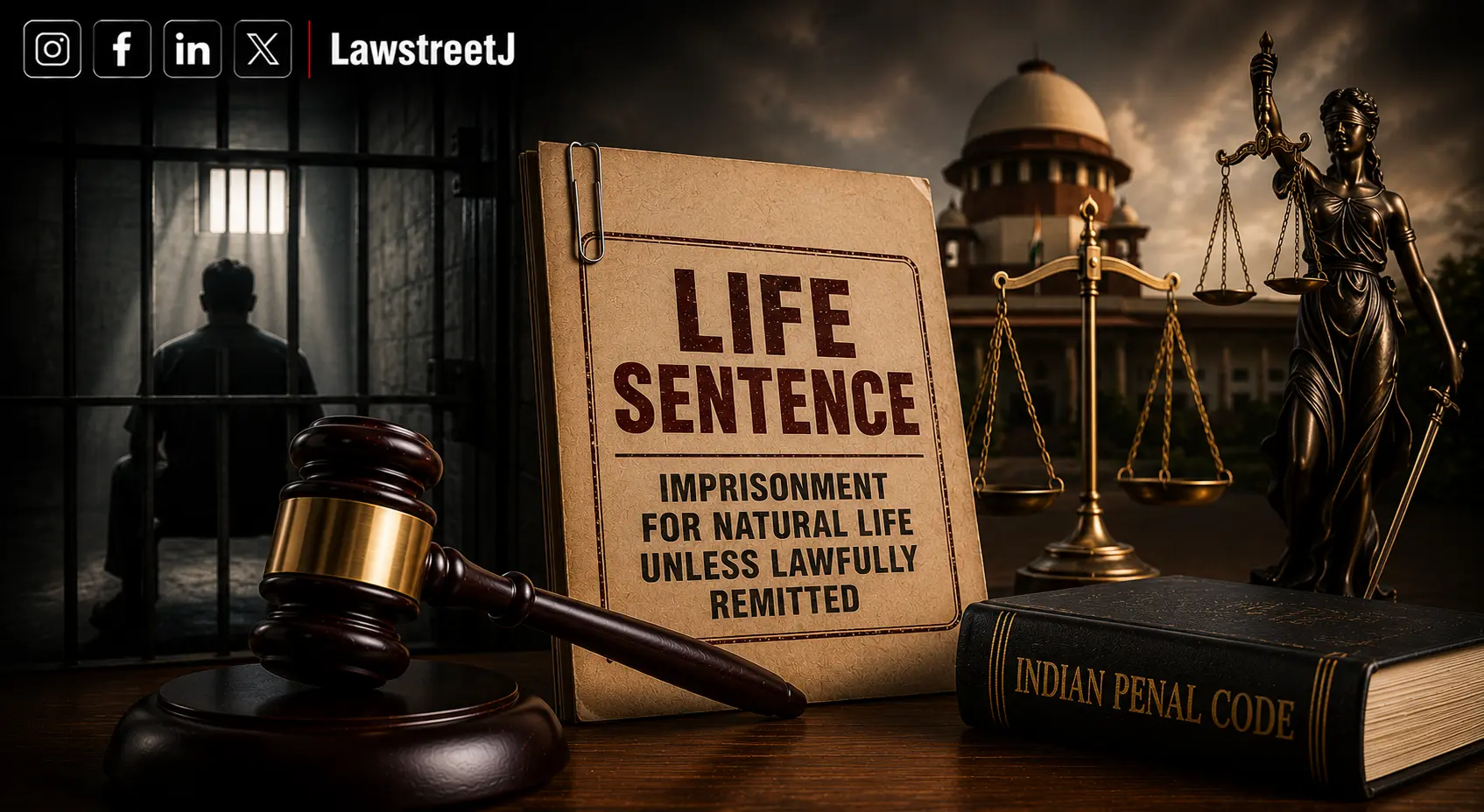
New Delhi: The Supreme Court has dismissed a batch of writ petitions filed under Article 32 by four death-row convicts whose sentences were commuted to ‘imprisonment for the remainder of natural life’, holding that such a sentence is constitutionally valid and that the Court cannot, in exercise of its writ jurisdiction, sit in appeal over clemency orders already passed by the President of India.
The Bench of Justice Sanjay Karol and Justice Augustine George Masih heard four tagged writ petitions raising common questions, with the assistance of the Attorney General for India, Mr. R. Venkataramani, along with Senior Counsel Mr. Rishi Malhotra for the petitioners and Additional Solicitors General Mr. S.V. Raju and Mr. Raja S. Thakare for the respondents.
The lead petitioner, Ramasrey @ Fakkad, had his death sentence under Sections 364A, 302 and 201 IPC modified to imprisonment for the remainder of natural life by the Allahabad High Court, and his subsequent SLP was dismissed as withdrawn in 2015. He contended that Section 302 IPC contemplates only death or life imprisonment, and that a sentence of imprisonment for the remainder of natural life is unconstitutional. Similar contentions were raised by Chander Kant Jha, whose death sentence for offences under Sections 302 and 201 IPC was modified by the Delhi High Court, with the State's appeal against the modification dismissed in 2019.
The remaining two petitions arose from a different footing – both petitioners, Atbir Singh and, jointly, Sarabjit Singh, Gurdev Singh @ Baldev Singh and Satnam Singh, had their death sentences commuted by the President of India in exercise of clemency power under Article 72, to imprisonment for the remainder of natural life without remission or parole. Their challenge additionally raised the question of whether such clemency orders were open to judicial review or modification by the Court.
Three questions arose for consideration: the constitutionality of the sentence awarded; whether judicial review of the President's clemency power is permissible under Article 32 or Article 136; and whether the Court could modify a sentence already modified in exercise of power under Article 72.
On the preliminary objection to maintainability, the Court traced the scope of Article 32, noting that while the right to approach the Supreme Court for enforcement of fundamental rights is itself a fundamental right and part of the basic structure per ‘L. Chandra Kumar v. Union of India’, this Court does not entertain such petitions in all circumstances and generally requires a showing that recourse to the jurisdictional High Court would not have been appropriate. Reference was made to ‘Daryao v. State of U.P.’, ‘Vasanta Sampat Dupare v. Union of India’ and ‘Bilkis Yakub Rasool v. Union of India’ on the equitable and discretionary character of this writ jurisdiction.
On the clemency question, the Court culled out principles from precedent – that the powers under Articles 72 and 161 are to be construed in the widest terms per ‘Epuru Sudhakar v. Govt. of A.P.’; that they must be exercised on the aid and advice of the Council of Ministers per ‘Maru Ram v. Union of India’; that they are executive in character per ‘Kehar Singh v. Union of India’; and that they remain distinct from the statutory remission power under the CrPC per ‘Union of India v. V. Sriharan’. Judicial review of such orders, the Court reiterated, is confined to whether the order was passed without application of mind, was mala fide, rested on extraneous considerations, ignored relevant material, or was arbitrary.
Finding none of these grounds to be met, the Court held that what the petitioners sought was not judicial review but an appeal over the President's exercise of executive power – impermissible even before this Court.
On the constitutionality of the sentence itself, the Court traced the evolution of the ‘remainder of natural life’ category to the three-judge bench decision in ‘Swamy Shraddananda (2) v. State of Karnataka’, which had identified a narrow set of cases falling short of the rarest-of-rare threshold under ‘Bachan Singh v. State of Punjab’, where an ordinary life sentence – which in practice runs to about fourteen years – would be disproportionately inadequate:
“92… A far more just, reasonable and proper course would be to expand the options and to take over what, as a matter of fact, lawfully belongs to the Court i.e. the vast hiatus between 14 years' imprisonment and death. It needs to be emphasised that the Court would take recourse to the expanded option primarily because in the facts of the case, the sentence of 14 years' imprisonment would amount to no punishment at all.”
The Court noted that this special category was subsequently tested before a Constitution Bench in ‘Union of India v. V. Sriharan’, where a majority of three judges upheld it as ‘well founded’, while the minority would have held sentences placed beyond the scope of remission to be unconstitutional; all five judges, however, agreed that ‘imprisonment for life’ under Sections 45 and 53 IPC means imprisonment for the remainder of the convict's natural life, subject always to the constitutional remedies of remission, commutation, and reprieve under Articles 72 and 161.
Given that a five-judge Bench had already upheld the validity of such sentences, the Court found it difficult to countenance the same challenge being re-agitated before a Bench of two judges, terming the attempt a misuse of the process of law. It also clarified that where a sentence of life imprisonment is awarded without the specific addition of ‘without remission’, the State's power under Section 432 CrPC to consider remission remains unaffected; it is only in the select cases where that condition is expressly imposed, having regard to the gravity of the offence, that the statutory remission route stands validly excluded.
Reliance placed by the petitioners on ‘Joseph v. State of Kerala’ was found inapplicable, since that decision was concerned only with the impermissibility of the State Government altering, by executive instruction, sentences already fixed by courts under the Sriharan framework – not with the constitutionality of the sentence itself.
Applying these principles to each petitioner, the Court held that Ramasrey @ Fakkad and Chander Kant Jha had not even availed of the statutory or constitutional remission remedies available to them, and saw no reason to entertain their petitions. As for Atbir Singh and the co-petitioners in the fourth petition, since clemency orders had already been passed by the President and no ground of judicial review was made out, their petitions were held to be equally unsustainable.
Holding all four writ petitions to be misdirected, the Supreme Court dismissed them, along with pending applications, if any.
Appearances:
For the Petitioners: Mr. Rishi Malhotra, learned Senior Counsel. For the Respondents: Mr. S.V. Raju and Mr. Raja S. Thakare, learned Additional Solicitors General. The Court also had the assistance of Mr. R. Venkataramani, learned Attorney General for India.
Case Title: Ramasrey @ Fakkad v. State of Uttar Pradesh, Writ Petition (Criminal) No(s). 553 of 2023, with Writ Petition (Criminal) No(s). 42 of 2024, Writ Petition (Criminal) No(s). 69 of 2025 and Writ Petition (Criminal) No(s). 198 of 2025



.jpeg)